Maybe your hip drops when you stand on one leg to pull on a shoe. Maybe your knee drifts inward on stairs, or the outside of your hip aches after a run. You've probably been told your glutes are "weak" and handed a sheet of clamshells, and after a few weeks you still can't feel anything working.
That's frustrating, and it's common. Most glute medius exercises look alike on paper, but they load the muscle very differently. Some barely reach a third of its maximum. Others push it close to its maximum. Without knowing which is which, it's easy to spend months on the easy end and decide your body just won't change.
This guide sorts the best workouts for gluteus medius strength by what EMG studies measured. You'll learn what the gluteus medius muscle actually does, why side-lying and standing exercises train it differently, what the research says about runners, knee valgus and hip pain, and how to build it into a routine you can do at home.
10 Gluteus Medius Exercises, Ranked by Muscle Activity
The order below comes from one study, so the numbers are comparable. Boren and colleagues (2011) put surface electrodes on the gluteus medius of 24 healthy adults and recorded 18 rehabilitation exercises, with several variations. Each score is the peak activity as a percentage of the muscle's maximal voluntary contraction. Values above about 60 percent count as very high. The last column shows what other studies found for the same move, which is often lower, because labs measure differently. Boren's table has 22 rows. These are ten that work well at home, kept in his order. We left out his harder clamshell variations, which are covered under move 10, and a few others, such as drills on a balance platform.
| # | Exercise | Gluteus medius activity (Boren 2011) | Other studies | Equipment |
|---|---|---|---|---|
| 1 | Side plank with top-leg lift | 103% (dominant leg down), 89% (dominant leg up) | None found; Boren's was the only study of this move in a 23-study review (Macadam 2015) | None |
| 2 | Single-leg squat | 82% | 64% (Distefano 2009) | None |
| 3 | Front plank with hip extension | 75% | None found | None |
| 4 | Side-lying hip abduction | 63% | 81% (Distefano), 70% with an ankle weight (McBeth 2012), 42% (Bolgla 2005) | None, or ankle weight |
| 5 | Lateral step-up | 60% | 38% (Ayotte 2007) | Step or stair |
| 6 | Skater squat | 60% | None found | None |
| 7 | Pelvic drop (hip hitch) | 58% | 57% (Bolgla 2005) | Step or stair |
| 8 | Single-leg deadlift | 56% | 59% (Distefano) | None, or dumbbell |
| 9 | Single-leg glute bridge | 55% | High for the middle fibers (Moore 2020) | None |
| 10 | Clamshell | 47% | 38% to 40% (Distefano) | None, or loop band |
1. Side plank with a top-leg lift
Lie on your side, prop yourself on your forearm with your elbow under your shoulder, and lift your hips into a straight line. Then raise your top leg a foot or so and lower it with control. Both hips work here. The hip underneath holds your body up, and the hip on top lifts the leg. In Boren's study its two versions were the top two exercises in the whole set: 103 percent with the dominant leg underneath and 89 percent with it on top. Our side plank exercise guide covers the base position. If the full version is too much, do it with your bottom knee on the floor. Start with 2 sets of 6 to 10 lifts per side.
2. Single-leg squat
Stand on one leg, reach the other foot slightly forward and sit back and down as far as you can control, then stand up. Keep your pelvis level and your knee pointing over your middle toes. The gluteus medius is what stops your knee from caving in and your opposite hip from dropping. Boren recorded 82 percent. Distefano and colleagues (2009), who tested 12 exercises in 21 active adults, recorded 64 percent, and the same move also worked the gluteus maximus hard. Hold a door frame or the back of a chair at first, and squat only as deep as you can keep your knee in line.
3. Front plank with hip extension
Set up a forearm plank. Lift one foot off the floor, bend that knee and press the heel up toward the ceiling, then lower the leg back to hip height. Do all your reps on one side, then switch. This is the version Boren tested, and it's a surprise on this list. With one leg in the air, your pelvis wants to tip and twist, and your hips have to hold it square. Boren recorded 75 percent, and the same move topped the study for the gluteus maximus. It's a good way to train both glutes and your trunk at once.
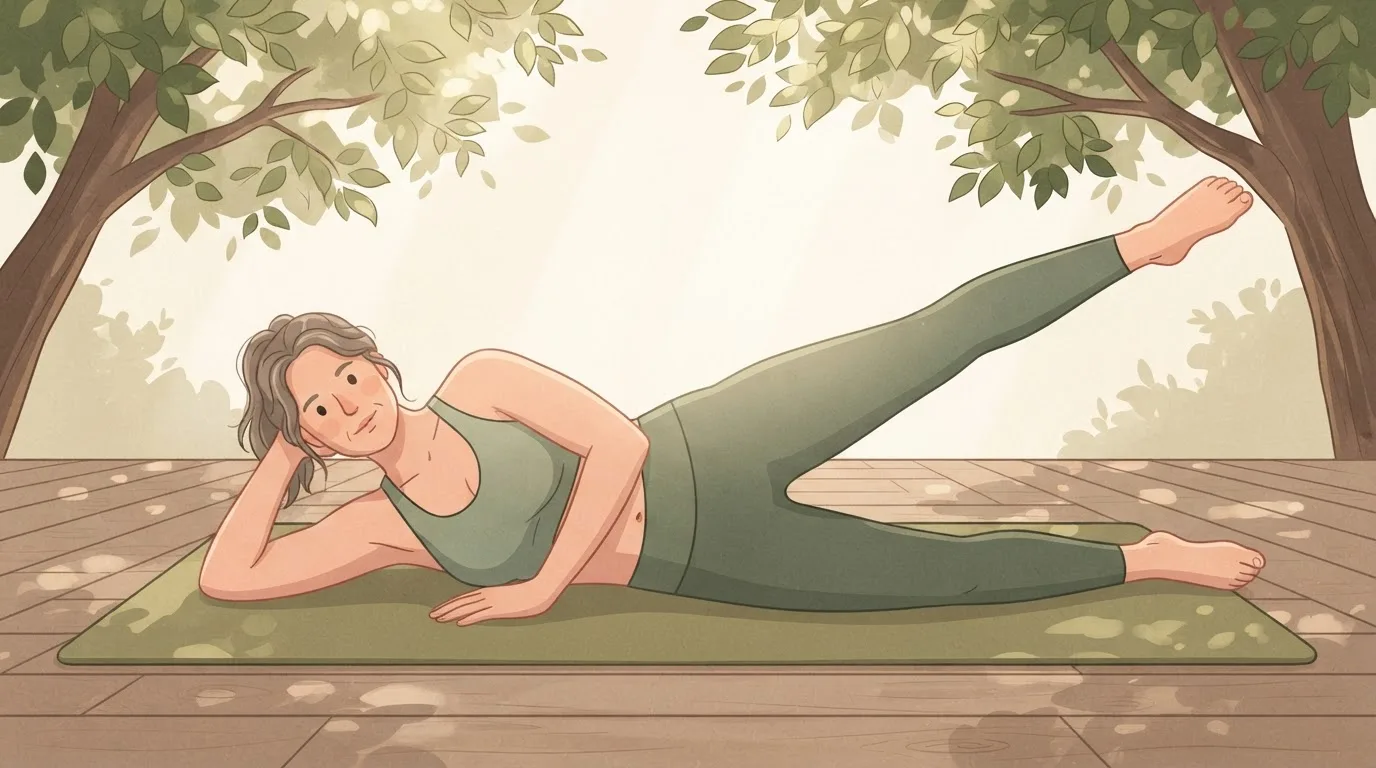
4. Side-lying hip abduction
Lie on your side with your bottom knee bent for balance and your top leg straight, in line with your body. Lift the top leg toward the ceiling, leading with your heel and keeping your toes pointing forward, then lower slowly. Don't let the leg drift forward, and don't roll your hips back. Distefano found it the single best gluteus medius exercise of the 12 they tested, at 81 percent. In 20 distance runners wearing an ankle weight of 5 percent of body mass, McBeth and colleagues (2012) recorded 70 percent in the gluteus medius against 54 percent in the tensor fasciae latae, the small muscle at the front of the hip that likes to take over. Turning the toes up toward the ceiling flipped that balance in their study, so keep them pointing forward. Do 2 to 3 sets of 12 to 20 slow reps per side.
5. Lateral step-up
Stand side-on to a step or the bottom stair. Put the near foot on it and push through that heel to stand up, letting the other foot rise beside it without pushing off the floor. Lower slowly. Boren recorded 60 percent. Ayotte and colleagues (2007) recorded a lower 38 percent in 23 adults, a reminder that the same exercise scores differently between labs. Use the step-up exercise guide for foot placement. A 15 to 20 centimeter (6 to 8 inch) step is enough to begin.
6. Skater squat
Stand on one leg and bend it as you reach the other knee back toward the floor behind you, like a single-leg reverse lunge where the back foot never touches down. Keep your chest over your standing foot. Boren recorded 60 percent. It's a harder relative of the single-leg squat that suits people whose knees don't like sitting straight down.
7. Pelvic drop, also called the hip hitch
Stand side-on on the edge of a step with one foot on it and the other hanging off. Keep both knees straight. Let the hanging side of your pelvis drop an inch or two, then lift it back up using the hip of the standing leg. The movement is tiny, and that's the point: it isolates the job the gluteus medius does when you stand on one leg. Boren recorded 58 percent and Bolgla and Uhl (2005) recorded 57 percent. A meta-analysis by Moore, Semciw and Pizzari (2020) reviewed 56 studies and found that variations of this move reached high activity in all three parts of the gluteus medius, and in both parts of the gluteus minimus underneath it. Few exercises did that.
8. Single-leg deadlift
Stand on one leg with a soft knee and hinge forward, reaching the other leg straight back as your chest lowers, then stand back up. Keep your hips square to the floor so the lifted leg's hip doesn't open toward the ceiling. Boren recorded 56 percent and Distefano 59 percent. It also trains the hamstrings and gluteus maximus. The single-leg deadlift guide breaks down the hinge. Hold a dumbbell in the opposite hand once the bodyweight version feels steady.
9. Single-leg glute bridge
Lie on your back with one knee bent and the other leg straight, then drive through your planted heel to lift your hips until your body forms a line from knee to shoulder. Keep your hips level as you lift. Boren recorded 55 percent, and the Moore meta-analysis listed it among the best options for the middle part of the gluteus medius. For harder versions with a couch or bench, see our guide to hip thrust variations, which includes the single-leg hip thrust.
10. Clamshell
Lie on your side with your hips and knees bent and your feet together. Keeping your feet touching, lift your top knee as far as you can without rolling your pelvis back, then lower. It scores lower than its reputation: 47 percent in Boren's study and 38 to 40 percent in Distefano's. But it has one strength. Using fine-wire electrodes in 20 adults, Selkowitz and colleagues (2013) found the clam worked the gluteal muscles far more than the tensor fasciae latae, with the best ratio of the 11 exercises they tested. That makes it a good first exercise for learning to feel the outer hip. The clamshell exercise guide covers form, and a loop band above the knees makes it harder. Boren's harder clamshell progressions, which reached 62 to 77 percent, are different moves that turn the thigh inward to lift the foot instead of the knee, so don't compare them with the standard clam.
What the Gluteus Medius Does: Hip Abduction and Pelvic Stability
The gluteus medius is a fan-shaped muscle on the outside of your pelvis. It starts on the wide upper part of the hip bone and narrows to a tendon on the bony point at the top of your thigh bone, the greater trochanter. Most of it sits above and in front of the gluteus maximus, so it shapes the upper, outer part of your hip.
Three parts that work separately
An anatomy study by Gottschalk, Kourosh and Leveau (1989) described the gluteus medius as three parts, anterior, middle and posterior, and found that it stabilizes the hip joint early in each step. Later work confirmed the split. Semciw and colleagues (2013) placed fine-wire electrodes in all three segments in 15 healthy adults. All three fired in two bursts while the foot was on the ground, but the front part peaked later, and the three responded differently in strength tests. Their conclusion was that the gluteus medius is made of three functionally independent parts. That's why most exercises work some parts harder than others.
Two jobs: moving the leg and holding the pelvis
The gluteus medius function people learn first is hip abduction, moving your leg out to the side. Its bigger everyday job runs the other way. When you stand on one leg, it pulls down on the pelvis from the thigh to stop the opposite side from dropping. A review of hip kinesiology by Neumann (2010) describes both views: the thigh moving on the pelvis, and the pelvis moving on the thigh. Walking, running and climbing stairs are long chains of single-leg stance, so this muscle works on every step you take.
The one-leg test
Clinicians check this with the Trendelenburg test. You stand on one leg, and if the pelvis on the lifted side drops instead of staying level or rising slightly, the hip abductors on the standing side aren't holding it. Hardcastle and Nade (1985) examined 50 healthy people and 103 with hip or spine problems to standardize the test. They warned that pain, poor effort and leaning the trunk over the standing leg can all give a misleading result. So treat a home version as a clue only.
Glute Med EMG Rankings: How to Read the Numbers
Rankings like the one above help, but the same exercise can land in very different places from one study to the next. Side-lying hip abduction is the clearest case: 81 percent in Distefano's lab, 70 percent in McBeth's with an ankle weight, 63 percent in Boren's and 42 percent in Bolgla and Uhl's. Electrode placement, the test used for the maximum and the way each person performs the move all shift the number.
What makes an exercise score high
A literature review by Reiman, Bolgla and Loudon (2012) points to three things that decide how hard the gluteal muscles work: the length of the lever the muscle has to move, the direction of gravity, and how you position your body. That explains most of the ranking. Side planks and side-lying lifts put your body weight or your leg directly against gravity. Single-leg standing moves make the muscle hold your whole pelvis up. Lying on your back or on all fours turns gravity away from the side of the hip.
Low, moderate, high and very high
A systematic review by Ebert and colleagues (2017) sorted 33 exercises from 20 studies into four bands: low (0 to 20 percent), moderate (21 to 40), high (41 to 60) and very high (above 60). Prone, all-fours and two-leg bridge exercises mostly sat in the low or moderate bands. Standing on one leg while the other leg moved often reached high or very high. Use the bands to plan a progression: start in moderate, build to high, and add very high moves once your form holds.
Watch the muscle that steals the work
The tensor fasciae latae (TFL) also lifts the leg to the side, and it turns the thigh inward as well. Selkowitz's fine-wire study ranked exercises by how much more they worked the glutes than the TFL. The clam came first, then side-stepping, then the single-leg bridge. McBeth's runners showed the opposite risk: when they turned the top leg out during side-lying abduction, the TFL outworked the gluteus medius, 71 to 53 percent. If you feel the front of your hip more than the side, check that your toes point forward and your leg stays in line with your body.
Where the reviews agree
Across 23 studies, a review by Macadam, Cronin and Contreras (2015) found the highest gluteus medius readings, 81 to 103 percent, during the side bridge with hip abduction, standing hip abduction with an elastic band at the ankle, and side-lying hip abduction. The 103 percent at the top of that range is Boren's own side plank figure. High readings show which exercises load the muscle most. They don't prove which one makes it stronger over months, because EMG studies measure a single session, not months of training.
Side-Lying vs Standing Gluteus Medius Exercises
Side-lying exercises move your leg against gravity. Standing exercises make the muscle hold your pelvis. Both have a place, and the studies show when each one wins.
| Exercise (Bolgla and Uhl 2005, 16 adults; values as tabulated by Boren 2011) | Type | Gluteus medius activity |
|---|---|---|
| Pelvic drop | Standing, weight on the measured leg | 57% |
| Standing hip abduction, hips bent 20 degrees, measured leg standing | Standing, weight on the measured leg | 46% |
| Standing hip abduction, measured leg standing | Standing, weight on the measured leg | 42% |
| Side-lying hip abduction | Lying, leg moving | 42% |
| Standing hip abduction, measured leg lifting | Standing, leg moving | 33% |
| Standing hip abduction, hips bent 20 degrees, measured leg lifting | Standing, leg moving | 28% |
The standing-leg exercises worked the gluteus medius significantly harder than the standing leg-lift exercises. Side-lying abduction was the only moving-leg exercise that kept up, because gravity pulls straight down on the lifted leg. When you stand and kick a leg out to the side, the hip you're standing on does most of the work.
Band walks show the same thing. In 21 adults doing sideways steps against a resistance band, Youdas and colleagues (2013) recorded 52 percent in the gluteus medius of the standing leg against 35 percent in the stepping leg. So if one hip is weaker, make it the standing leg.
Everyday single-leg tasks follow the same rule. In 20 healthy adults, Sinsurin and colleagues (2020) found that stepping down from a 20 or 30 centimeter step drew about 55 percent more gluteus medius activity than walking on level ground.
Which to choose
- Start side-lying if you can't yet feel the outer hip working, if single-leg balance is shaky, or if standing exercises hurt your knee. Side-lying abduction and clams let you learn the movement with no balance demand.
- Move to standing as soon as you can. The pelvic drop, single-leg squat, step-up and band walk train the muscle in the position it works in when you walk, run and climb stairs.
- Keep one of each in your routine for the long run. They load the muscle at different lengths and angles, and the Moore meta-analysis found that different exercises reach the different parts of the muscle best.
One more point: for some people the gap closes. In 15 patients at least six weeks after a hip replacement, a study by Jacobs, Bolgla and colleagues (2009) found no difference in gluteus medius activity between two weight-bearing and two non-weight-bearing exercises. Pick the version you can do well and without pain.
Find out what's really holding you back
FitCraft, our mobile fitness app, pairs you with an AI coach who builds you a personalized plan around your goals, schedule, and fitness level. Every FitCraft program is designed by Domenic Angelino, MPH (Brown University) and NSCA-CSCS, with research published in the Journal of Strength and Conditioning Research and Medicine & Science in Sports & Exercise.
Take the Free Assessment Free • 2 minutes • No credit cardGluteus Medius, Knee Valgus and Runners
Knee valgus is the knee caving inward when you land, squat or run. Poor control at the hip is one reason it happens, which is where the gluteus medius comes in.
The theory
A clinical commentary by Powers (2010) pulled together the case that poor control of the hip, pelvis and trunk can change how the knee moves and how it's loaded. He linked hip motion problems to ACL tears, IT band syndrome and kneecap pain, and argued that knee rehab should include hip and trunk control. It's an expert commentary rather than a trial, so the trials below matter more.
What runners show
In a case series by Fredericson and colleagues (2000), 24 distance runners with IT band syndrome had weaker hip abductors on the injured leg than on their other leg and than 30 healthy runners. After a 6-week program focused on the gluteus medius, hip abductor torque rose about 35 percent in the women and 51 percent in the men, and 22 of the 24 were back running without pain. The rehab had no control group, so it can't show that the strengthening caused the recovery.
A systematic review by Mucha and colleagues (2017) looked at 11 studies of hip abductor strength and running injuries. Weakness lined up with IT band syndrome in several studies. For kneecap pain, shin splints, stress fractures and Achilles problems, the link was unclear.
Cause or consequence?
Weak hips may follow knee pain rather than cause it. A meta-analysis by Rathleff and colleagues (2014) found that adults with kneecap pain had weaker hips than pain-free people. But in the prospective studies, which measure people before anyone gets hurt, hip strength didn't predict who developed the pain.
Strengthening still helps
Whatever the cause, the treatment trials are encouraging. In a randomized trial by Khayambashi and colleagues (2012), 28 women with kneecap pain did either 8 weeks of hip abductor and external rotator strengthening or nothing. The exercise group improved in pain, function and hip strength, and kept the pain and function gains at six months. In a larger trial of 199 patients, Ferber and colleagues (2015) compared 6 weeks of hip and core strengthening with knee strengthening. Both groups improved by about the same amount, but pain eased a week sooner and hip strength rose more in the hip group.
Strength doesn't change your running form by itself
Willy and Davis (2011) split 20 female runners whose thighs angled inward too much while running into two groups. One group did a 6-week program of hip strengthening and mirror practice on the single-leg squat, and the other kept running as usual. In the trained group, hip strength rose and the single-leg squat improved, but running mechanics didn't change. A stronger gluteus medius gives you the capacity. Changing how you run takes practice in the running itself. For lateral knee and hip pain from the IT band, our guide to IT band stretches covers what stretching can and can't do.
What Are the Symptoms of a Weak Gluteus Medius?
The usual symptoms of a weak gluteus medius are a hip that drops when you stand on one leg, a knee that caves in on single-leg moves and one side tiring early. No single symptom proves weakness, but these are worth checking:
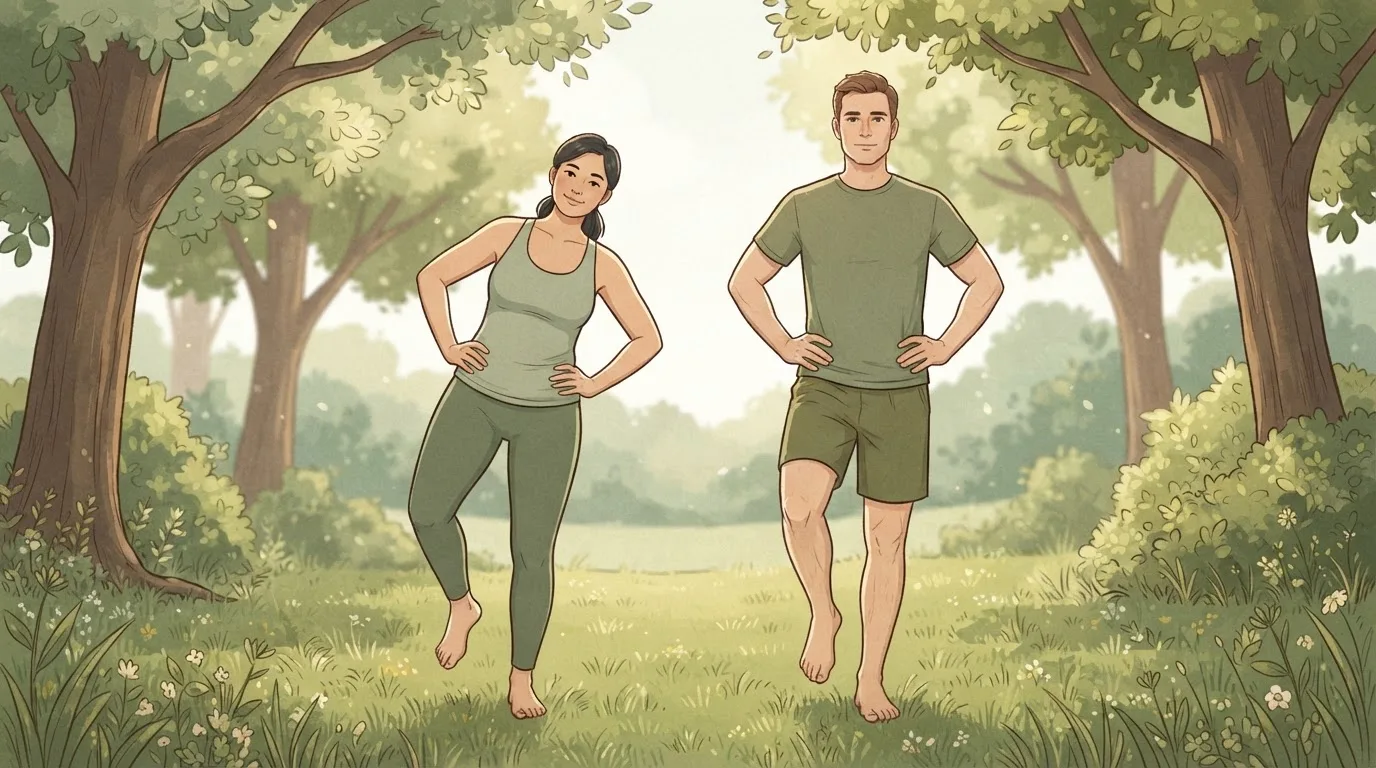
- Your pelvis drops when you stand on one leg. Stand on one leg for 30 seconds in front of a mirror with your hands on your hips. If the hip of the lifted leg sinks, the standing hip may not be holding it.
- Your knee caves in on a single-leg squat. Do five slow single-leg squats to a chair. A knee that drifts inward past your big toe, or a hip that drops, points to poor hip control, the same pattern Willy and Davis trained.
- One side tires first. If 15 side-lying leg raises are easy on one side and a struggle on the other, train the weaker side first and match the stronger side to it.
- The outside of your hip aches. Pain over the bony point of the outer hip that's worse when you lie on that side or climb stairs can come from gluteal tendinopathy, an irritated gluteus medius or minimus tendon. A review by Grimaldi and colleagues (2015) notes that it's most common in mid-life and in women. Pain like this needs a clinician's assessment.
A Gluteus Medius Workout You Can Do at Home
Do one of these two or three times a week, on its own or at the end of a lower body session. Rest 30 to 60 seconds between sets. Move to the next level when every set feels controlled and your pelvis stays level.
Level 1: learn the movement (about 10 minutes)
| Exercise | Sets | Reps per side |
|---|---|---|
| Clamshell | 2 | 15 to 20 |
| Side-lying hip abduction | 3 | 12 to 15, 2 seconds down |
| Pelvic drop on a stair | 2 | 10 to 12 |
| Single-leg glute bridge | 2 | 8 to 12 |
Level 2: build single-leg strength (about 15 minutes)
| Exercise | Sets | Reps per side |
|---|---|---|
| Side plank with top-leg lift | 3 | 6 to 10 |
| Single-leg squat to a chair | 3 | 6 to 10 |
| Lateral step-up | 2 | 10 to 12 |
| Single-leg deadlift | 2 | 8 to 10 |
| Band walk, weaker leg as the standing leg | 2 | 10 to 12 steps each way |
How long does it take to strengthen your gluteus medius?
Four training programs on this page, from Fredericson, Willy and Davis, Khayambashi and Ferber, all produced clear strength gains in 6 to 8 weeks. Two of them trained three times a week, and Ferber's patients were asked to exercise at least six days a week. Growth is slower. In a 10-week study by Attarieh and colleagues (2026), 17 adults trained one leg with hip abduction and the other with hip extension. Abduction grew the gluteus medius and minimus by about 4 percent, while extension produced no significant change in them. If you want the outer hip to look fuller, give abduction work at least three months.
For the full glute picture, including the gluteus maximus and a 12-week home progression, see our best glute exercises at home. For loosening stiff hips before these sessions, our hip mobility exercises take about 10 minutes.
If you'd like the plan built around you, our comparison of the best fitness apps for women sets out the options. FitCraft's strength workouts use bodyweight and dumbbells plus a handful of band exercises, and an AI coach demonstrates each move on an interactive 3D model, with tips that name the muscles to focus on. Your coach says your name as you train, your workouts adjust as you progress, and streaks help keep short sessions like these going. The AI coach and programs were designed by Domenic.
What Exercises Should I Avoid If I Have a Gluteus Medius Tear?
With a suspected gluteus medius tear, avoid hard hip exercises of any kind until a doctor or physical therapist has examined it. A suspected tear needs a clinician's exam, and often imaging, before you load it. Don't try to work through outer hip pain on your own.
For the more common problem, gluteal tendinopathy, the research points to two things. The Grimaldi review names excessive hip adduction, the thigh drawn across your body's midline, as a key factor because it compresses the tendon. Then, in a randomized trial of 204 people aged 35 to 70, Mellor and colleagues (2018) compared 8 weeks of education plus exercise with a steroid injection and with waiting. At 8 weeks, 51 of 66 people in the exercise group reported success, against 38 of 65 after the injection and 20 of 68 who waited. At a year, exercise still beat the injection on overall improvement.
So for most outer hip pain, the answer is the right exercise program, guided by a clinician.
The Bottom Line
The gluteus medius holds your pelvis level every time you stand on one leg, which means every step you walk or run. The exercises that load it hardest are the side plank with a leg lift and the single-leg squat. Side-lying abduction and clams are good places to learn, and standing single-leg work carries it into daily life. Strength comes in about 6 to 8 weeks of steady work. If you run, strong hips help, but they won't change your stride unless you also practice the stride.
The hard part is doing a few unglamorous sets two or three times a week for two months. As Katie put it, "I've tried everything. This is the first time I've stuck with something past two weeks." Pick two exercises from the list and do them today.
Frequently Asked Questions
What is the best exercise for gluteus medius?
In an EMG comparison of 18 exercises, the side plank with the top leg lifted produced the most gluteus medius activity, at 103 percent of a maximal contraction, followed by the single-leg squat at 82 percent (Boren 2011). Side-lying hip abduction is the best starting point: it scored 81 percent in another study and needs no equipment.
How long does it take to strengthen your gluteus medius?
In four training studies in this guide, hip abductor strength rose clearly within 6 to 8 weeks. In one 6-week program, injured runners raised their hip abductor torque by about 35 percent (women) and 51 percent (men). Visible muscle growth takes longer, usually several months.
Does walking strengthen gluteus medius?
Walking works the gluteus medius on every step, because it holds your pelvis level while one foot is off the ground. Harder single-leg tasks work it more: stepping down from a 20 or 30 centimeter step drew about 55 percent more gluteus medius activity than level walking in one study. For real strength gains, add the single-leg and side-lying exercises in this guide.
What is the 8 8 8 rule for glutes?
The 8-8-8 rule is a social media finisher: 8 full reps, then 8 short pulses at the top, then an 8-second hold, done back to back. No study has tested it. It works the way any hard set works, by taking a light load close to failure, so use it once at the end of a session, for example on a glute bridge or side-lying leg raise.
What is the difference between the gluteus medius and gluteus maximus?
The gluteus maximus is the large muscle of the buttock and mainly drives your hip backward, as in standing up from a squat. The gluteus medius sits higher and to the side, on the outer hip, and mainly moves your leg out to the side and holds your pelvis level when you stand on one leg. Hip thrusts and squats lean on the maximus; side-lying and single-leg exercises lean on the medius.
Can you grow your gluteus medius?
Yes, though it grows slowly. In a 10-week study, training one leg with hip abduction grew the gluteus medius and minimus by about 4 percent, while hip extension training on the other leg produced no significant change in them. Side-to-side work such as abductions belongs in any plan that aims to build the upper, outer hip.