If you can climb stairs, you already know the basic move. A step-up puts one foot on a box or step, and that leg lifts you until you stand tall on top. Then you lower yourself back down slowly.
The hard part is making the top leg do the work. Pushing off hard with your bottom foot, or bouncing off the floor, takes work away from the leg you are trying to train.
This guide starts you on a low step with just your bodyweight, then builds to a box about knee height and a dumbbell in each hand.
Quick Facts: Step-Ups
- Equipment needed: A sturdy box, step, bench or the bottom stair; a dumbbell in each hand makes it harder
- Difficulty: Beginner. ACE lists the step-up as a beginner exercise, and with your bodyweight on a low step it is the same move as climbing a stair. A box closer to knee height and dumbbells make it harder.
- Modality: Strength
- Body region: The front of the thighs and the glutes, with help from the backs of the thighs and the front of the hips
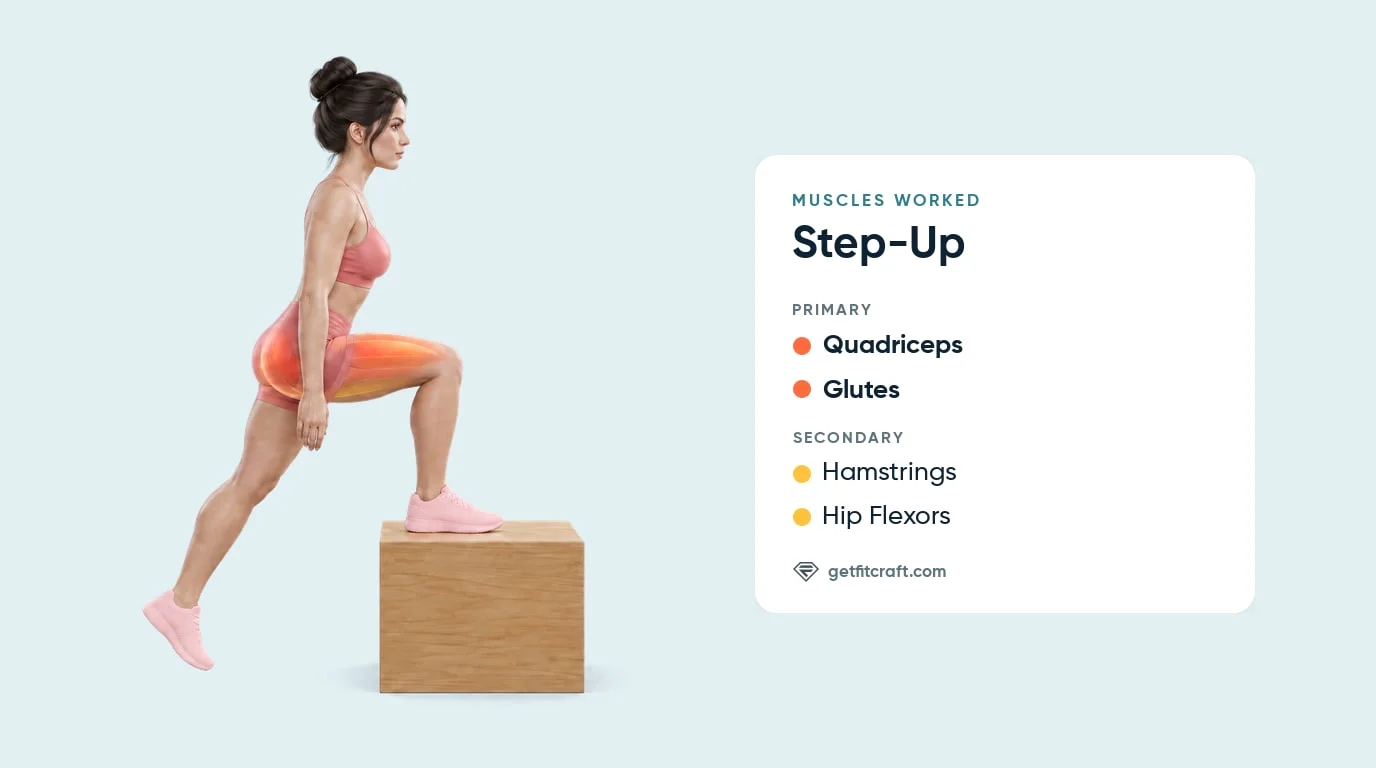
Muscles Worked by Step-Ups
Primary muscles: the quadriceps and the glutes. On the leg that is on the box, the quadriceps on the front of your thigh straighten your knee and the glutes straighten your hip as you push up and stand tall. The same leg then lowers you back down under control. ExRx lists the quadriceps as the main target of the dumbbell step-up and the gluteus maximus as the main target of the bodyweight step-up.
Secondary muscles: the hamstrings and the hip flexors. The hamstrings on the back of your thigh help steady your hip and knee as you rise; ExRx calls them dynamic stabilizers in this exercise. The hip flexors at the front of your hip lift your foot up onto the box and bring your other leg up beside it. They work harder in the step-up to knee drive, covered below, where you drive the back knee up to hip height at the top.
What the studies found about the glutes: in young, healthy adults, forward step-ups with no weight recruited the gluteus maximus only modestly, far less than a prone hip extension with a heavy weight, and the authors judged that too little to strengthen it (MacAskill 2014). A study that added a load found glute activity very high. In 15 trained women lifting a weight they could manage only six times, on an 18-inch box, the forward step-up drew more gluteus maximus and hamstring activity than three other step-up variations (Simenz 2012). A 2020 review ranked step-ups and their variations highest for gluteus maximus activity among the loaded exercises it covered, above 60 percent of a maximal contraction (Neto 2020). Its step-up figures all came from that one study of 15 women. The MacAskill and Simenz studies differ in load and box height, which may explain the gap, but neither one tested that. ExRx also notes that standing a little farther from the box shifts the work toward the glutes, and standing closer shifts it toward the quadriceps.
Step-by-Step: How to Do Step-Ups
If you are new to step-ups, start on the bottom stair and hold the rail until the movement feels steady.
Step 1: Choose a Sturdy Step
Use a sturdy box, an exercise step, a sturdy bench or the bottom stair. It must be flat and stable and must not slide or tip. Start with a low step and work up to a box about knee height or a little lower, where your front thigh is about level with the floor and your hip and knee bend to about a right angle.
Form tip: never use a chair that can tip, anything on wheels, or a soft or wobbly surface.
Step 2: Place Your Whole Foot on the Box
Stand facing the box, close enough to put your whole foot on top, with your feet about hip-width apart and your arms relaxed at your sides. Put one whole foot flat on the box, heel included, with your toes pointing ahead. Hold a rail or a wall if your balance is unsure.
Form tip: if your heel hangs off the edge, stand a little closer to the box.
Step 3: Push Up and Stand Tall
Shift your weight onto the foot on the box and push through that whole foot to straighten your hip and knee until you stand tall on the box, then bring your other foot up beside it. Let the top leg do the work, with at most a light push from the bottom foot and no bounce. Keep your chest up with only a slight forward lean, keep your front knee in line with your toes, and breathe out as you push up.
Form tip: keep your front knee pointing the same way as your toes, never caving inward.
Step 4: Step Down With Control
Step down with the foot that came up last while the leg still on the box lowers you slowly, over about two to three seconds, then bring the other foot down. Breathe in on the way down. Never jump or drop off the box.
Form tip: control matters more than speed.
Step 5: Repeat, Switch Legs, Then Add Dumbbells
Do all your reps leading with one leg and then switch, or swap the leading leg every rep, and keep the reps even on both sides. Once bodyweight feels easy, hold a dumbbell in each hand at your sides with your palms facing in and your shoulders down.
Form tip: stop and step down if your knee hurts.
Get a personalized lower-body workout
FitCraft does not include step-ups, but it builds your plan from the dumbbell, band, and bodyweight exercises in its library, including the split squat and the Bulgarian split squat, at the right volume for your level, goals, and equipment.
Take the Free Assessment Free · 2 minutes · No credit card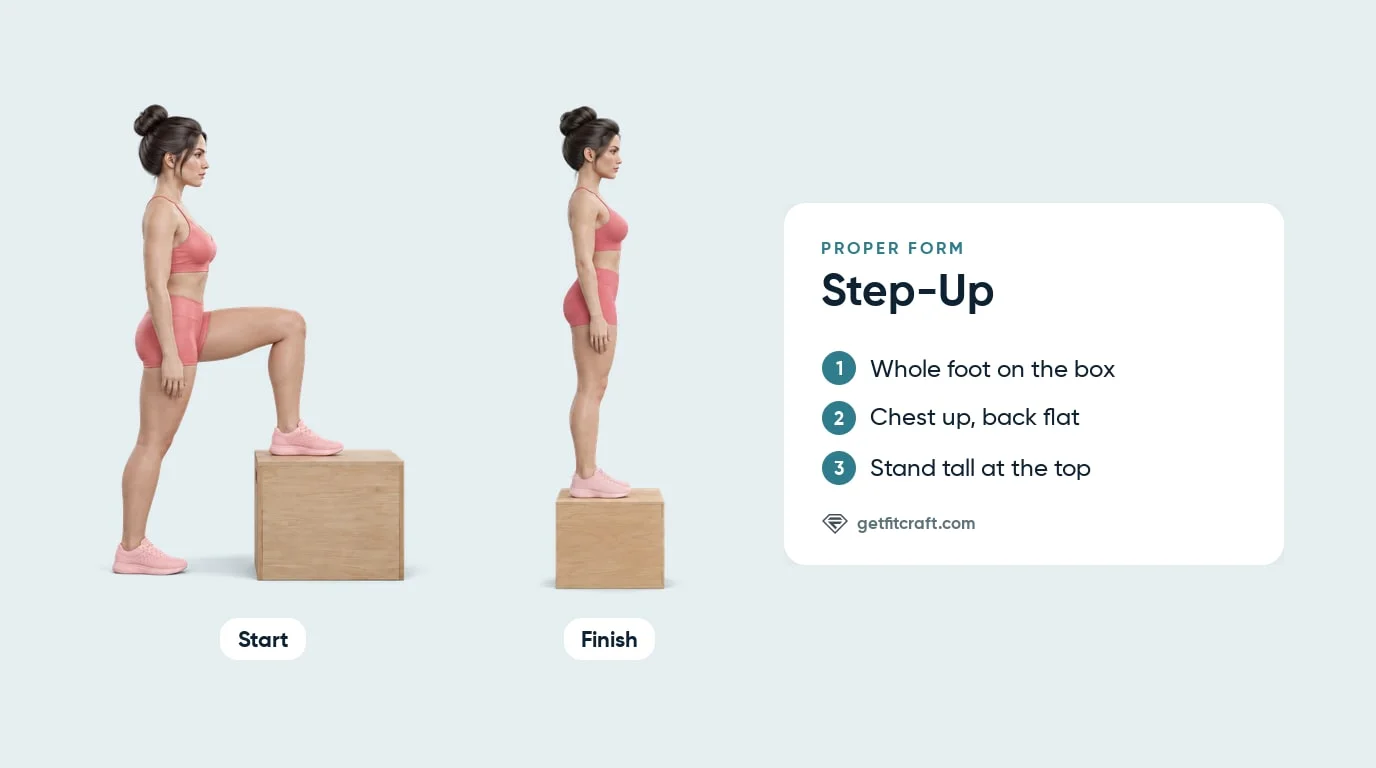
Common Mistakes (and How to Fix Them)
These are the mistakes to watch for, with the fix for each one.
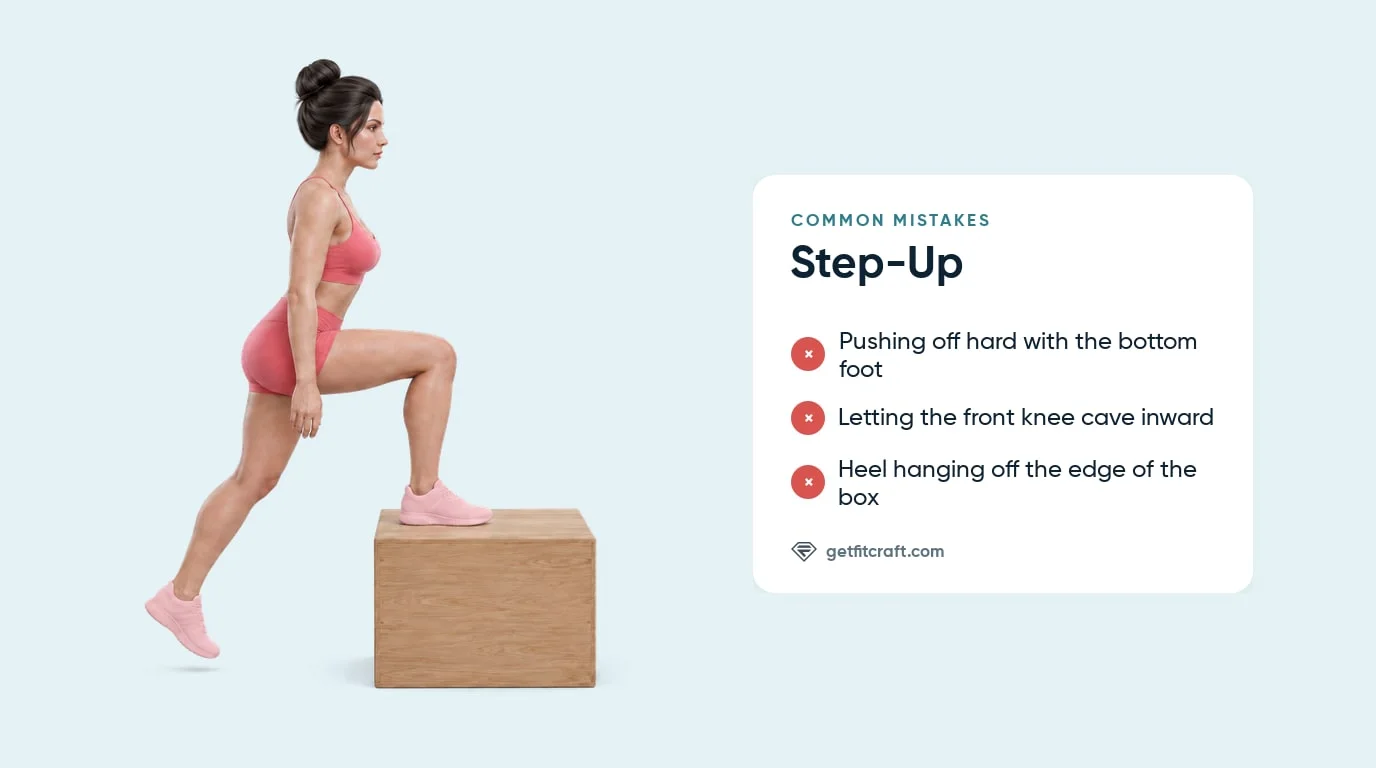
- Pushing off hard with the bottom foot. A hard push or a bounce off the floor takes work away from the leg on the box, the one you are training. Fix it by letting the top leg lift you, with at most a light push from the bottom foot. If you need a bounce to get up, use a lower step.
- Letting the front knee cave inward. Fix it by keeping your front knee pointing the same way as your toes as you rise and as you lower.
- Heel hanging off the edge of the box. Fix it by standing close enough to put your whole foot on top, heel included, before you push up.
- Leaning far forward as the back leg comes up. Folding forward to haul the back leg up is a common error. Fix it by keeping your chest up and your back flat, with only a slight forward lean as you start, and finish standing tall.
- Dropping off the box instead of lowering slowly. Fix it by stepping down with the foot that came up last while the leg on the box lowers you over two to three seconds.
- Using a box too high to step up smoothly. Fix it by starting low, like the bottom stair, and raising the box only when you can step up smoothly with no bounce. About knee height is plenty.
Step-Up Variations: Easier and Harder Versions
Start with an easier version if you need it, and make step-ups harder one change at a time. Barbell, cable and kettlebell step-ups exist too, but this guide covers bodyweight and dumbbells only.
Bottom-Stair Step-Up (Easier)
Use a single stair or another low step, and hold the rail or a wall for balance. Cleveland Clinic shows step-ups on a step or a single stair. Use just your bodyweight until the movement feels steady.
Bodyweight Step-Up (Standard)
This is the version taught in the steps above: a forward step-up onto a sturdy box or step, with your arms relaxed at your sides. ExRx notes that a shorter step makes it easier and a taller box or dumbbells make it harder.
Dumbbell Step-Ups
Hold a dumbbell in each hand, hanging at your sides with your palms facing in, your arms relaxed and your shoulders down. Step up exactly as in the bodyweight version. Pick a weight light enough that you can still step up with no bounce and lower yourself slowly. ACE teaches the step-up with dumbbells at your sides, and loaded step-ups ranked highest for glute activity in the 2020 review described above.
One Dumbbell at Your Chest
Hold one dumbbell at your chest instead of one in each hand, a progression Cleveland Clinic suggests. Hold it as you would for a goblet squat, and keep your chest up as you step.
A Box Closer to Knee Height
Raise the box toward knee height, where your front thigh is about level with the floor. The NSCA's technique guide for tactical athletes uses a 12 to 18 inch box, which puts the hip and knee of your leading leg at about 90 degrees. Raise it only when you can step up smoothly from the lower one. Boxes above knee height are not covered here.
Slower Lowering
Take about three seconds to lower yourself back down, with the leg on the box in control the whole way.
Lateral Step-Up
Stand side-on to the box and step up sideways with the leg nearer to it, toes pointing straight ahead, as NASM teaches its side step-up, and keep your hips level. In older adults, the lateral step-up asked more of the gluteus medius, on the side of the hip, than the forward step-up did (Mercer 2009). Another study of older adults found that the lateral step-up asked more of the knee and calf muscles, while the forward step-up asked more of the muscles that straighten the hip (Wang 2003). In healthy adults, kneecap stress was similar in both and lower than in a forward step-down at the same step height (Chinkulprasert 2011).
Step-Up to Knee Drive
At the top, stand on the top leg and drive your other knee up to about hip height, balance for a moment, then step back down. NASM's version raises the other knee for balance, and ACE holds the one-leg stance at the top. It adds work for the hip flexors of the lifted leg. It is a different exercise from the rear lunge knee drive listed below.
When to Avoid or Modify Step-Ups
Step-ups suit most healthy adults. A burn in the front of your thigh or your glutes is normal; any pain in a joint, your lower back or your neck means stop and step down carefully. A few conditions call for a check with a doctor or physical therapist first. Always consult your physician or physical therapist for personalized guidance.
- Knee, hip or ankle pain, including knee arthritis or a recent injury. Each rep bends and straightens your front leg while it carries your body weight. See a doctor or physical therapist before you do step-ups, and ask them which exercises suit you. During any rep, pain in your knee, hip or ankle means stop and step down.
- Recent knee, hip, ankle or back surgery. Get clearance from your surgeon before you do step-ups, and ask them or your physical therapist when and how to return.
- Balance problems, dizziness or frequent falls. On every rep you stand on one leg on a raised surface for a moment, and a fall from a box can hurt. Check with your doctor or physical therapist before you do step-ups, and ask which version suits you. If you feel dizzy or unsteady, step down, hold on to something steady and rest.
- Lower back pain, sciatica or a disc problem. See a doctor or physical therapist before you do step-ups, especially with dumbbells, and ask them which exercises suit you. Any lower back pain during a rep means stop.
- Uncontrolled high blood pressure or heart disease. Ask your doctor whether step-ups suit you and how hard to work. Keep breathing on every rep; never hold your breath.
- Pregnancy or early postpartum. Ask your doctor or midwife before you do step-ups, and ask which version fits your stage. Any pain in your back, belly or pelvis means stop, and so does feeling dizzy or unsteady.
Related Exercises
If step-ups are part of your plan, these exercises train the same muscles or the same one-leg strength:
- One leg at a time: Split Squats, Rear Lunges and Bulgarian Split Squats also train the quads and glutes one leg at a time, with your feet on the floor or your back foot on a bench.
- Both feet down: Goblet Squats and Squats work the quads and glutes with both feet on the floor.
- A knee drive in a lunge: the Rear Lunge Knee Drive is a different exercise from the step-up to knee drive: you step back into a lunge, then drive the back knee up to hip height.
- Glutes from the floor: Glute Bridges train your glutes lying on your back, with no box and no balance demand.
- A one-leg hinge: Single Leg Deadlifts work the glutes and hamstrings on one leg with a hip hinge instead of a step.
How to Program Step-Ups
Step-ups make a good first one-leg exercise. In a study of healthy adults, the step-up asked the least of the hip of four stepping exercises, including step-downs and single-leg squats, and the authors called it a good starting task for hip strengthening (Hatfield 2017). For people new to strength training, the American College of Sports Medicine position stand on progression models for resistance training recommends 8 to 12 reps and training 2 to 3 days a week (Ratamess et al., 2009). It sets no numbers for step-ups themselves, so the sets and rest times below are a practical starting point, not figures from the position stand.
| Version | Sets × Reps | Rest between sets | Frequency |
|---|---|---|---|
| Easier (the bottom stair or a low step, holding a rail or a wall) | 2 × 8-12 per leg | 60 seconds | 2-3 sessions/week |
| Beginner (bodyweight onto a box up to about knee height) | 2-3 × 8-12 per leg | 60-90 seconds | 2-3 sessions/week |
| Harder (a dumbbell in each hand, a three-second lowering, or a knee drive at the top) | 3 × 8-12 per leg | 90-120 seconds | 2-3 sessions/week |
Pace and breathing: take about a second or two to step up and two to three seconds to lower yourself back down. Breathe out as you push up onto the box and breathe in as you step back down, and never hold your breath.
When to make it harder: raise the box or add dumbbells only when every rep is smooth, with the top leg doing the work and no bounce off the bottom foot.
Form floor over rep targets: end the set when your front knee starts to cave inward, you need to push off hard with the bottom foot, or you start dropping off the box instead of lowering slowly. Fewer clean reps beat a full set of sloppy ones.
Step-Ups and FitCraft
Step-ups need only a sturdy step to start and a pair of dumbbells later, so they are easy to add to a home workout.
The FitCraft app does not include step-ups, so use the steps and variations above to plan them yourself: start with your bodyweight on the bottom stair or a low step, work up to a box about knee height, then hold a dumbbell in each hand at your sides. The closest exercises in the app are the split squat and the Bulgarian split squat, which also work one leg at a time.
FitCraft builds its plans from dumbbell, bodyweight and a few band exercises, with no barbells. It teaches form with 3D demos and turns your workouts into a game.
Frequently Asked Questions
What muscles do step-ups work?
Step-ups mainly work your quadriceps and glutes on the leg that is on the box. Your quadriceps straighten your knee and your glutes straighten your hip as you push up and stand tall. Your hamstrings help, and your hip flexors lift each foot up onto the box.
Do step-ups work your glutes?
Yes. The glutes are one of the two main muscles in a step-up, along with the quadriceps. In one study, step-ups with no weight recruited the main glute muscle only modestly (MacAskill 2014), while a 2020 review found that loaded step-ups and their variations produced the highest glute activity of the loaded exercises it covered (Neto 2020). ExRx also notes that standing a little farther from the box shifts the work toward the glutes.
What are the benefits of step-ups?
Step-ups build your thighs and glutes one leg at a time, with the same move you use to climb stairs. Stepping up onto a box also takes strength and coordination, which help keep you balanced. You need only a sturdy step to start, and dumbbells make it harder as you get stronger.
How high should the box be for step-ups?
Start low, like the bottom stair, and raise it only when you can step up smoothly without bouncing off your back foot. About knee height is plenty: with your foot on top, your thigh is about level with the floor and your hip and knee bend to about a right angle.
Can you do step-ups at home without a box?
Yes. Use the bottom step of your stairs, and hold the rail if you need it. Whatever you step on has to be flat and sturdy, and it can't slide or tip. Never use a chair that can tip, anything on wheels, or a soft or wobbly surface.
How do you do dumbbell step-ups?
Hold a dumbbell in each hand, hanging at your sides with your palms facing in and your arms relaxed. Keep your shoulders down and stand tall; your legs do the lifting. Then step up as you would with your bodyweight: whole foot on the box, push through it to stand tall, and lower yourself slowly. Add dumbbells only once bodyweight step-ups feel easy.
Can I do step-ups with knee pain?
Not while your knee hurts. A burn in your thighs and glutes is normal, but your knee should never hurt during a step-up, and any knee pain during a rep means stop and step down carefully. If you have knee pain, knee arthritis or a knee injury, see a doctor or physical therapist before you do step-ups, and ask them which exercises suit you.