You want to get stronger, but most workouts you find are full of jump squats, burpees and box jumps. Your knees grumble on the stairs, your lower back gets cranky, or you're carrying extra weight and every landing feels like it. So you skip strength work, or you try a class and pay for it for two days.
It's easy to decide your joints are too old or too heavy for real training. They aren't. You were handed a plan built around jumping, and jumping is the one part you can drop without losing much. Your muscles respond to effort, and you can get to a hard effort with your feet on the floor.
This guide explains what low impact means for strength work, what the research says about building muscle without heavy weights or jumps, the 10 exercises to use, a 6-week plan with dumbbells, bands and bodyweight, and swaps for sore knees, hips and shoulders. It's written for adults in their 30s and 40s who want strength that lasts, whether you're restarting, carrying extra weight or looking after a joint.
What Is Low Impact Strength Training?
Low impact strength training is resistance training with no jumping, hopping or hard landing. Your feet, hands or back stay in contact with the floor, a wall or a bench for every rep, and you move the weight under control. Low impact describes the landing forces, not the effort. A slow set of chair squats can leave your legs shaking.
That makes it different from low intensity strength training, where the sets stay easy on purpose. Light, easy sets have their place for recovery and learning a move, but they won't build much muscle. This guide is about low impact work that still gets hard.
Three rules turn any strength exercise into a low impact one:
- No jumping or landing. Replace jump squats with chair squats, jumping lunges with split squats, and burpees with incline push-ups.
- A controlled tempo. Lower each rep over about 2 to 3 seconds and don't bounce at the bottom.
- Joint-friendly ranges. Work through the range that feels fine today, and use a chair, wall or counter to set your depth and steady your balance.
How much does low impact spare your joints?
The best numbers come from people with instrumented knee replacements that measure the force inside the joint. Kutzner and colleagues (2010) recorded five people during daily tasks. A knee bend peaked at about 253 percent of body weight, close to level walking at 261 percent and standing up from a chair at 246 percent, while walking downstairs reached 346 percent. D'Lima and colleagues (2008) measured three patients during exercise: stationary cycling stayed near 1 times body weight, and jogging consistently went past 4 times body weight.
Two lessons follow. A bodyweight knee bend loads your knee about as much as a step of ordinary walking, so it asks no more of the joint than a walk does. And the big rises in joint force come with running. Both studies were small and measured replaced knees, and neither tested jump squats, but jogging, a mild bouncing activity, already went past 4 times body weight.
Does Low Impact Strength Training Build Muscle?
Yes, as long as the sets get hard. Muscle responds to how close each set comes to your limit more than to how heavy the weight is or how fast you move it. That's good news if heavy barbells and jumps are off the table.
Lighter weights work when the sets get hard
A 2017 meta-analysis by Schoenfeld and colleagues pooled 21 studies of sets taken to failure and found similar muscle growth with light loads (60 percent of your one-rep max or less) and heavy loads, while heavy loads built more maximal strength. Effort is the catch. In an 8-week trial, Lasevicius and colleagues (2022) found that light sets at 30 percent of max grew the thigh muscle by 7.8 percent when taken to failure and by only 2.8 percent when stopped well short. Our review of whether light weights build muscle covers that research in full.
How close to failure you need to go
Close, but not all the way. In a series of meta-regressions, Robinson and colleagues (2024) found that muscle growth rose as sets ended closer to failure, while strength gains were similar across a wide range. And in a review of 15 studies, Refalo and colleagues (2023) found no clear extra muscle from going all the way to failure compared with stopping short of it.
So end most sets with 1 to 3 good reps left in the tank, a measure trainers call RIR, or reps in reserve. You'll know you're there when the last two reps slow down even though you're pushing hard. With light dumbbells and bands, that often takes 15 to 25 reps, which is fine.
Slow reps give you control
Tempo is about control and joint comfort, and it doesn't add extra muscle by itself. A 2015 meta-analysis by Schoenfeld, Ogborn and Krieger of 8 studies found similar muscle growth with reps lasting anywhere from half a second to 8 seconds, and very slow reps of more than 10 seconds looked worse. A 2 to 3 second lowering and a steady 1 to 2 second lift sits comfortably inside that range. It also stops you bouncing out of the bottom of a squat, and it makes a light dumbbell feel heavier.
Bands count as real resistance
Across 8 trials, Lopes and colleagues (2019) found no difference in upper- or lower-body strength gains between elastic bands and conventional weights. Bands are light and cheap, and their pull starts light and builds as they stretch. Our comparison of resistance bands vs weights covers where each one runs out.
Find out what's really holding you back
FitCraft, our mobile fitness app, pairs you with an AI coach who builds you a personalized plan around your goals, schedule, and fitness level. Every FitCraft program is designed by Domenic Angelino, MPH (Brown University) and NSCA-CSCS, with research published in the Journal of Strength and Conditioning Research and Medicine & Science in Sports & Exercise.
Take the Free Assessment Free • 2 minutes • No credit cardThe 10 Best Low Impact Strength Exercises
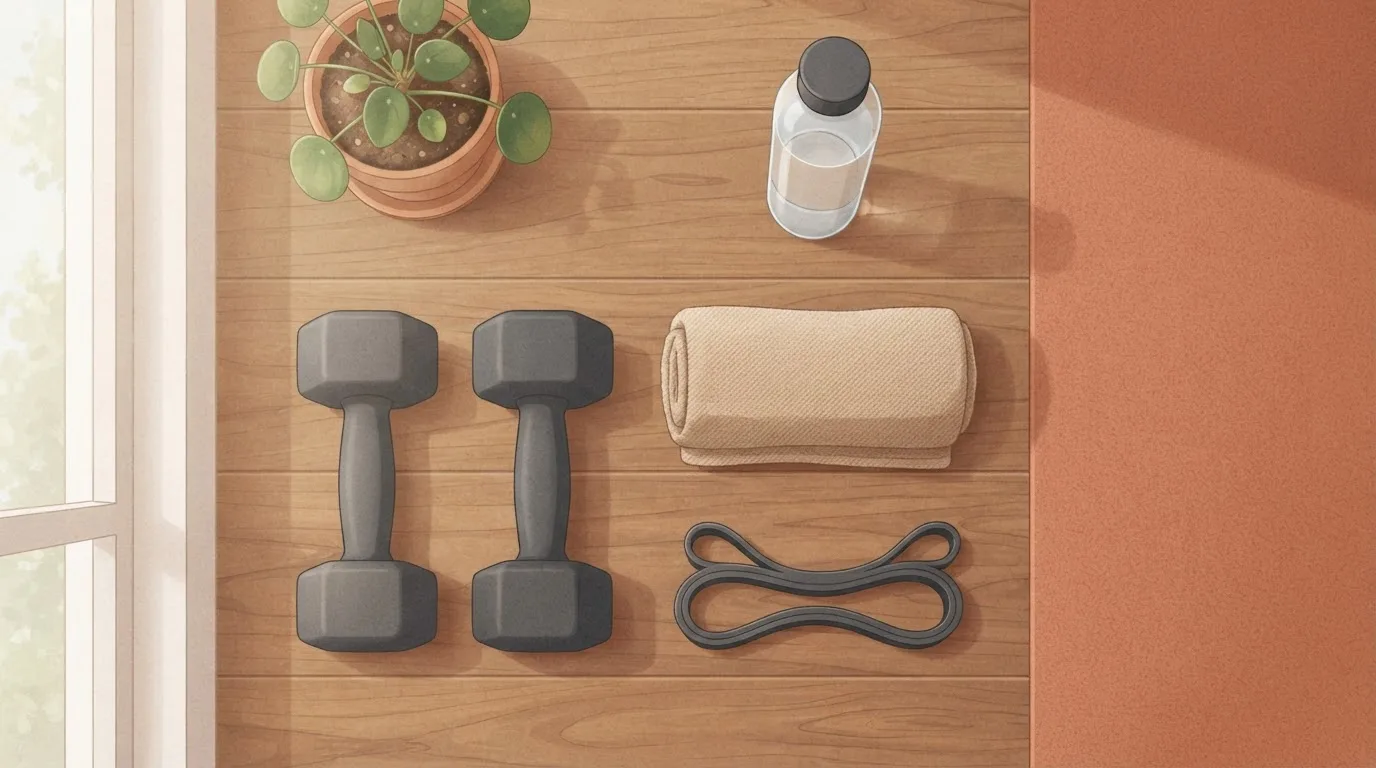
These 10 moves cover your legs, hips, chest, back and shoulders with nothing more than a pair of dumbbells, a loop band, a sturdy chair and a step. Every one keeps you in contact with the floor or a support.
| # | Exercise | Main muscles | Equipment |
|---|---|---|---|
| 1 | Chair squat | Quads, glutes | Chair, 1 dumbbell |
| 2 | Glute bridge | Glutes, hamstrings | Mat, optional dumbbell |
| 3 | Supported split squat | Quads, glutes | Chair for balance |
| 4 | Step-up to a low step | Quads, glutes | Stair or step |
| 5 | Dumbbell Romanian deadlift | Hamstrings, glutes, back | 2 dumbbells |
| 6 | Wall sit | Quads | Wall |
| 7 | Incline push-up | Chest, shoulders, triceps | Counter or bench |
| 8 | One-arm dumbbell row | Upper back, lats, biceps | Chair, 1 dumbbell |
| 9 | Half-kneeling dumbbell press | Shoulders, triceps | 1 dumbbell |
| 10 | Band pull-apart | Upper back, rear shoulders | Loop band |
Lower body
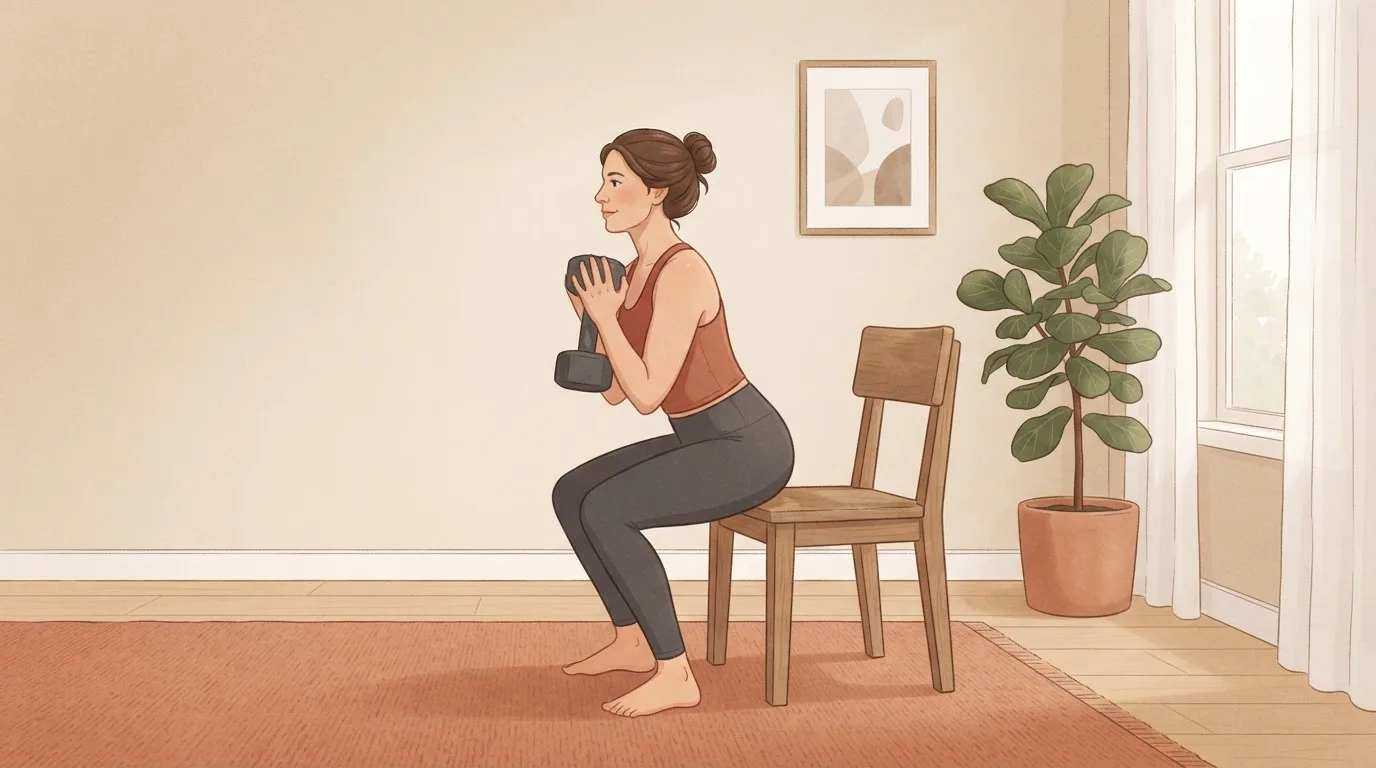
1. Chair squat. Stand in front of a chair holding one dumbbell against your chest. Sit back slowly until you lightly touch the seat, then stand up without rocking. A higher seat makes it easier on your knees and a lower one makes it harder. It's a goblet squat with a built-in depth guide.
2. Glute bridge. Lie on your back with your knees bent and feet flat. Push through your heels to lift your hips until your body makes a line from knees to shoulders, squeeze for a second and lower slowly. Rest a dumbbell across your hips when 20 reps feel easy.
3. Supported split squat. Stand in a long stride with one hand on a chair. Lower your back knee toward the floor, keeping your front heel down, then push back up. Your feet stay planted, so you skip the braking that makes forward lunges hard on some knees.
4. Step-up to a low step. Place one foot on the bottom stair, push through that heel to stand up, and lower yourself back down slowly with the same leg doing the work. Start at 6 to 8 inches. A higher step works your glutes more but bends your knee further.
5. Dumbbell Romanian deadlift. Hold a dumbbell in each hand in front of your thighs. With your knees soft, push your hips back and slide the weights down your legs until you feel your hamstrings stretch, keeping your back flat, then stand tall. This hinge trains the back of your body without loading your knees much.
6. Wall sit. Lean your back against a wall and slide down until your knees are bent at a comfortable angle, then hold. A shallow wall sit is often the first leg exercise sore knees tolerate, because nothing moves. Go a little lower or hold a little longer each week.
Upper body
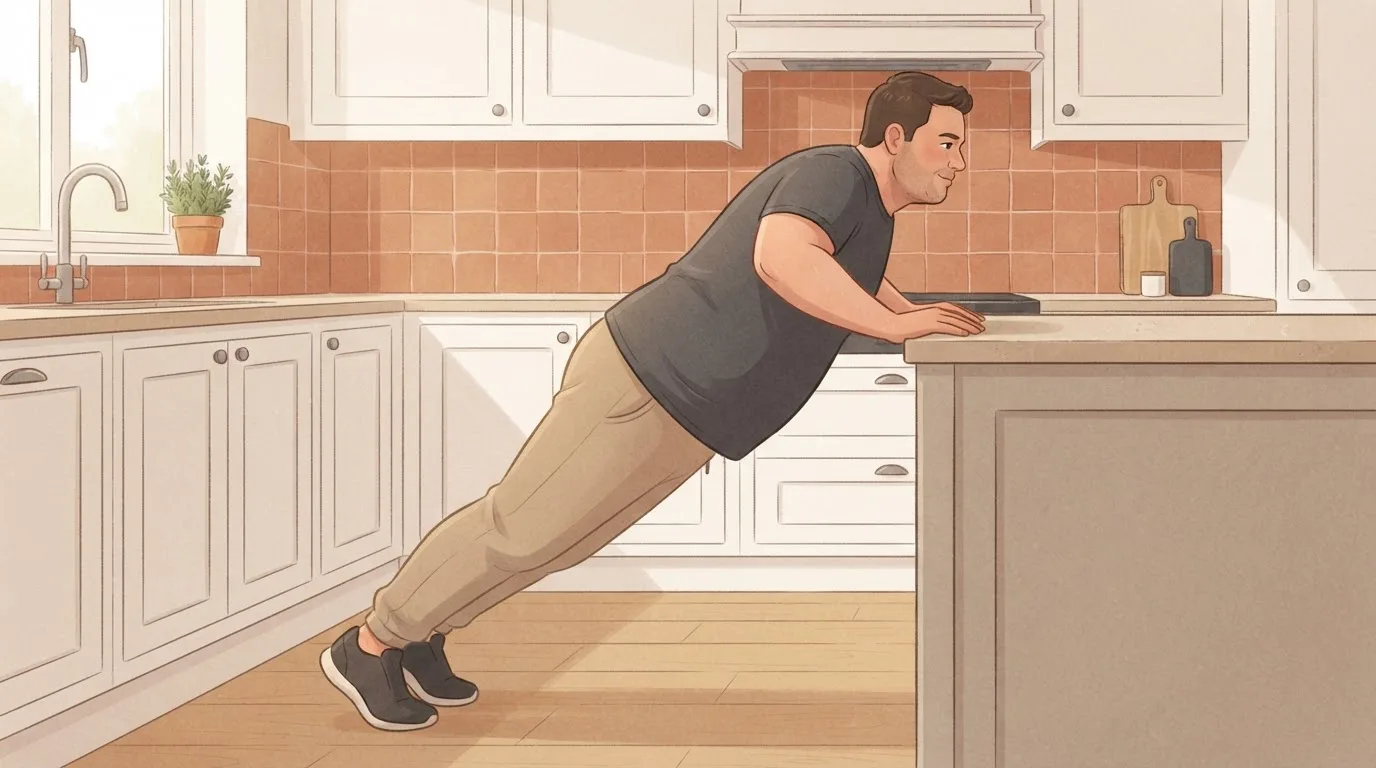
7. Incline push-up. Put your hands on a kitchen counter or sturdy bench, walk your feet back until your body is straight, and lower your chest toward the edge with your elbows angled about 45 degrees from your sides. The higher the surface, the easier it is. Our incline push-up guide shows the full progression to the floor.
8. One-arm dumbbell row. Put one hand and the same-side knee on a sturdy chair or bench, with your back flat. Pull the dumbbell in the other hand up toward your hip, pause, and lower it slowly. Supporting your trunk this way keeps your lower back out of it.
9. Half-kneeling dumbbell press. Kneel on one knee on a cushion, hold a dumbbell at your shoulder with your palm facing in, and press it up and slightly forward. Kneeling stops you leaning back, and the palm-in grip is kinder to most shoulders than pressing with your palm forward.
10. Band pull-apart. Hold a light loop band in front of your chest with straight arms, then pull your hands apart until the band touches your chest, squeezing your shoulder blades together. It trains the upper back muscles that desk work weakens, and it's easy on every joint.
A 6-Week Low Impact Strength Training Plan for Beginners
This plan runs three days a week, for example Monday, Wednesday and Friday, alternating two workouts. Each session takes 30 to 35 minutes, including a 5-minute warm-up of marching on the spot, arm circles and one easy set of the first exercise. It's built on the beginner guidance in the American College of Sports Medicine position stand (2009): two to three days a week, mostly 8 to 12 reps a set, and small load increases. Weeks 5 and 6 allow up to 15 reps, because home dumbbells come in big steps and extra reps are how you progress until the next size up.
| Workout A | Workout B |
|---|---|
| Chair squat | Step-up to a low step |
| Incline push-up | Half-kneeling dumbbell press |
| Glute bridge | Dumbbell Romanian deadlift |
| One-arm dumbbell row | Band pull-apart |
| Wall sit | Supported split squat |
| Weeks | Sets x reps | Reps left at the end of each set | Focus |
|---|---|---|---|
| 1 to 2 | 2 x 10 to 12 (wall sit 2 x 20 sec) | 3 to 4 | Learn each move and find your depth |
| 3 to 4 | 3 x 10 to 12 (wall sit 3 x 30 sec) | 2 to 3 | Add the third set and slow the lowering to 3 seconds |
| 5 to 6 | 3 x 10 to 15 (wall sit 3 x 40 sec) | 1 to 2 | Add reps or load each week |
Rest about 60 to 90 seconds between sets. On your days off, walking or the routines in our guide to low impact cardio at home keep your heart and lungs working without adding strength sessions. If you want harder intervals that still avoid jumping, our review of the high-intensity, low-impact research explains how that works.
How to choose your starting weight
In week 1, pick a dumbbell or band you could lift about 3 or 4 more times than the reps you're asked for. If the last rep is a grind, go lighter. If you could do 10 more, go heavier next session. Most beginners in their 30s and 40s start with a pair of light dumbbells for presses and rows and a heavier single dumbbell for squats and deadlifts. Women in their 40s will find more on load and bone health in our guide to strength training for women over 40.
How to progress without adding impact
Make a move harder in this order: add reps up to the top of the range, add a set, slow the lowering, add a one-second pause at the hardest point, then use a heavier dumbbell or band. The ACSM suggests raising the load by 2 to 10 percent once you can do one or two reps more than your target. With fixed home dumbbells, that's when you add reps or a pause until the next size up feels possible. You never need to add a jump.
Joint-Friendly Swaps for Sore Knees, Hips and Shoulders
Physical therapists often use a simple rule: mild discomfort during a set that has settled by the next morning is usually fine to train through. Sharp pain, or pain that's worse the next day, means you swap the move, shrink the range or lighten the load. Our guide to exercising with joint pain covers the bigger picture.
| If this bothers you | Try this instead |
|---|---|
| Knees: deep squats | Chair squat to a higher seat, or a glute bridge |
| Knees: lunges | Supported split squat with a short range, or a step-up to a 4-inch step |
| Knees: wall sits | A shallower wall sit, held for less time |
| Hips: squats that pinch at the bottom | Wider stance with toes turned out a little, and a higher chair |
| Hips: split squats | Glute bridge, or a side-lying leg raise |
| Shoulders: overhead pressing | Incline push-up, or a half-kneeling press angled forward with the palm facing in |
| Shoulders: floor push-ups | A higher incline push-up on a counter |
| Lower back: Romanian deadlift | Glute bridge, or a shorter hinge to just above the knees |
Sore knees
Keep your heel down and let your knee travel only as far forward as feels fine. Strengthening the thigh and hip muscles is a mainstay of care for many kinds of knee pain, and our guide on how to strengthen knees explains why. Use step height and chair height as dials: a higher step or a lower chair bends your knee further and makes the move harder.
Sore hips
A pinch at the front of the hip at the bottom of a squat often eases with a slightly wider stance and a shorter range. Bridges and side-lying leg raises train the glutes with little hip bend, so they're the safe base while you find your range on the standing moves.
Sore shoulders
Pressing straight overhead is the move most likely to annoy a sore shoulder. Press at an angle in front of you with your palm facing in, keep push-ups on an incline, and do plenty of rows and band pull-aparts so the back of your shoulder gets as much work as the front.
Is Low Impact Strength Training Good for Weight Loss?
It helps, mostly by protecting your muscle while you eat less. In a 2022 meta-analysis by Lopez and colleagues of 114 trials and 4,184 people with overweight or obesity, resistance training plus eating fewer calories cut about 5.3 kg of fat compared with no program, while lean mass held steady. Resistance training alone added about 0.8 kg of lean mass. Your eating drives most of the change on the scale, and strength training decides how much of the loss is fat.
Weight loss also takes load off sore knees. In a study of 142 older adults with knee arthritis who were overweight, Messier and colleagues (2005) found that each kilogram of weight lost took about 4 kilograms of force off the knee with every step. That's the main reason a low impact plan makes sense if you're carrying extra weight: you can build the muscle that supports your knees now, without the landings that make them ache.
What Not to Do When Lifting With Sore Joints
- Don't bounce. Dropping into the bottom of a squat or lunge turns a controlled rep into a small landing.
- Don't hold your breath through a whole set. Breathe out as you push and in as you lower.
- Don't chase failure on a move that hurts. Swap it, or stop a few reps short.
- Don't add jumps to make it harder. Add reps, a pause or a slower lowering first.
- Don't jump to a much heavier weight. Small steps give your joints and tendons time to catch up with your muscles.
- Don't skip the warm-up. Five minutes of easy movement makes the first working set feel far better.
The Bottom Line
Low impact strength training builds muscle the same way any strength training does: by taking your sets close to your limit. Drop the jumps, lower each rep under control, use dumbbells, bands and bodyweight, and swap any move that pinches. Three sessions a week for six weeks gives you a solid first block to build on.
If you'd like the plan built and paced for you, our comparison of the best strength training apps sets out the options. FitCraft's strength workouts use bodyweight and dumbbells plus a handful of band exercises such as band pull-aparts, and an AI coach demonstrates each one on an interactive 3D model and says your name as you train. Your workouts adjust as you progress, and streaks help you keep the three days a week. Stacy, 41, said that after her second child she needed something stupidly simple. Start with Workout A this week.
Frequently Asked Questions
What are some good low-impact exercises?
Good low-impact strength exercises are chair squats, glute bridges, supported split squats, step-ups to a low step, incline push-ups, one-arm dumbbell rows, band pull-aparts and wall sits. For cardio, walking, cycling, swimming and the elliptical keep impact low. None of them involve jumping or a hard landing, and all of them can be made harder with more reps or a slower lowering.
How should a beginner start strength training?
Start with two or three full-body sessions a week and sets of 8 to 12 reps, which is what the American College of Sports Medicine recommends for beginners, using 5 to 8 basic moves. Pick weights that leave 3 or 4 reps in reserve for the first two weeks while you learn the form, then work closer to your limit and add load in small steps.
Can low impact strength training build muscle?
Yes. A meta-analysis of 21 studies found that light and heavy loads built similar muscle when every set was taken to failure (Schoenfeld 2017), and none of those sets needed a jump. Heavy loads built more maximal strength, so add weight over time where your joints allow it.
Is low impact strength training good for weight loss?
It helps, mainly by protecting your muscle while you eat less. In a meta-analysis of 114 trials of people with overweight or obesity, resistance training combined with eating fewer calories cut about 5.3 kg of fat compared with no program while lean mass held steady (Lopez 2022). Your eating drives most of the weight change, and the strength work shapes what the weight is made of.
What not to do when lifting?
Don't bounce out of the bottom of a rep, hold your breath through a whole set, add weight in big jumps, or push to failure on a move that hurts. Warm up for five minutes first, lower each rep under control, and make a move harder with more reps or a slower lowering before you add load.
Can you do low impact strength training every day?
You can move every day, but hard full-body strength sessions work best two to four days a week with a rest day between them. If you want to train daily, alternate lower-body and upper-body days, or put walking and mobility on the days in between.