Your shoulders look fine from the front. You do push-ups, you press, maybe you added lateral raises. Then you catch your reflection from the side and the back of your shoulder looks flat, or your shoulders seem to sit a little further forward every year.
The cause is usually simple. The rear delt is the one head of the shoulder that pushing exercises skip, and it's also the first exercise people drop when a workout runs long, because a set of light reverse flyes doesn't feel like much. Skip it for a few months and the gap shows.
This guide gives you a home rear delt workout built from 10 moves that need nothing more than light dumbbells, a resistance band or your bodyweight. It covers the anatomy of the posterior deltoid, the EMG studies behind each move, how a row differs from a fly for the rear delts, and what the evidence really says about rear delts and posture.
10 Rear Delt Exercises You Can Do at Home
The list runs from the moves that isolate the rear delt most to the rows that share the work with your upper back. That order is our coaching judgment, informed by the EMG studies further down. No single study has ranked all 10, so treat the order as a rough guide.
| # | Exercise | Equipment | What the research shows | Best for |
|---|---|---|---|---|
| 1 | Chest-supported reverse fly | Dumbbells, bench | Neutral grip beat palms-down on a reverse fly machine (Schoenfeld 2013) | Strict isolation, sore lower backs |
| 2 | Bent-over reverse fly | Dumbbells | Same movement path as #1, no bench needed | Training with no bench |
| 3 | Seated bent-over reverse fly | Dumbbells, chair | Same path, less hamstring and back demand | Beginners, tight hamstrings |
| 4 | Prone T raise, thumbs up | Bodyweight or very light dumbbells | 88% of a maximal contraction at 100 degrees (Reinold 2004) | No equipment, shoulder health |
| 5 | Prone Y raise | Bodyweight | Top move for the lower trapezius (Ekstrom 2003) | Pairing rear delts with the lower traps |
| 6 | Band pull-apart | Resistance band | Palms down beat palms up or neutral (Fukunaga 2022) | Quick sets, warm-ups |
| 7 | Band face pull | Band and a door anchor | No published EMG we could verify | Rear delts plus the rotator cuff |
| 8 | Dumbbell high row, elbows out | Dumbbells, bench | 63% in an elbows-out strap row (Youdas 2021) | Heavier loading |
| 9 | Inverted row, elbows wide | Sturdy table, bar or straps | Over 61% in four inverted row versions (Youdas 2016) | Rear delt calisthenics |
| 10 | Side-lying rear delt raise | One dumbbell | No direct EMG; loads the top of the range | One arm at a time, uneven sides |
1. Chest-supported dumbbell reverse fly
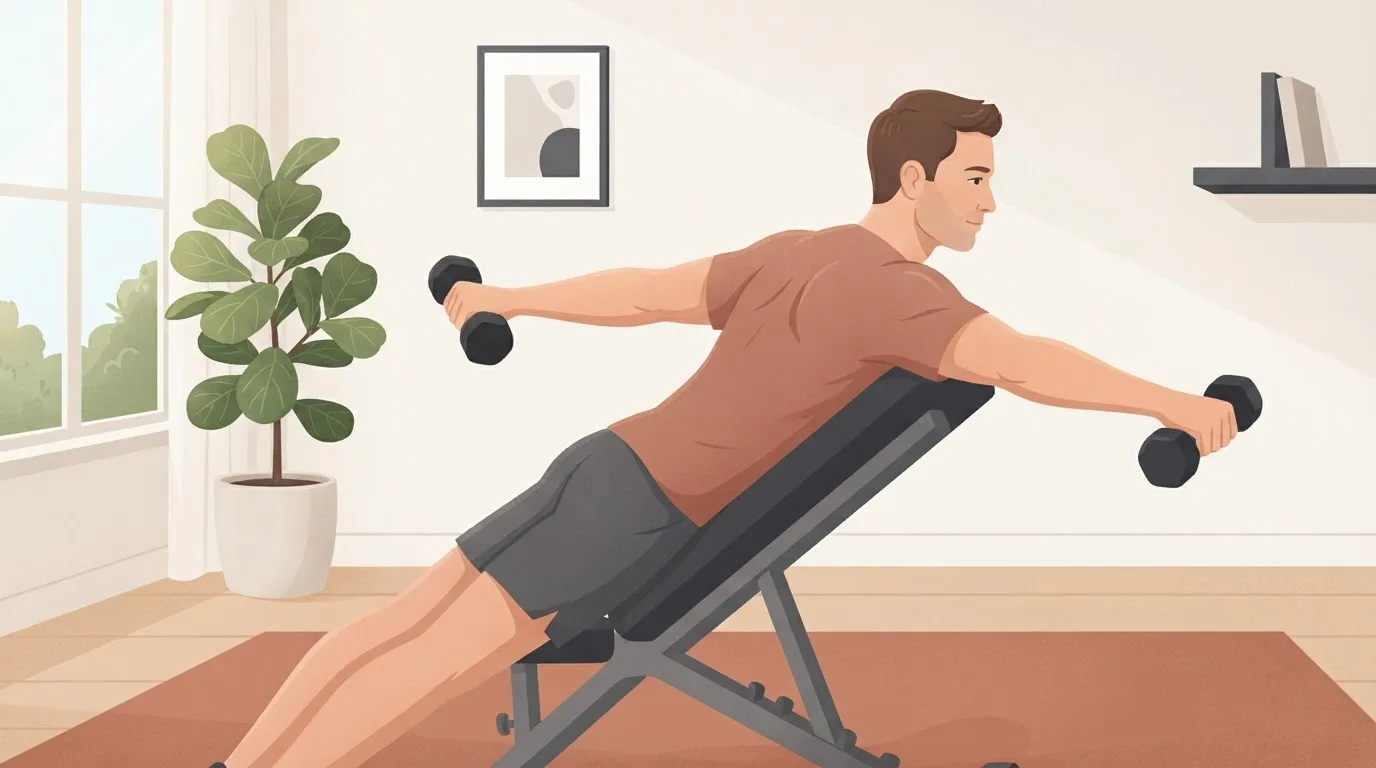
Set a bench to a 30 to 45 degree incline and lie face down on it with a light dumbbell in each hand, palms facing each other. With a soft bend in your elbows, sweep your arms out and back until your upper arms line up with your shoulders, pause for a second, then lower for two seconds. The bench holds your torso still, so you can't swing the weight up. Keep your palms facing in: on a reverse fly machine, Schoenfeld and colleagues (2013) found that a neutral grip produced more posterior deltoid and infraspinatus activity than a palms-down grip in 19 trained men. The gap was small, and it was measured on a machine, so read it as a tiebreaker. Domenic's rear delt raise guide covers the chest-supported setup and the common form faults. Do 2 to 4 sets of 12 to 20 reps.
2. Bent-over dumbbell reverse fly
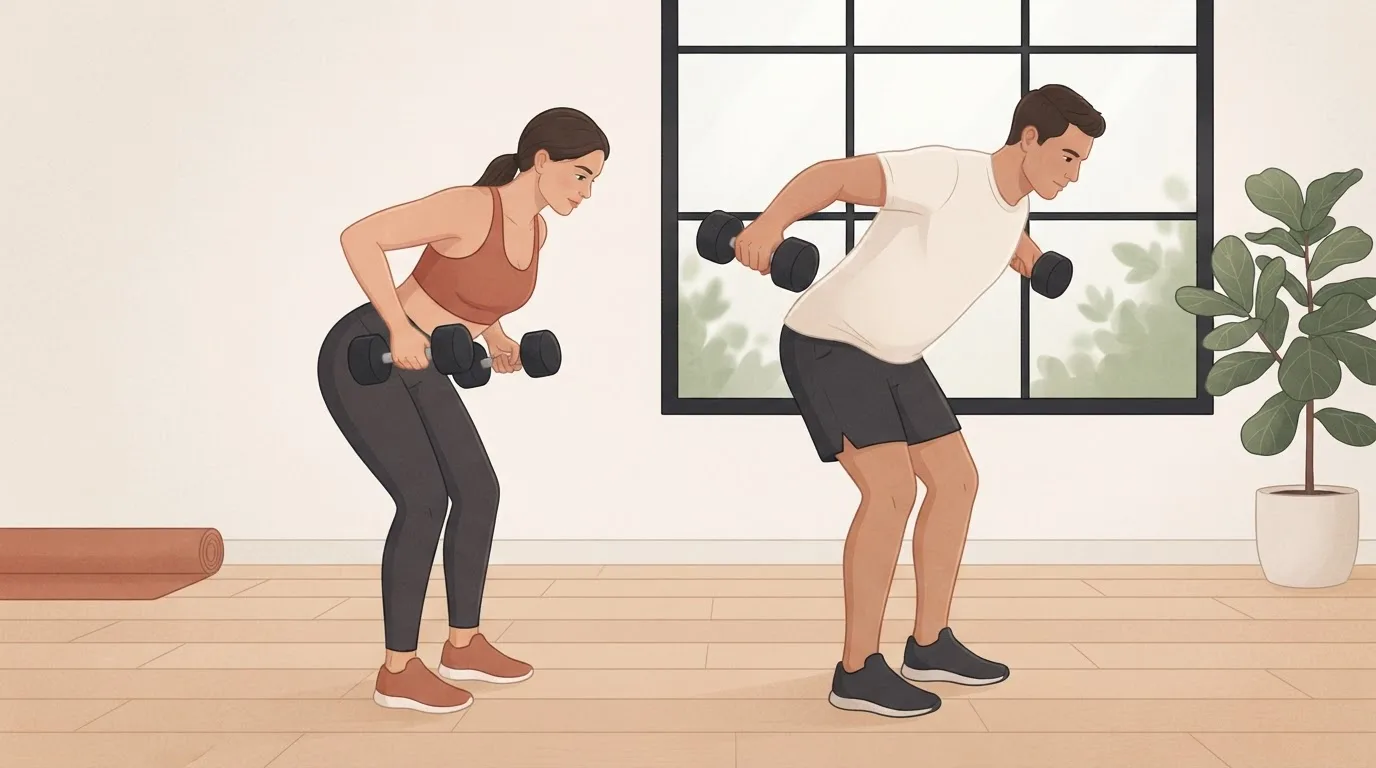
Stand with your feet hip-width apart, soften your knees and hinge forward until your chest is close to parallel with the floor, back flat. Let the dumbbells hang under your shoulders, then raise them out to the sides in the same arc as the bench version. It's the most common rear delt exercise at home because it needs no bench. The trade-off is your lower back and hamstrings hold the hinge, and it's easy to start rocking your torso to lift heavier dumbbells. If you see yourself rocking, the weight is too heavy.
3. Seated bent-over reverse fly
Sit on the edge of a chair or bench with your feet together, lean your chest toward your thighs and let the dumbbells hang beside your calves. Raise them out to the sides from there. Sitting takes the hamstrings and most of the lower back out of the hold, which makes this the easiest place to learn the movement. It suits beginners and anyone whose lower back tires before their shoulders do.
4. Prone T raise with the thumbs up
Lie face down on the floor or a bench with your arms out to the sides, slightly above shoulder height, and turn your thumbs toward the ceiling. Lift your arms a few inches, hold for two seconds and lower. Start with no weight at all. In fine-wire EMG of 10 healthy adults, Reinold and colleagues (2004) recorded 88 percent of a maximal contraction in the posterior deltoid during this exact position: prone horizontal abduction at 100 degrees with the arm turned out. It was the highest posterior deltoid reading of the seven shoulder exercises they tested. A later study of 22 adults by Reinold and colleagues (2007) found 87 percent for the same move, against 38 percent for a standing thumbs-up raise angled slightly forward of your side.
5. Prone Y raise
Use the same position as the T raise, but angle your arms overhead into a Y with your thumbs up. It's harder than it looks, and you may need no weight for weeks. The Y shifts more of the work to the lower trapezius, the muscle that pulls your shoulder blades down and back. Ekstrom and colleagues (2003) tested 10 exercises in 30 adults and found the prone overhead arm raise produced the most lower trapezius activity. Alternate T and Y raises and you train the back of the shoulder and the muscles that steady the shoulder blade in one short block.
6. Band pull-apart
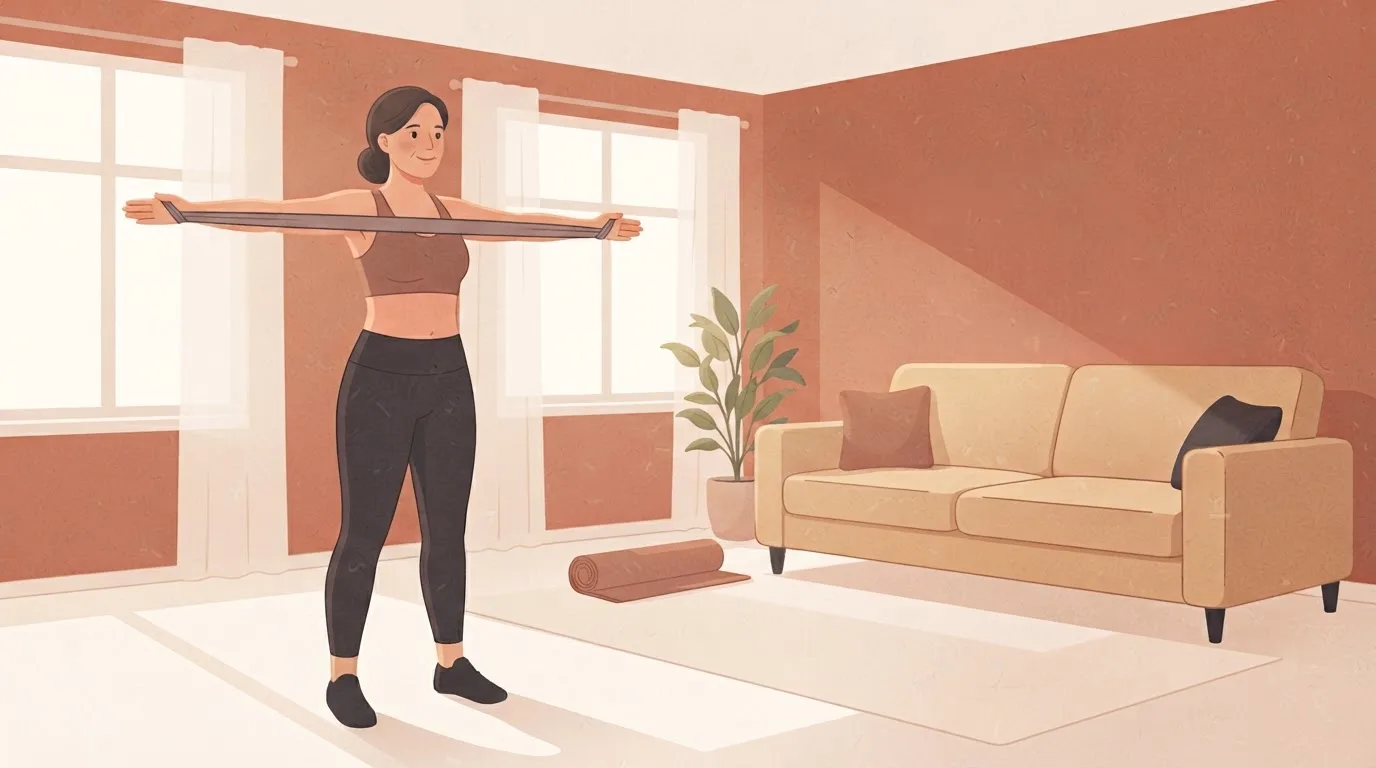
Hold a light resistance band at shoulder height with your hands about shoulder-width apart and your arms straight out in front. Pull the band apart until your arms make a T and the band touches your chest, then let it back slowly. Keep your shoulders down away from your ears. The band pull-apart exercise guide shows the grip and the common mistakes. One small study has measured it. Fukunaga and colleagues (2022) recorded 10 healthy men doing pull-aparts with a band that felt moderately hard. Pulling straight across, the rear delt reached 48 percent of a maximal contraction with the palms down, 38 percent with the palms facing each other and 33 percent with the palms up. That's the opposite of the machine result in move 1, so treat grip as a small detail. Do 2 to 3 sets of 15 to 25 reps, or a quick set between other exercises.
7. Band face pull
Anchor a band at about forehead height in a door, hold one end in each hand with your palms down and step back until the band is taut. Pull your hands toward your forehead while your elbows travel out and slightly up, and finish with your hands beside your ears and your knuckles pointing back. The finish adds a bit of outward rotation, which brings in the small rotator cuff muscles behind the shoulder. If you train in a gym, a cable face pull with a rope is the same movement. Unlike the pull-apart, the band face pull has no EMG study we could verify, so we list it for its movement path rather than a measured number.
8. Dumbbell high row with the elbows out
Lie face down on an incline bench, or hinge forward as in move 2, with your palms facing your feet. Row the dumbbells up with your elbows flared out wide until your upper arms are level with your shoulders and your elbows sit at about 90 degrees. This is the rear delt row, and because you bend your elbows, it lets you use heavier dumbbells than a fly. In the strap study described below, the version with the elbows out reached 63 percent of a maximal contraction in the posterior deltoid (Youdas 2021). That study used suspension straps, and we found no study of this exact dumbbell exercise, so treat the number as a guide to the movement path.
9. Inverted row with the elbows wide
Lie under a sturdy table, a low bar or a pair of suspension straps, grab the edge with your hands wider than your shoulders and pull your chest up toward it with your body straight. Let your elbows travel out to the sides rather than down by your ribs. Youdas and colleagues (2016) measured 26 adults doing four inverted row versions on a portable pull-up device. The posterior deltoid stayed above 61 percent of a maximal contraction in all four, with palms up or down and with one or both feet down. Test the table first, and see the inverted row exercise guide for the setup and easier versions.
10. Side-lying rear delt raise
Lie on your side with a light dumbbell in your top hand, the arm hanging in front of your chest. Keeping a soft elbow, raise the dumbbell up and back until your arm points at the ceiling, then lower slowly. Gravity loads this one hardest partway up, when your arm points straight out in front of you. That's a more stretched position for the rear delt than the top of a bent-over fly. We found no EMG study of it, so use it as a one-arm option, especially if one shoulder is clearly weaker than the other.
Posterior Deltoid Anatomy: What the Rear Delt Does
The deltoid is the cap of muscle over your shoulder joint. It's usually taught as three heads: front, side and rear. The rear head, the posterior deltoid, starts on the spine of your shoulder blade and runs forward and down to the outside of your upper arm.
Three heads is a simplification. Sakoma and colleagues (2011) dissected 60 shoulders and found the deltoid splits into seven segments, each defined by its own internal tendon. PET scans of six volunteers then showed those segments working unevenly during the same arm raise. In practice, that means no single exercise trains every fiber of the shoulder equally, which is one reason the back of the shoulder needs its own exercises.
Its two main jobs
- Pulling the arm back at shoulder height. With the arm raised to 90 degrees, the posterior deltoid and the infraspinatus had the largest leverage for moving the arm backward of the 10 shoulder muscles measured in cadavers by Kuechle and colleagues (1997). This is the reverse fly motion, and it's why the rear delt does most of the work there.
- Pulling the arm down and back from in front of you. In the forward-and-back plane, the teres major and the posterior deltoid had the largest extensor leverage of 18 muscle regions measured by Ackland and colleagues (2008). Low rows and pull-downs use this action, which is why the rear delt helps in them but shares the work with your back.
Why pressing leaves it behind
Pushing moves your arm forward, the opposite of what the rear delt does. Campos and colleagues (2020) recorded 13 trained men doing four common shoulder and chest exercises at 60 percent of their max. The posterior deltoid reached 3.5 percent of a maximal contraction in the bench press, 2.5 percent in the dumbbell chest fly and 11.4 percent in the shoulder press. The lateral raise did best, at 24 percent. A week of push-ups and presses can leave your rear delts close to untrained. If shoulder width is your main goal, the side delts matter more, and our guide on how to get broader shoulders covers them. For the full shoulder session with press, lateral raise and rear delt fly, and the weekly set counts for each head, see our dumbbell shoulder workout.
What EMG Studies Show About Rear Delt Exercises
EMG measures the electrical activity in a muscle, reported as a percentage of that muscle's maximal effort. Researchers often treat readings above about 60 percent as very high. The numbers below come from different labs, electrodes and loads, so compare readings within each study.
| Study | People | Exercise | Posterior deltoid activity |
|---|---|---|---|
| Reinold 2004 | 10 adults, fine-wire EMG | Prone raise at 100 degrees, thumbs up | 88% (highest of 7 exercises) |
| Reinold 2007 | 22 adults, fine-wire EMG | Same prone raise vs a standing thumbs-up raise | 87% vs 38% |
| Youdas 2021 | 28 adults, suspension straps | Straight-arm sweep / elbows-out row / elbows-in row | 88% / 63% / 45% |
| Youdas 2016 | 26 adults, portable bar | Inverted row, four grip and foot versions | Over 61% in all four |
| Fukunaga 2022 | 10 men, resistance band | Band pull-apart straight across, palms down / neutral / palms up | 48% / 38% / 33% |
| Schoenfeld 2013 | 19 trained men, machine | Reverse fly, neutral vs palms-down grip | Neutral grip slightly higher |
| Campos 2020 | 13 trained men | Lateral raise / shoulder press / bench press | 24% / 11.4% / 3.5% |
Three patterns hold across these studies:
- Straight arms out at shoulder height win. The two highest readings, 88 percent in two separate labs, both came from moving straight arms backward at about shoulder height.
- Elbow path changes everything in a row. The same strap row went from 45 to 63 percent when the elbows moved out from the ribs to shoulder height.
- Light weights are enough. In the 2007 study, the prone raise was done with dumbbells averaging about 1.5 kilograms (3 pounds), the most each person could lift 10 times, and still read near the top of the scale. You don't need heavy weights for a rear delt exercise to work.
A word of caution: high activity in a short test shows a muscle is working hard. It doesn't measure growth over months, and we found no published trial that compared rear delt growth between these exercises. Pick moves that read high, then build them up with more reps and sets over weeks.
Rows vs Flyes for Rear Delts
Most people assume their rows already cover the rear delts. Whether they do depends on one thing: where your elbows travel.
In the 2021 strap study by Youdas and colleagues, 14 men and 14 women did three versions of a bodyweight row on suspension straps, leaning back at about 45 degrees. The results for three muscles show the trade-off clearly:
| Row version | Elbow path | Posterior deltoid | Middle trapezius | Latissimus dorsi |
|---|---|---|---|---|
| Low row | Elbows bent, close to the ribs | 45% | 43% | 48% |
| High row | Elbows bent, out at shoulder height | 63% | 75% | 12% |
| Horizontal abduction row | Arms straight, swept out to the sides | 88% | 94% | 31% |
The low row split the work between the lats, the rear delts and the mid-back. Once the elbows rose to shoulder height, lat activity collapsed to 12 percent and the rear delts and middle trapezius took over. The straight-arm version, which is a reverse fly on straps, produced the most rear delt activity of all. The paper doesn't report significance tests for the rear delt differences, so read the overall pattern.
The anatomy explains it. A row with the elbows by your ribs is mainly shoulder extension, a job the rear delt shares with the lats and teres major. A row with the elbows out at shoulder height is the same backward sweep as a fly, the rear delt's strongest line of pull. Bending your elbows in the high row shortens the lever, so you can hold heavier dumbbells than in a fly.
So count your rows by elbow path. An elbows-in row splits the work between your lats, rear delts and mid-back, so count it as partial rear delt work. An elbows-out row counts as full rear delt work. A fly isolates the rear delt most, with light weights. A balanced week uses both: a fly or a prone raise for isolation, and an elbows-out row when you want to load heavier. Our guide to dumbbell back exercises covers the elbows-in rows that train the lats.
Find out what's really holding you back
FitCraft, our mobile fitness app, pairs you with an AI coach who builds you a personalized plan around your goals, schedule, and fitness level. Every FitCraft program is designed by Domenic Angelino, MPH (Brown University) and NSCA-CSCS, with research published in the Journal of Strength and Conditioning Research and Medicine & Science in Sports & Exercise.
Take the Free Assessment Free • 2 minutes • No credit cardDo Rear Delt Exercises Improve Posture?
Rear delt exercises are often sold as a posture fix. The evidence supports a smaller claim: they're one useful part of a plan that also stretches the front of your chest.
What the rear delt can and can't move
Rounded shoulders usually describe shoulder blades that sit forward and tilted. The rear delt attaches to your upper arm, so it moves the arm. Pulling the shoulder blades back is the job of the middle and lower trapezius and the rhomboids. The good news is that the same moves train them. In the strap study, the middle trapezius reached 94 percent in the straight-arm sweep, and Ekstrom's team found that a prone raise with the arm turned out was among the two strongest middle trapezius exercises they tested.
Strength alone hasn't been shown to move the shoulders back
A review by Hrysomallis (2010) found that studies comparing people's muscle strength with their resting shoulder blade position detected no link. Muscle length did show one. The interventions that changed resting shoulder blade position either stretched the chest muscles alone or combined that stretching with strengthening of the muscles that pull the shoulder blades back. In a randomized trial of 28 college swimmers, Lynch and colleagues (2010) found an 8-week posture exercise program reduced forward head angle and forward shoulder position compared with a control group.
None of these studies tested rear delt exercises on their own. So train the back of your shoulders, stretch your chest, and expect gradual change over months. Whether rounded shoulders cause pain at all is less settled than social media suggests. Our guide on how to fix rounded shoulders covers that evidence, a self-check and a 4-week plan.
Why balance matters if you lift
Kolber and colleagues (2014) examined 46 men who lifted weights at least twice a week and 31 men who didn't. The lifters were more likely to show clinical signs of shoulder impingement. Those signs were linked to lateral raises and upright rows taken above shoulder height, and less common in men who trained their external rotators. This kind of study can't prove cause, but it fits the usual coaching advice: if you press and raise a lot, give the back of your shoulder its own work.
A Home Rear Delt Workout for Beginners and Intermediates
Add one of these to the end of an upper body or pull session, two times a week. Rest 45 to 60 seconds between sets. If you train back and rear delts together, do your rows first and these after.
Beginner: band and bodyweight (about 10 minutes)
| Exercise | Sets | Reps |
|---|---|---|
| Prone T raise, thumbs up, no weight | 2 | 10 to 12, 2-second hold at the top |
| Band pull-apart | 2 | 15 to 20 |
| Seated bent-over reverse fly, very light dumbbells | 2 | 12 to 15 |
Intermediate: dumbbells and a band (about 15 minutes)
| Exercise | Sets | Reps |
|---|---|---|
| Dumbbell high row, elbows out | 3 | 10 to 12 |
| Chest-supported reverse fly | 3 | 12 to 20 |
| Band face pull | 2 | 15 to 20 |
| Prone Y raise | 2 | 8 to 10 |
That's 6 to 10 hard sets for the rear delts each week across two sessions, which matches what most people need for any one deltoid head. The reasoning behind those numbers is in the dumbbell shoulder workout guide linked above.
How to work rear delts so you feel them
- Go lighter than you think. Start with 2 to 5 kilograms (5 to 12 pounds) per hand for a reverse fly. If your torso rocks or your shoulders shrug, drop the weight.
- Think "hands wide", not "squeeze". Reaching your hands out to the walls keeps the work on the rear delt. Pinching the shoulder blades hard turns the set into a mid-back exercise.
- Keep your shoulders away from your ears. Shrugging hands the lift to the upper traps.
- Stop at shoulder height. That's the position where the rear delt has its best leverage, so there's no reason to swing higher.
- Add reps before weight. Once you can do 20 clean reps, move up by the smallest dumbbell jump you have.
Rear Delt Calisthenics: No Equipment Needed
You can train the back of your shoulders with no dumbbells or band at all. These bodyweight moves cover it:
- Prone T, Y and W raises. Do them on the floor, 8 to 12 reps of each letter, with a 2-second hold at the top.
- Inverted row under a table. Use a heavy, solid table and row with your elbows wide. Bend your knees to make it easier.
- Corner row. Stand with your back to a corner, elbows bent and pressing into each wall, and push your body away from the corner. The corner row exercise guide shows it step by step. It suits beginners because you control the effort entirely.
- Reverse snow angels. Lie face down and sweep your arms from your sides up past your head and back, just off the floor, keeping your thumbs up. Go slowly: each rep should take about four seconds.
Make bodyweight versions harder by slowing down and holding longer at the top. Once 15 slow reps feel easy, a pair of light dumbbells or a band will move you forward faster.
If you'd rather have the sets planned for you, a dumbbell workout app can carry the plan. FitCraft's strength workouts use bodyweight and dumbbells plus a handful of band exercises such as band pull-aparts. An AI coach demonstrates each one on an interactive 3D model you can zoom in on, and says your name while you train. Your workouts adjust as you progress, and streaks help keep short sessions like these from slipping. The AI coach and programs were designed by Domenic.
The Bottom Line
The rear delt pulls your upper arm backward, and it does its best work with your arms out at shoulder height. Reverse flyes, prone T raises, band pull-aparts and rows with your elbows flared all train that motion, and light weights are enough. Rows with your elbows tucked help too, but they split the work with your lats and mid-back. Pair rear delt work with a chest stretch if posture is your goal, and give it 6 to 10 sets a week.
The hard part is keeping these small exercises in your week once the novelty wears off. As Tim put it, "I didn't think an app could replace my trainer. My AI coach proved me wrong." Pick two moves from the list and add them to your next session.
Frequently Asked Questions
Which exercise for rear delts?
The highest rear delt readings in EMG studies came from moves that sweep straight arms out to the sides at shoulder height: a prone raise with the thumbs up (88 percent of a maximal contraction) and a straight-arm row on suspension straps (also 88 percent). At home, the chest-supported dumbbell reverse fly is the most practical version of that movement, because the bench stops you from swinging.
What exercise hits all three deltoids?
No single exercise loads all three heads hard. In one EMG comparison of trained men, the lateral raise worked the rear delt more than the shoulder press or bench press did, but only to 24 percent of its maximum. An overhead press, a lateral raise and a rear delt fly together cover the front, side and back of the shoulder.
Which delt is most important?
None of the three heads matters more than the others, but they don't need equal direct work. The front delt already works in every push-up and press. The side delt sets how wide your shoulders look, and the rear delt fills out the shoulder from the side and back. Most people who train at home need more direct side and rear delt work than front work.
Is 3 exercises enough for shoulder day?
Yes. One press, one lateral raise and one rear delt move, done for 3 to 4 hard sets each, covers all three heads. If you train shoulders twice a week, that adds up to roughly 6 to 8 direct sets for each of the side and rear delts, which is enough for most people to see progress.
What exercises are on a pull day?
A pull day usually holds a vertical pull such as a pull-up, a horizontal row, a curl and a rear delt move. Rear delts fit there because your rows have already warmed up the back of your shoulders. Finish with a reverse fly or band pull-aparts after your rows, with light weights and 12 to 20 reps.
How to get V shape shoulder?
A V shape comes mostly from wide side delts and wide lats above a smaller waist. Lateral raises build the side delts, rows and pull-ups build the lats, and rear delt work rounds out the shoulder from the side. Lower body fat around the waist makes the same shoulders look wider.