Most upper-body plans train the muscles you can see in a mirror. The serratus anterior, the serratus muscle on the side of your ribcage under your arm, rarely gets an exercise of its own. Every push-up, overhead press and reach still depends on it. When it's underused, a shoulder blade can lift off the ribs, overhead work starts to pinch, and push-ups feel stuck in the front of the shoulder.
That gets frustrating. You stretch, you foam roll, you try a shoulder routine from a video, and nothing feels different. After a while you start to suspect your shoulders are simply built badly.
They usually aren't. The serratus is a pushing muscle, and it responds to what every muscle responds to: the right movement, loaded and repeated. This guide gives you the 8 serratus anterior exercises with the best evidence, what the serratus anterior does, how to tell if yours is weak, what a winged scapula means, and a weekly plan with bodyweight, a band or a dumbbell.
The 8 Best Serratus Anterior Exercises
The first three need nothing but a floor and a wall. The next two use a resistance band, and the last three use a dumbbell. Every one of them either pushes the shoulder blade forward around the ribs, called protraction, or rotates it upward as the arm goes overhead.
| # | Exercise | Equipment | What it trains | Sets x reps |
|---|---|---|---|---|
| 1 | Push-up plus | Floor | Protraction at the top of a push-up | 2-3 x 8-12 |
| 2 | Scapular push-up | Floor, wall or counter | Protraction alone, elbows straight | 2-3 x 10-15 |
| 3 | Wall slide | Wall, optional band | Upward rotation above shoulder height | 2-3 x 10-12 |
| 4 | Band dynamic hug | Resistance band | Protraction with the arms wide | 2-3 x 12-15 |
| 5 | Band punch with a reach | Resistance band | Protraction at the end of a punch | 2-3 x 12-15 per side |
| 6 | Supine dumbbell punch | One dumbbell, floor | Protraction lying down | 2-3 x 12-15 per side |
| 7 | Dumbbell scaption raise | Two light dumbbells | Upward rotation through the overhead range | 2 x 10-12 |
| 8 | Dumbbell pullover | One dumbbell, floor | Lats and chest, shoulder blades into full overhead range | 2-3 x 10-12 |
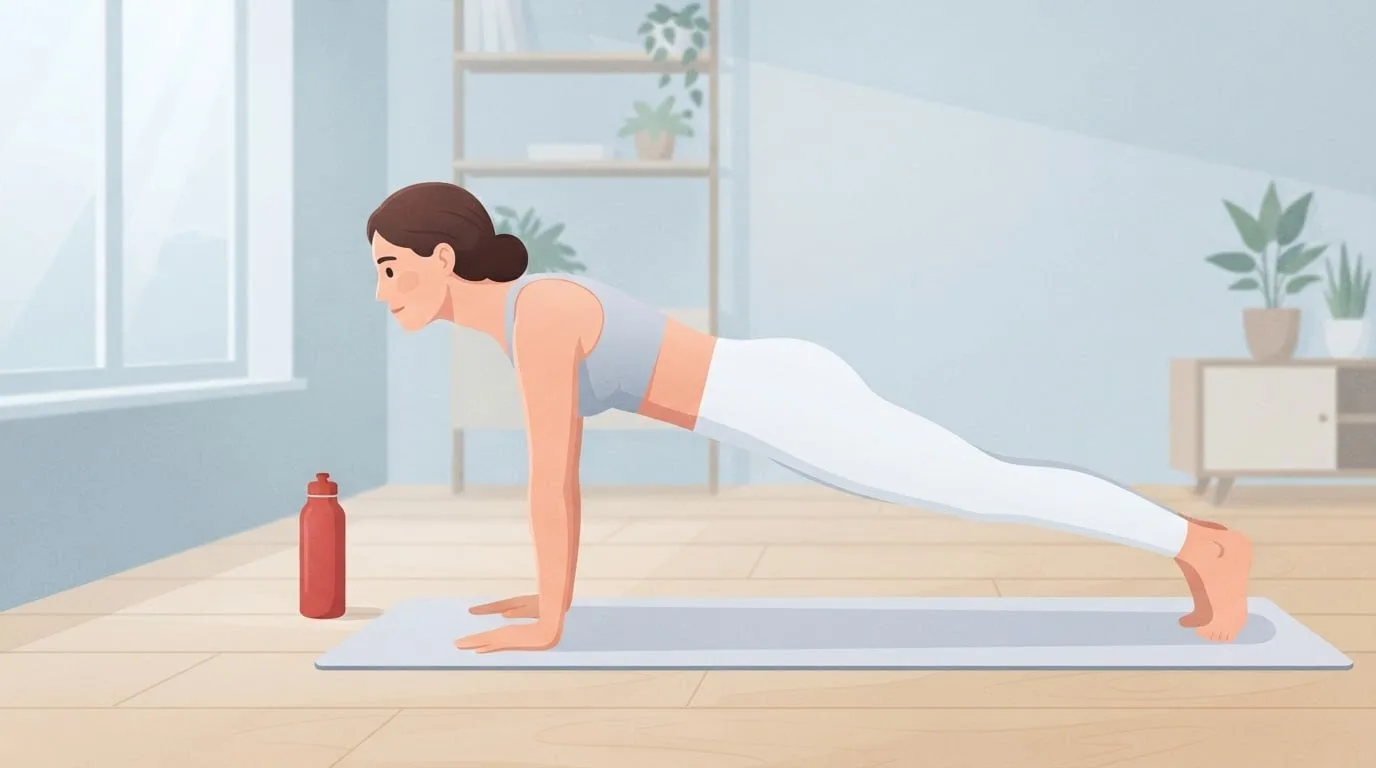
1. Push-up plus
Set up in a normal push-up, lower yourself and press back up. At the top, keep your elbows locked and push the floor a little further away, so your upper back rounds slightly and your shoulder blades slide apart around your ribs. Hold that for a second, let the blades settle back, and start the next rep. The finish is the exercise.
Ludewig and colleagues (2004), in the American Journal of Sports Medicine, recorded 30 adults, some healthy and some with mild shoulder problems. The standard push-up plus produced the highest serratus activity of the versions tested, up to 123 percent of a maximal contraction. During the plus, the upper trapezius worked at less than a fifth of the serratus's level. The wall version, and parts of the knee and elbow versions, let the upper trapezius work up to twice as hard as the serratus.
So the floor version is the target and the easier ones are rungs on the way to it. If a full push-up isn't there yet, do the plus on an incline push-up against a counter or on a kneeling push-up, and keep your shoulders away from your ears.
Two shortcuts don't help much. Lehman, Gilas and Patel (2008) found that doing push-ups on a Swiss ball made no significant difference to scapular muscle activity in 10 men, while raising the feet above the hands changed it more. A 2023 meta-analysis by Arghadeh and colleagues pooled 38 studies: an unstable surface raised serratus activity only slightly, and only in the push-up plus, while it raised the upper trapezius in ordinary push-ups. Skip the ball. Raise your feet on a step when the floor version gets easy.
2. Scapular push-up
Hold the top of a push-up, or a hand plank, with your arms straight. Without bending your elbows, let your chest sink between your shoulders so your shoulder blades pinch together. Then push the floor away so they spread apart. That's one rep, and the whole movement is only an inch or two.
A scap push-up is the plus on its own. It lets you practice the movement for more reps before you add the push-up. Start with your hands on a kitchen counter if the floor is too hard, and move down to the floor as soon as you can. The higher your hands, the more your upper traps tend to take over.
3. Wall slide
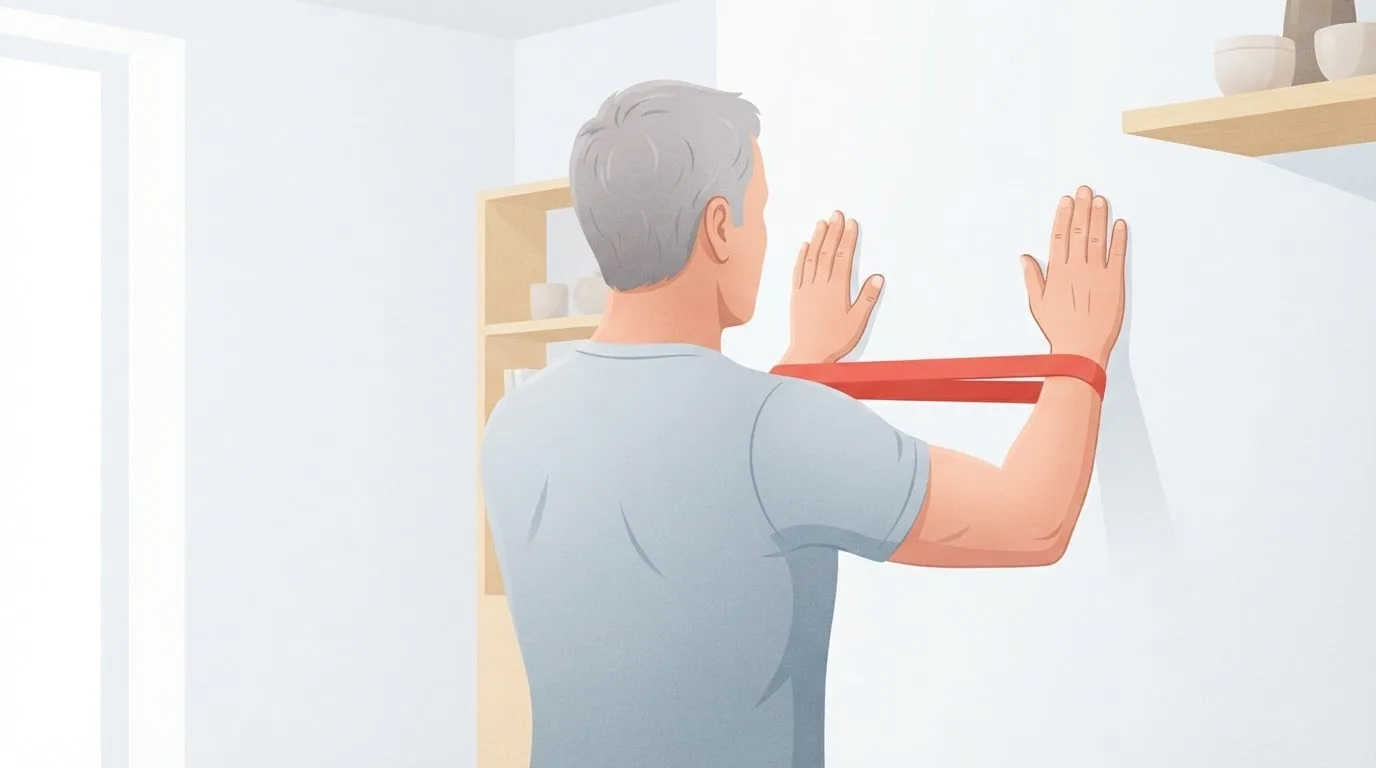
Stand facing a wall with your forearms on it, elbows at shoulder height and shoulder-width apart. Lean gently into the wall and slide your forearms up as high as you can without shrugging, then slide them back down. A light band around your wrists, held apart, makes your shoulders work harder. That's a coaching cue rather than a tested variation.
The wall slide covers the range push-ups can't reach. Hardwick and colleagues (2006), in the Journal of Orthopaedic and Sports Physical Therapy, tested 20 healthy adults. With the arm at shoulder height, the wall slide, a wall push-up plus and an arm raise produced the same serratus activity. Above shoulder height, serratus activity kept rising in the wall slide and the arm raise as the arms went higher, up to 140 degrees. Our guide on how to fix rounded shoulders uses the same exercise for posture.
4. Band dynamic hug
Wrap a band around your upper back at armpit height and hold one end in each hand, arms out wide at about shoulder height with a slight bend in the elbows, as if you were holding a large ball. Bring your hands together in front of your chest in a wide arc. At the end, reach forward a few more inches so your shoulder blades wrap around your ribs. Return slowly.
Decker and colleagues (1999), in the American Journal of Sports Medicine, designed this exercise and tested it against seven others in 20 healthy adults. The serratus punch, scaption, the dynamic hug and both push-up pluses kept the serratus above 20 percent of a maximal contraction. The push-up plus and the dynamic hug produced the most. The authors credit the exercises that push the shoulder blade forward while it stays rotated upward.
5. Band punch with a reach
Loop the same band behind your back and hold one end in your right hand at chest height. Punch straight forward, and when your elbow is straight, reach your fist a few inches further without twisting your torso. Pause, let the shoulder blade return, then bend the elbow. Do all your reps, then switch sides.
The reach is what makes it a serratus exercise. In Decker's study the serratus punch consistently cleared 20 percent of a maximal contraction, and a plain forward punch did not. If you don't own a band, the next exercise does the same job with a dumbbell.
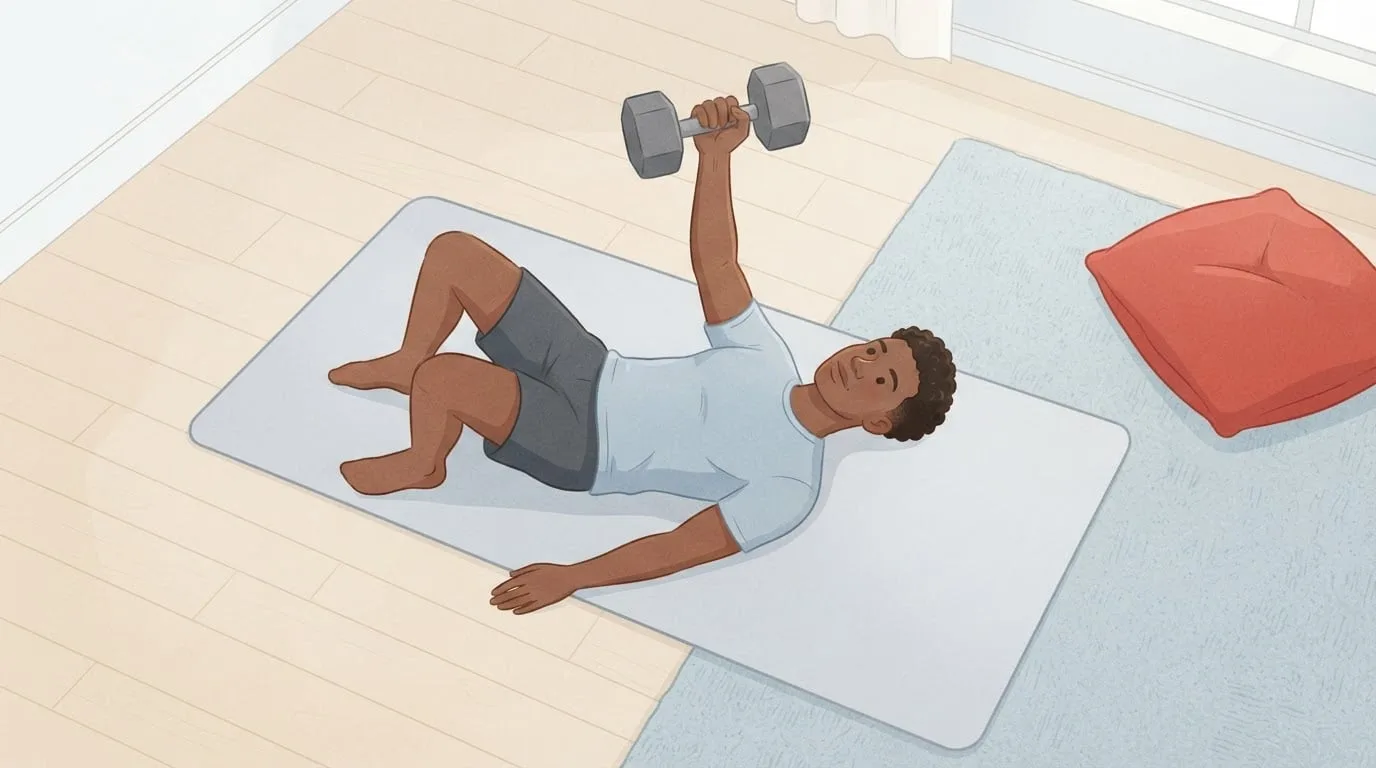
6. Supine dumbbell punch
Lie on your back with your knees bent and hold a light dumbbell straight up over your shoulder, elbow locked. Reach it toward the ceiling so your shoulder blade lifts off the floor, hold a second, then let the blade sink back. The dumbbell travels only two or three inches, and your elbow never bends.
Lying down keeps the upper trapezius out of the job. Riek and colleagues (2023) compared four exercises in 10 people with paraplegia. The supine serratus punch produced the highest serratus activity and the lowest upper trapezius ratio, with the dynamic hug second on that ratio. It's a small study in a specific group, but it points the same way as the push-up plus data.
7. Dumbbell scaption raise
Stand holding two light dumbbells with your thumbs pointing up. Raise your arms at about 30 degrees in front of your sides, the plane your shoulder blades sit in, and keep going past head height to overhead. Lower over about three seconds. Two to five pounds is enough to start.
Ekstrom, Donatelli and Soderberg (2003) recorded 30 healthy adults through 10 exercises. The serratus anterior was most active in the ones that needed a lot of upward rotation: this arm raise above 120 degrees and a diagonal reach up and across the body. So most of the serratus work in a scaption raise comes in the top third. Don't stop at shoulder height. If overhead pinches, stop just below the painful point and use the wall slide for the top range.
8. Dumbbell pullover
Lie on the floor with your knees bent, holding one dumbbell in both hands over your chest with soft elbows. Lower it in an arc behind your head until your upper arms come close to the floor, then pull it back over your chest. Our dumbbell pullover page covers the grip.
The pullover appears on most serratus lists, and it's the weakest pick on this one. The electromyography studies of the pullover measured the chest and the lats, not the serratus, so no data ranks it. It earns a place because it takes your shoulder blades into full overhead rotation under load while it trains your lats and chest. Do it last, after the protraction moves.
What Does the Serratus Anterior Muscle Do?
The serratus anterior is a flat, fan-shaped muscle that starts on the outer surface of your upper eight or nine ribs and attaches along the inner edge of your shoulder blade, the edge nearest your spine. Its name comes from the Latin for saw, after the saw-tooth slips that show along the ribs of a lean person. The long thoracic nerve supplies it, according to Martin and Fish's 2008 anatomical review.
The serratus anterior function comes down to three actions:
- Protraction. It pulls the shoulder blade forward around the ribcage. That's the last few inches of a punch, which is why the serratus is nicknamed the boxer's muscle.
- Upward rotation. It turns the shoulder blade so the socket faces up as your arm rises. The serratus and the trapezius are considered the only upward rotators of the shoulder blade, so you can't reach fully overhead without it.
- Holding the blade flat. It keeps the inner edge and the lower tip of the shoulder blade pressed against the ribs while the arm moves. When it can't, the inner edge lifts away. That's medial winging.
Put simply, the serratus anterior keeps your shoulder blade moving with your arm and stuck to your ribcage while it does. Serratus anterior exercises follow from that. They push the shoulder blade forward, take the arm high overhead, or both.
Find out what's really holding you back
FitCraft, our mobile fitness app, pairs you with an AI coach who builds you a personalized plan around your goals, schedule, and fitness level. Every FitCraft program is designed by Domenic Angelino, MPH (Brown University) and NSCA-CSCS, with research published in the Journal of Strength and Conditioning Research and Medicine & Science in Sports & Exercise.
Take the Free Assessment Free • 2 minutes • No credit cardHow to Tell if Your Serratus Anterior Is Weak
Two home checks give you a reasonable read. Neither one is a diagnosis. You'll need someone to watch your back, or a phone propped up to film it.
- The wall push check. Stand an arm's length from a wall with your hands on it at shoulder height and do 10 slow wall push-ups. Watch for the inner edge of a shoulder blade lifting away from the ribs. That medial winging is the classic sign of a weak serratus anterior.
- The weighted raise check. Hold a 3 or 5 pound dumbbell, or a full water bottle, in each hand. Raise both arms forward to overhead 5 times, then out to the sides 5 times, slowly. Look for winging, or a blade that hitches, jerks or moves out of step with the other one, mostly on the way down.
The second check is the scapular dyskinesis test. McClure and colleagues (2009) filmed 142 college athletes doing it with 3 or 5 pound weights, and trained raters agreed on what they saw 75 to 82 percent of the time.
Keep the result in perspective. In the companion study, Tate and colleagues (2009) measured 66 of those athletes in 3D. Shoulders judged to have obvious dyskinesis really did rotate upward less. They were no more likely to hurt than normal shoulders, though. A shoulder blade that moves a little differently is common and often harmless. Serratus exercises are a reasonable response either way, and pain, sudden winging or trouble lifting the arm are reasons to see a clinician.
Winged Scapula: Which Weak Muscle Causes It, and Can Exercise Fix It?
A winged scapula is a shoulder blade whose edge lifts away from the ribcage instead of lying flat. There are two main kinds, and they point to different muscles:
- Medial winging. The inner edge lifts toward the spine. This is serratus anterior weakness, most often from an injury to the long thoracic nerve.
- Lateral winging. The outer edge drifts out and the shoulder drops. This usually comes from trapezius weakness after a spinal accessory nerve injury, and less often from the rhomboids.
Whether exercise fixes winging depends on the cause. When the nerve is healthy and the muscle is just weak or poorly coordinated, strengthening is the treatment, and the exercises above are the tools. Choi and colleagues (2017) showed that the floor push-up plus still recruits the serratus more than the wall version in 15 men with winging. That measured activation in one session, not a cure.
Nerve injury is different. Martin and Fish report that most serratus palsies resolve on their own within 24 months, so 6 to 24 months of conservative care is common, and surgery is considered only if the nerve doesn't recover. Exercise keeps the shoulder strong and mobile through that time, under a clinician's guidance. Didesch and Tang (2019) add a third cause that's easy to miss: a traumatic tear of these muscles off the shoulder blade. Winging that follows a fall, a sudden heavy pull or a blow needs an exam before any home program.
Serratus Anterior and Shoulder Impingement
A quiet serratus shows up again and again in painful shoulders. Ludewig and Cook (2000), in Physical Therapy, studied 52 construction workers who worked overhead. Those with impingement symptoms showed lower serratus activity at every load and every phase of raising the arm. Their shoulder blades also rotated upward less and tipped forward more. A 2009 review by Ludewig and Reynolds found the same pattern, reduced serratus and increased upper trapezius activity, across several shoulder conditions. These studies show an association, so they can't tell you whether the weak serratus came first.
The treatment evidence is modest but real. Saito and colleagues (2018) pooled 6 randomized trials in adults with subacromial pain. Programs focused on the shoulder blade improved pain during activity and shoulder function in the short term, though the groups were level again at a 4-week follow-up. Serratus work is one useful part of a shoulder program, not the whole fix. Our guide to rotator cuff exercises covers what the impingement trials prescribed for the cuff itself.
How to Train the Serratus Anterior: Sets, Reps and a Weekly Plan
The EMG studies rank exercises, and none of them sets a dose. So train the serratus like any small stabilizing muscle. Do 2 to 3 sets of 8 to 15 controlled reps, 2 to 3 times a week, either at the end of an upper-body session or as a 10-minute routine on its own. The last few reps of each set should feel hard while the movement stays clean.
Serratus anterior exercises at home with no equipment
| Order | Exercise | Sets x reps | Rest |
|---|---|---|---|
| 1 | Scapular push-up (counter or floor) | 2 x 12-15 | 45 sec |
| 2 | Push-up plus (the hardest version you can do for 8 clean reps) | 3 x 8-12 | 60 sec |
| 3 | Wall slide | 2 x 10-12 | 45 sec |
| 4 | Hand plank, pushing the floor away the whole time | 2 x 20-30 sec | 45 sec |
Serratus anterior exercises with dumbbells and a band
| Order | Exercise | Sets x reps | Rest |
|---|---|---|---|
| 1 | Supine dumbbell punch | 2 x 12-15 per side | 30 sec |
| 2 | Band dynamic hug | 2 x 12-15 | 45 sec |
| 3 | Push-up plus | 2 x 8-12 | 60 sec |
| 4 | Dumbbell scaption raise | 2 x 10-12 | 45 sec |
| 5 | Dumbbell pullover | 2 x 10-12 | 60 sec |
To progress, add reps until you reach the top of the range on every set, then make one thing harder. For the plus, that means moving from counter to knees to floor to feet on a step. For the punch and the scaption raise, use a heavier dumbbell or a slower lowering. Change one thing at a time.
Balance the pushing with pulling. The serratus moves the shoulder blade forward and up, while the middle and lower trapezius pull it back and down, and a healthy shoulder needs both. The research on upper cross syndrome found that the programs that worked strengthened all of them together. If your arms won't reach fully overhead even when you lie on the floor, the limit is probably mobility rather than strength, and our shoulder mobility exercises start with a test that tells you which.
FitCraft's strength workouts use dumbbells and bodyweight, plus a handful of resistance-band exercises, and an AI coach demonstrates each move on an interactive 3D model you can rotate and zoom. Workouts adjust as you progress, and streaks, calendar tracking and leaderboards help you keep showing up for the small sessions that are easy to skip. To see how it works without equipment, visit our page on the bodyweight workout app for home.
The Bottom Line
Serratus anterior exercises do two things: push the shoulder blade forward around the ribs, or rotate it up as the arm goes overhead. The push-up plus has the strongest evidence, the wall slide and scaption raise cover the overhead range, and the supine punch and dynamic hug load the serratus without letting your upper traps take over. Two or three sets, two or three times a week, is enough to start.
Your shoulders aren't broken. A muscle that never got its own exercise just needs one, done often enough for the change to add up.
Frequently Asked Questions
What are the best serratus anterior exercises?
The push-up plus, scapular push-ups, wall slides, the band dynamic hug and the supine dumbbell punch have the best evidence. Each one pushes the shoulder blade forward around the ribs or rotates it upward for overhead reaching, the two jobs of the serratus anterior. In a study of 30 adults, the standard push-up plus produced the highest serratus activity of the push-up versions tested.
How to tell if serratus anterior is weak?
Film your back while you do 10 slow wall push-ups, then 5 slow arm raises overhead holding a 3 to 5 pound weight. A weak serratus anterior shows up as the inner edge of a shoulder blade lifting off the ribs, or a blade that hitches or moves out of step with the other one, mostly on the way down. It's a screen, not a diagnosis, so see a clinician if the shoulder hurts or the winging came on suddenly.
Can you fix winged scapula with exercise?
It depends on the cause. Mild winging from poor muscle control usually improves with serratus and trapezius strengthening. Winging from a long thoracic nerve injury usually recovers on its own within 24 months, and exercise keeps the shoulder strong while a clinician manages that recovery.
What weak muscle causes winged scapula?
Most often the serratus anterior, which causes medial winging, where the inner edge of the shoulder blade lifts toward the spine. Weakness of the trapezius, and less often the rhomboids, causes lateral winging instead. The usual cause is an injured nerve: the long thoracic nerve for the serratus and the spinal accessory nerve for the trapezius.
What is the number one exercise for shoulder impingement?
No single exercise wins. The trials that helped people with impingement used whole programs of rotator cuff and shoulder blade exercises. A 2018 meta-analysis of 6 trials found that scapular exercises improved pain and function in the short term, so a serratus move like the push-up plus belongs in the program, alongside cuff work.
What is the best sleeping position for a winged scapula?
No study has tested sleeping positions for winged scapula. Sleeping on your back, or on the other side with a pillow supporting the affected arm, keeps your body weight off that shoulder blade and is a sensible choice. Ask the clinician treating the winging if a position causes pain or tingling.
Do you need a serratus anterior stretch?
Rarely. The serratus anterior is far more often weak or underused than tight, so strengthening is the usual priority. If you want to stretch it, sit or stand tall, take one hand behind your back and gently draw that shoulder blade back toward your spine for 20 to 30 seconds.