Hold a light dumbbell in each hand, arms hanging at your sides or in front of your thighs. Raise one dumbbell up and across your body, letting the elbow bend, until it is at about shoulder height in front of your chest, toward your opposite shoulder. Lower it slowly. Switch arms. That's the pec raise.
The most common mistake is grabbing heavier dumbbells and heaving them up. The up-and-across path is what makes this a pec raise rather than a front raise, and the movement should stay slow, upright, and strict. Add momentum and the dumbbell swings up instead of being lifted from your shoulder.
This guide covers the setup, the five-step technique, the most common mistakes, how to scale the movement down to a simple front raise or up to slower reps and pec squeeze crossovers, and how to program it inside a real training week.
Quick Facts: Pec Raises
- Equipment needed: Dumbbells (a light pair), or empty hands
- Difficulty: Intermediate (as rated in the FitCraft app); the front raise is easier and pec squeeze crossovers are harder
- Modality: Strength
- Body region: Upper body (front of the shoulders, with the upper chest helping)
Muscles Worked
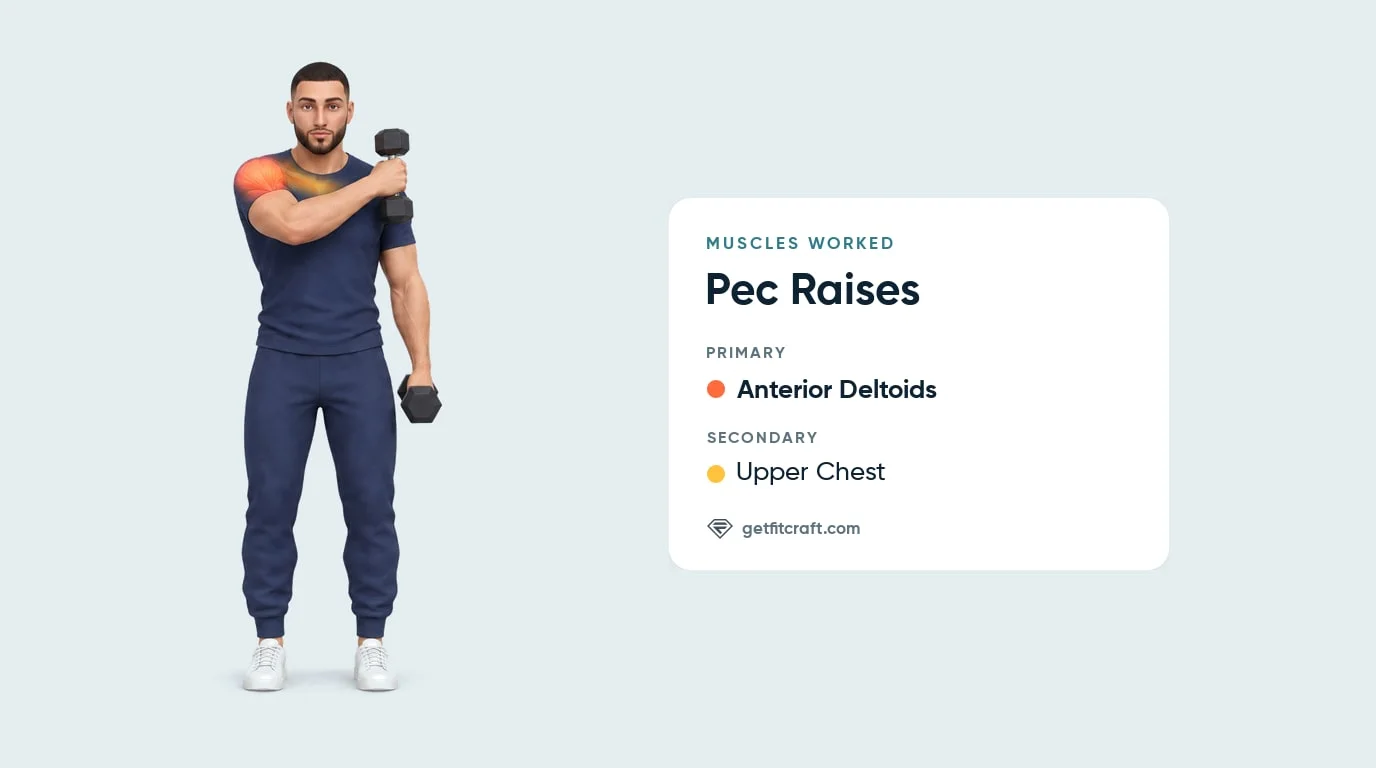
Primary mover: the anterior deltoids, at the front of your shoulders. They lift your arm forward and up, raising the dumbbell from your thigh to about shoulder height, then control it as you lower it back down.
Secondary mover: the upper chest (the upper fibers of the pectoralis major, which run from your collarbone to your upper arm). It helps the front of your shoulder lift the arm and bring it across your body toward your opposite shoulder.
Why the path across your body matters: a front raise lifts the dumbbell straight ahead. In a pec raise your arm also travels across your body, which is the job your upper chest helps with, and your elbow bends as the arm rises, which keeps the dumbbell closer to your shoulder. That shorter lever is why pec raises are the easier of the two cross-body raises in the FitCraft app: pec squeeze crossovers keep the arm longer.
Step-by-Step: How to Perform Pec Raises
Read the setup steps even if you have done front raises for years. The brace and lifting from the shoulder are what keep the cross-body path strict.
Step 1: Set Your Stance and Grip
Stand tall with your feet about hip-width apart and your knees soft, holding a light dumbbell in each hand with your arms hanging at your sides or just in front of your thighs, palms facing in. Set your shoulders down and back and keep your head level, eyes forward.
Start with a light dumbbell you can lift without any swing.
Step 2: Brace Before the First Rep
Brace your core and stand tall so your torso stays upright through every rep and you never lean back to start the lift. Set your shoulder blades down and back so the raise starts from a stable, un-shrugged position.
Brace before the first rep, and keep breathing; do not hold your breath.
Step 3: Raise One Dumbbell Across Your Body
Raise one dumbbell up and across your body, letting the elbow bend as the arm rises, until the dumbbell is at about shoulder height in front of your chest, toward your opposite shoulder, with your thumb on top. Take about a second on the way up, breathe out as you lift, and pause briefly at the top. Lift your whole arm from the shoulder; the elbow can finish anywhere from a soft bend to about a right angle. You should feel the front of your shoulder doing most of the lifting, with your upper chest helping bring the arm across.
Let your arm cross toward your opposite shoulder as it rises; lifting straight ahead turns it into a front raise.
Step 4: Lower With Control
Lower the dumbbell along the same path back to your thigh over one to two seconds, breathing in. No dropping, no bouncing into the next rep. Rushing the way down is how sets quietly turn into swings.
Lift from your shoulder, not with momentum. If the dumbbell starts swinging, end the set.
Step 5: Alternate Sides and Keep Your Torso Upright
Raise the other dumbbell along its own path toward your opposite shoulder. Keep your hips facing forward and your torso upright; a slight turn of the shoulders that follows the arm is fine. Alternate arms at a steady rhythm for the full set, with no lean-back, no twist, and no shrug creeping in as fatigue builds. Keep your head level and your eyes forward instead of dropping your head to watch the dumbbell.
Stop at about shoulder height. There is no need to go higher, and stop sooner if your shoulder feels tight.
Get this exercise in a personalized workout
FitCraft, our mobile fitness app, uses an AI coach to program isolation exercises like this into your plan at the right volume and intensity, based on your level, goals, and equipment. Every FitCraft program is designed by Domenic Angelino, MPH (Brown University) and NSCA-CSCS, with research published in the Journal of Strength and Conditioning Research and Medicine & Science in Sports & Exercise.
Take the Free Assessment Free · 2 minutes · No credit card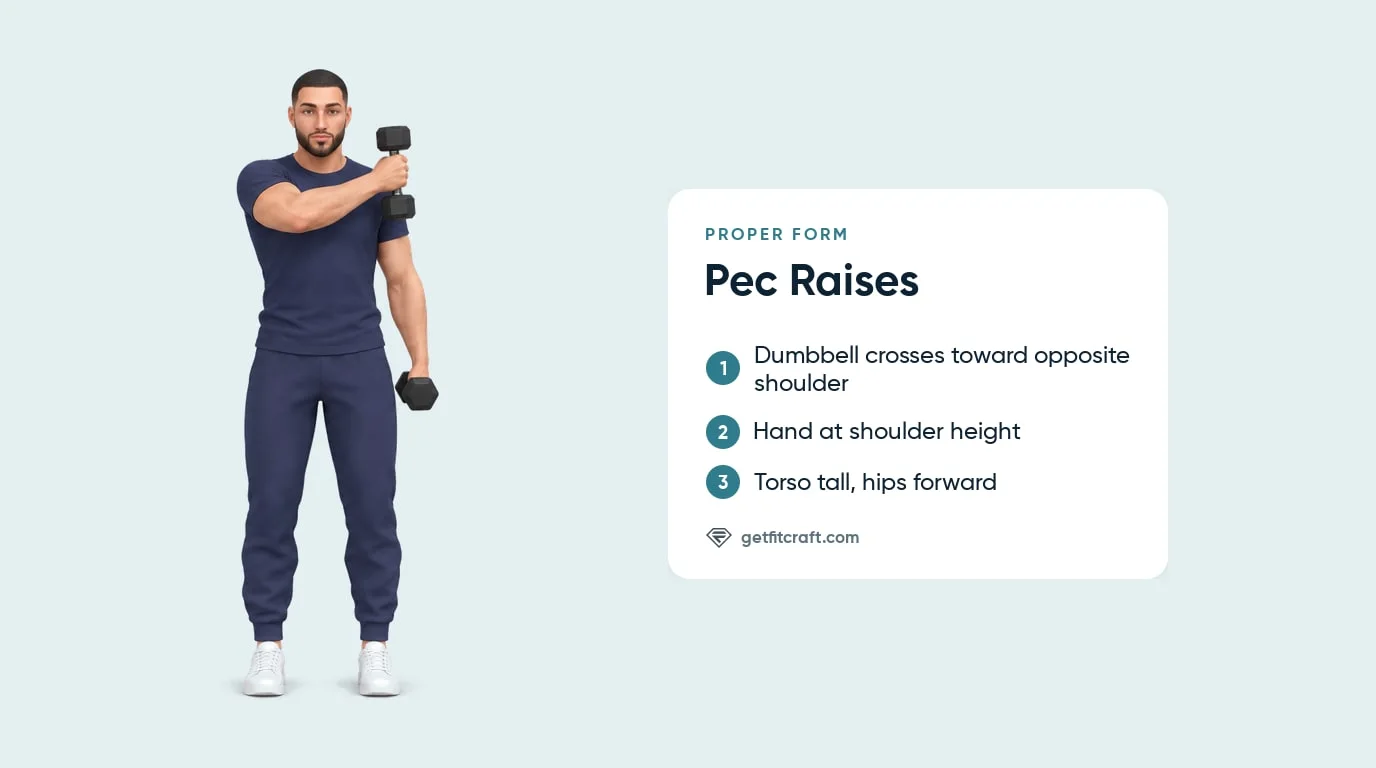
Common Mistakes (and How to Fix Them)
These are the most common pec raise mistakes and how to fix them.
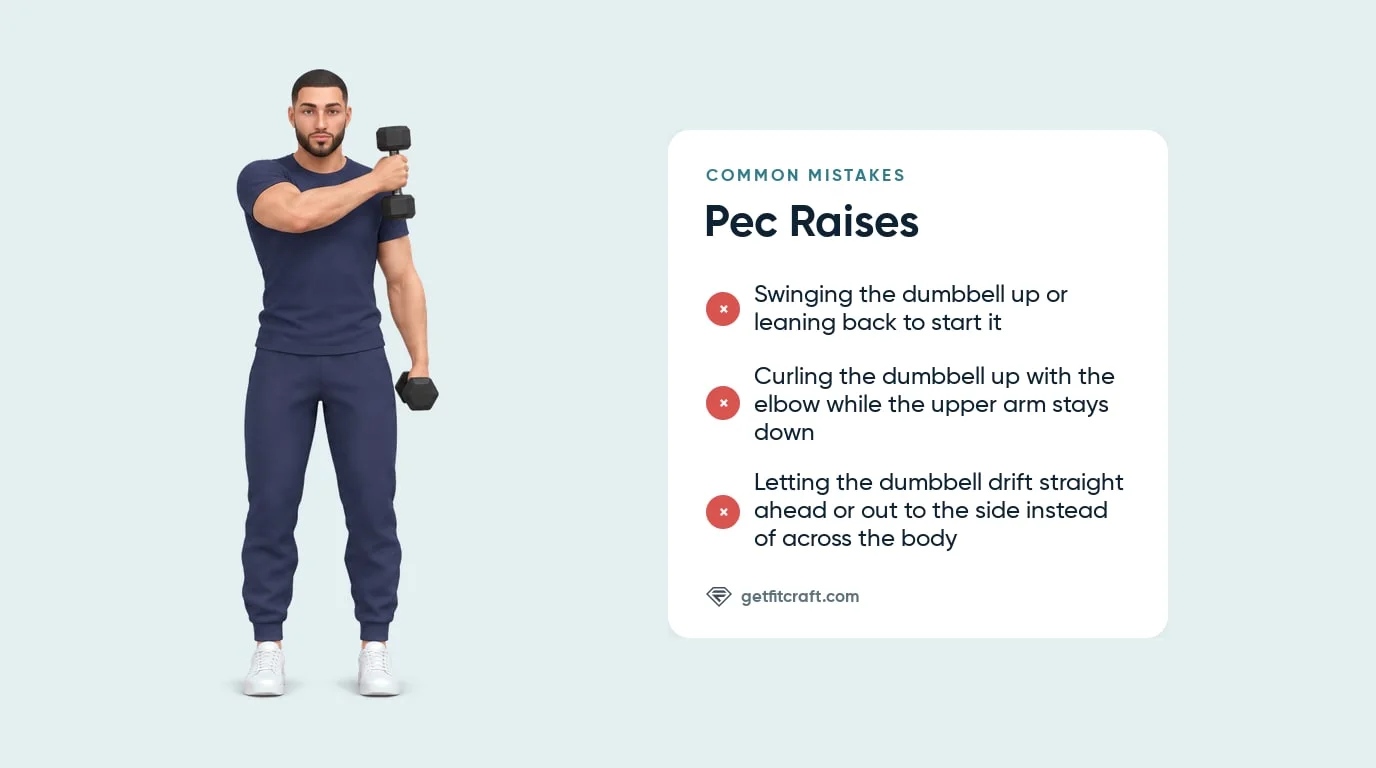
- Swinging the dumbbell up. The hips rock back and the dumbbell rides the momentum to shoulder height instead of being lifted from your shoulder. A dumbbell that is too heavy is the usual cause. Fix: use a lighter dumbbell, brace your core, and start every rep from a still arm.
- Letting the dumbbell drift straight ahead or out to the side. Without the path across your body, it stops being a pec raise. Fix: aim the dumbbell at your opposite shoulder and finish in front of your chest, thumb on top.
- Shrugging as the arm rises. The working shoulder climbs toward your ear. Fix: set your shoulder blades down and back before rep one, and think "long neck" as the dumbbell rises.
- Turning it into a curl. The elbow bends and the dumbbell comes up while the upper arm stays down by your side, so the shoulder barely lifts. Fix: lift your elbow and upper arm up and across along with the dumbbell. The elbow can finish anywhere from a soft bend to about a right angle, as long as the upper arm rises from the shoulder.
- Twisting the torso with the arm. The cross-body path invites your torso to follow the dumbbell, turning the raise into a twist. A slight turn of the shoulders that follows the arm is fine; a twist or lean used to swing the weight up is not. Fix: brace your core before each rep and keep your hips facing forward.
- Dropping your head to watch the dumbbell. Fix: keep your head level and your eyes forward through the whole rep.
- Letting the dumbbell drop. The dumbbell falls back to your thigh instead of being lowered. Fix: lower it along the same path over one to two seconds, every rep.
Pec Raise Variations: Regressions and Progressions
Start where you are and progress when your form is solid at the current level.
Front Raise (Beginner Regression)
The straight-ahead version: raise your arms directly in front of you to about shoulder height, with no crossover. Done with no weights, which the FitCraft app rates Beginner, it teaches the slow lift, the no-swing rule, and the height with one less thing to coordinate. Learn this first if the cross-body path feels awkward.
Pec Raises (Standard)
The full movement described above: alternating arms, each dumbbell raised up and across toward the opposite shoulder with the elbow bending as it rises, stopping at about shoulder height, and lowered over one to two seconds. The FitCraft app rates it Intermediate. With no dumbbells, the same move works with empty hands.
Slower Pec Raises (Harder)
The same movement with more time under control: take two to three seconds to lower the dumbbell and pause for a second at the top. If that is still easy, use a slightly heavier dumbbell, only while you can lift it without swinging or leaning.
Pec-Squeeze Crossovers (Advanced Progression)
The long-arm version of the same one-arm cross-body raise: the arm stays longer, with a soft bend in the elbow (it may bend up to about 45 degrees as it crosses), as it sweeps up and across, palm down, to about shoulder height in front of the opposite shoulder. The longer arm makes it harder, and the FitCraft app rates it Advanced.
When to Avoid or Modify Pec Raises
Pec raises are safe for most healthy adults with a light dumbbell, but the conditions below call for a doctor's or physical therapist's advice first. A burn in the front of your shoulder or your upper chest is normal; any pain in a joint, your lower back or your neck means stop the exercise. Always consult your physician or physical therapist for personalized guidance.
- Shoulder impingement or pinching at the top of the raise. Any pain or pinching in your shoulder as the dumbbell rises means stop. Get checked by a doctor or physical therapist before you do pec raises or other raises again.
- Rotator cuff tendinopathy or bursitis. Ask your doctor or physical therapist before you do this exercise, and follow their advice. Any pain in your shoulder means stop.
- Recent shoulder surgery. Do not do this exercise until your surgeon, doctor or physical therapist clears you for it.
- Biceps tendinopathy. The biceps tendon runs through the front of the shoulder, where this exercise works. Ask your doctor or physical therapist before you do pec raises, and stop at any pain in the front of your shoulder or your elbow.
- Neck pain. Any pain in your neck during or after pec raises means stop. Get checked by a doctor or physical therapist before you do this exercise again.
Related Exercises
If pec raises are part of your routine, these movements complement or extend the same training pattern:
- Same muscles, different raise path: Front Raises lift straight ahead and work the same muscles, mainly the front of the shoulder with the upper chest helping. Lateral Raises shift the emphasis to the side deltoid for width.
- Same raise, harder: Pec Squeeze Crossovers follow the same up-and-across path with a longer arm.
- Compound base for the chest: Chest Press and Push-Ups load the chest, front delts, and triceps together, and they should anchor any session that pec raises finish. Chest Fly, a two-arm fly lying on the floor, makes the chest the main mover.
- Upper back and back of the shoulders: W-Raises, Y-Raises, and T-Raises work the upper back and the back of the shoulders, which balances all this front-of-shoulder work.
- Antagonist balance: Pull-Aparts and Bent-Over Rows strengthen the rear delts and mid-back so all this front-of-shoulder volume stays balanced.
How to Program Pec Raises
Pec raises follow standard accessory-exercise programming. The American College of Sports Medicine (ACSM) Position Stand on resistance training gives a general framework for matching sets, reps, rest, and weekly frequency to your training level, but no ranges for pec raises specifically (Ratamess et al., 2009), so the table below is a practical starting point. Because the weight stays light, progress here comes from reps, a slower lowering, a pause at the top, and strictness far more than from dumbbell size.
| Version | Sets × Reps (per arm) | Rest between sets | Frequency |
|---|---|---|---|
| Easier (front raise with no weights, or empty hands) | 2-3 × 10-15 | 45-60 seconds | 2-3 sessions/week |
| Intermediate (the app's version, a light dumbbell) | 3-4 × 8-15 | 60-90 seconds | 2-4 sessions/week |
| Harder (slower lowering, a pause at the top) | 3-4 × 6-15 | 60-120 seconds | 2-4 sessions/week |
Where in your workout: late in an upper-body or push session, after your compound pressing is done. Doing isolation work first would tire the front of your shoulders and your upper chest before the presses that follow. Pec raises pair well as a superset partner with a pulling accessory like pull-aparts, which keeps the shoulder workload balanced front to back.
Form floor over rep targets: the set ends when the strictness ends. The first swinging rep, lean-back, creeping shrug, or rep where the elbow curls the weight up while the upper arm stays down is your true endpoint, whatever the target number said. Any pain in your shoulder means stop, not finish the set.
How FitCraft Programs This Exercise
Knowing how to do pec raises is step one. Knowing when to do them, how many reps, and when to progress is where most people get stuck.
FitCraft starts with a free assessment that maps your fitness level, goals, and available equipment, then builds a personalized plan. The app has pec raises as one exercise, one dumbbell at a time, rated Intermediate, and can include it in your plan; its 3D demonstration shows the up-and-across path.
The app also has the front raise, the easier straight-ahead version, and pec squeeze crossovers, the harder long-arm version, rated Advanced.
Frequently Asked Questions
What muscles do pec raises work?
Pec raises mainly work the anterior deltoids, the front of your shoulders, which lift your arm forward and up. The upper chest is the secondary mover: it helps lift the arm and bring it across your body as the dumbbell travels toward your opposite shoulder. You should feel the front of your shoulder doing most of the lifting, not your lower back or your neck.
What is the difference between a pec raise and a front raise?
The path of the dumbbell. In a front raise the dumbbell travels straight ahead to about shoulder height. In a pec raise it travels up and across your body and finishes in front of your chest, toward your opposite shoulder, with your thumb on top, and your elbow bends as your arm rises. Both mainly work the front of your shoulders, with your upper chest helping; in the pec raise, the upper chest also helps bring your arm across your body. The front raise is the simpler pattern and the easier place to start.
How heavy should pec raises be?
Light. Pick a dumbbell you can lift up and across your body to shoulder height without swinging or leaning back. If you need to lean back or heave to get the dumbbell moving, or your elbow curls the weight up while your upper arm stays down, the weight is too heavy for this exercise. Make the set harder by lowering more slowly and pausing at the top before you add weight, and go heavier only while every rep stays swing-free.
Are pec raises good for building your chest?
They help a little, but pec raises are mainly a shoulder exercise. The front of your shoulders does most of the lifting, and your upper chest helps bring your arm across your body. For building your chest, make compound pushes like push-ups and dumbbell chest presses, where the chest is a main mover, the base of your program. Use pec raises late in an upper-body session as light extra work for the front of your shoulders and your upper chest.
Can I do pec raises with shoulder pain?
No. Any pain or pinching in your shoulder joint means stop the exercise. A burn in the front of your shoulder or your upper chest is normal; pain is not. Get your shoulder checked by a doctor or physical therapist before you do pec raises or other raises again.