The squat to front raise trains your legs and the front of your shoulders in one rep, and the hard part is timing the raise with the squat.
In the FitCraft app's version, the dumbbells rise as you sit into the squat, reach shoulder height at the bottom, and come back down with control as you stand. If you rush it, the dumbbells swing up or drop; if you keep it smooth, both halves finish together.
This guide covers the setup, the five-step technique, the six mistakes that break the movement, how to scale it down to its component parts or up to paused and slower versions, and where it belongs in a training week.
Quick Facts: Squat to Front Raise
- Equipment needed: A pair of light dumbbells (the front of your shoulders limits the load)
- Difficulty: Advanced in the FitCraft app (practicing the squat and the front raise separately makes it easier)
- Modality: Strength
- Body region: Full body (legs and shoulders)
Muscles Worked
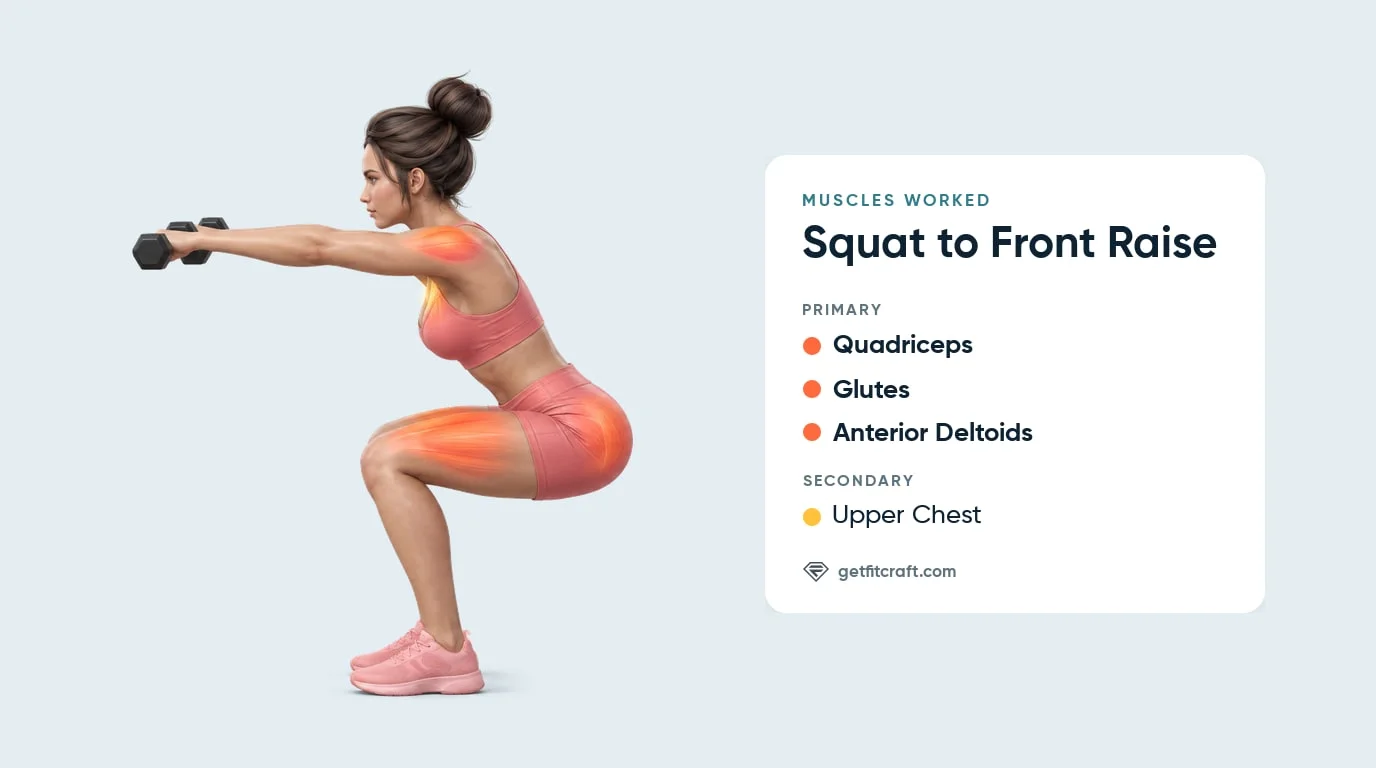
Primary movers: the quadriceps and glutes control the squat on the way down, then extend the knees and hips to drive you back up against the combined weight of your body and the dumbbells. The anterior deltoids, at the front of your shoulders, lift the dumbbells from your thighs to shoulder height on nearly straight arms as you squat down, then control them back to your thighs as you stand.
Secondary mover: the upper chest helps the front of your shoulders lift your arms forward.
Why the load stays light: your legs barely notice the dumbbells, but your shoulders hold them at the end of straight arms, which makes them much heavier there. So pick the weight for the raise. Because the legs and shoulders work at once, your heart rate rises quickly.
Step-by-Step: How to Perform the Squat to Front Raise
Learn the timing at half effort first, with light dumbbells or empty hands. The rep should feel like one motion: the dumbbells rise as you sit down and reach shoulder height at the bottom of the squat.
Step 1: Set Your Stance and Grip
Stand tall with your feet about shoulder-width apart, toes pointing forward or turned slightly out, holding a dumbbell in each hand in front of your thighs or at your sides with your palms facing your body. Keep a slight bend in your elbows. Lift your chest, look ahead and keep your weight across your whole foot.
Pick dumbbells you can raise to shoulder height without swinging; your shoulders, not your legs, set the limit here.
Step 2: Brace Your Core
Tighten your core before every rep, like you're about to take a light jab to the stomach. The brace holds your lower back neutral through the squat and stops your torso from swaying backward when the dumbbells rise out front.
Brace before you bend, and keep breathing; do not hold your breath.
Step 3: Squat Down and Raise the Dumbbells
Push your hips back and bend your knees to lower until your thighs are about parallel to the floor, or as low as you can with your heels down and your back flat; a higher squat is fine. As you go down, raise both dumbbells straight out in front of you, palms down, with a slight bend in your elbows, so your arms are level with the floor, at about shoulder height, when you reach the bottom. Keep your chest up, your back flat and your knees in line with your toes.
Lift with your shoulders, not with a swing, and keep your heels down.
Step 4: Stand and Lower the Dumbbells
Drive through your whole foot to stand, and as you rise, lower the dumbbells with control back to your thighs, keeping the same slight bend in your elbows and your shoulders down, away from your ears. Do not let the dumbbells drop. Raising the dumbbells as you stand, instead of as you squat down, is also fine; keep one timing through the set.
Step 5: Reset and Repeat
Stand tall with the dumbbells at your thighs and your shoulders down. Re-brace, then sink into the next squat as the dumbbells rise again. Aim for about a second on the way down and a short pause at the bottom, with no bouncing. Breathe in as you squat down and out as you stand, or just breathe steadily; never hold your breath. Keep the same steady rhythm and timing every rep.
Get this exercise in a personalized workout
FitCraft, our mobile fitness app, uses an AI coach to program compound strength exercises like this into your plan at the right volume and intensity, based on your level, goals, and equipment. Every FitCraft program is designed by Domenic Angelino, MPH (Brown University) and NSCA-CSCS, with research published in the Journal of Strength and Conditioning Research and Medicine & Science in Sports & Exercise.
Take the Free Assessment Free · 2 minutes · No credit card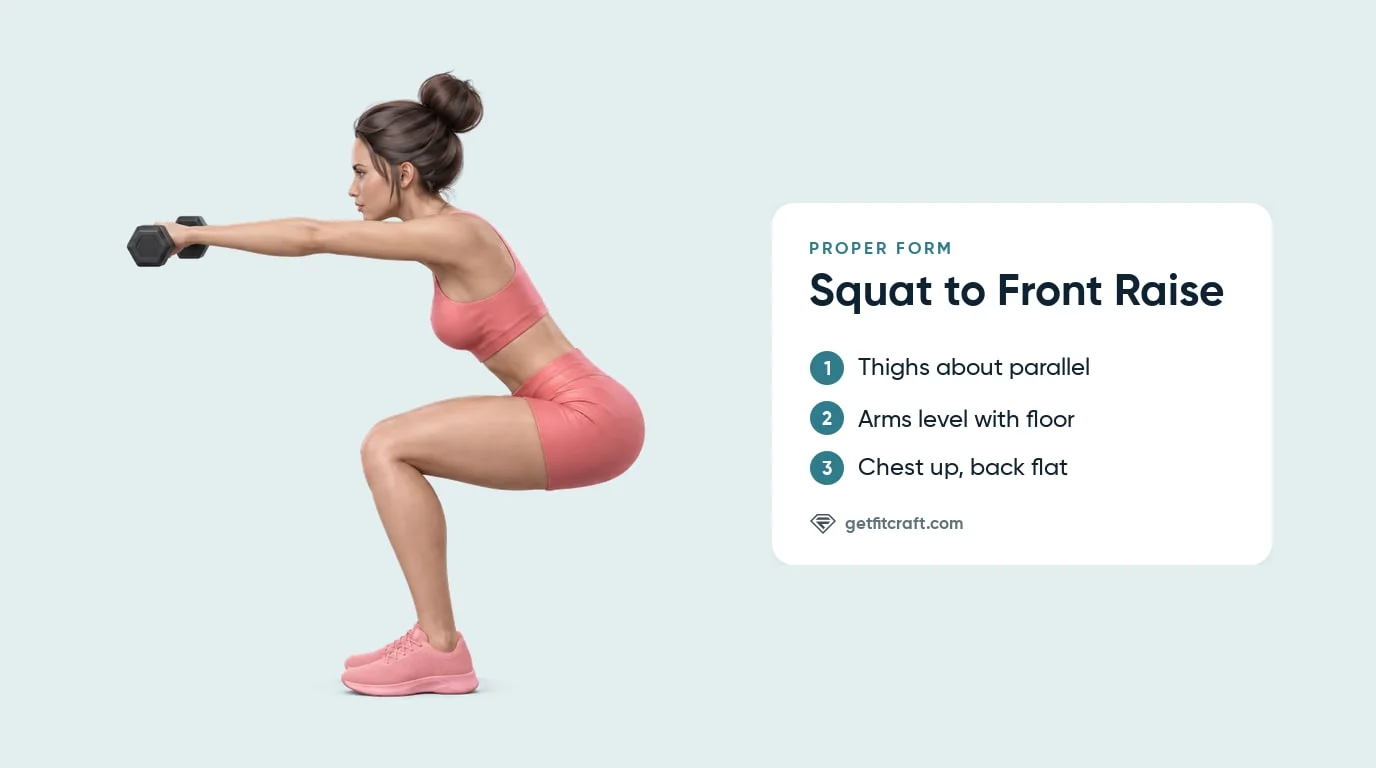
Common Mistakes (and How to Fix Them)
Here are the most common mistakes on the squat to front raise.
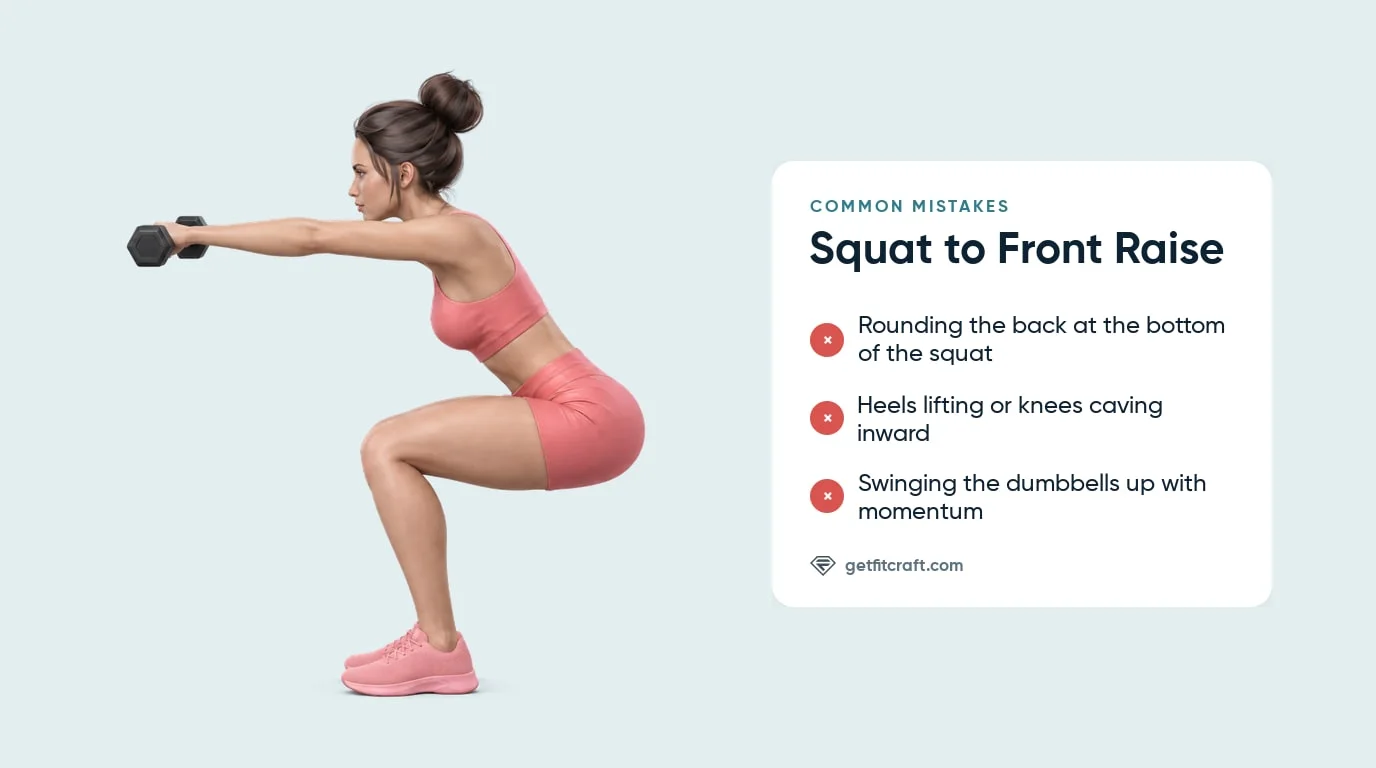
- Swinging the dumbbells up with momentum. The arms fling the dumbbells up instead of lifting them, or, if you raise them as you stand, the dumbbells ride the bounce out of the bottom, so the front of your shoulders does little of the work. Fix: lift smoothly with your shoulders, as strictly as you would in a front raise on its own. If the dumbbells sail past shoulder height, that rep was a swing.
- Bending the elbows so far that the hands drift toward your face. The arms fold and the dumbbells end up near your chin instead of out in front. Fix: keep the same slight elbow bend from start to finish and raise the dumbbells until your arms are level with the floor, at about shoulder height; just above is fine, and there is no need to go higher.
- Rounding the lower back in the squat. The chest drops as the hips sink and the spine flexes under load. Fix: brace before each descent, keep the chest lifted, and shorten the squat to the depth where your back holds its shape.
- Heels lifting or knees caving inward. The heels come up at the bottom, or the knees collapse toward each other during the stand, usually as fatigue builds. Fix: push your hips back, keep your weight over your whole foot, track the knees in line with the toes, squat only as low as your heels stay down, and end the set when the tracking goes.
- Letting the dumbbells drop as you stand. The arms give up on the way back and the dumbbells fall to your thighs. Fix: lower them with control as you stand. When you can no longer raise and lower them cleanly, end the set.
- Shrugging into the raise. The shoulders climb toward the ears as the dumbbells rise, and you feel it in your neck instead of the front of your shoulders. Fix: set the shoulder blades down before the rep and keep a long neck as the dumbbells travel up.
Squat to Front Raise Variations: Regressions and Progressions
Start where you are and progress when your form is solid at the current level.
Squat and Front Raise, Trained Separately (Easier)
The combination assumes both halves are already clean. If either one wobbles on its own, train them as separate exercises first: plain bodyweight squats for the legs, and the front raise with no weights for the shoulders. Combine them once neither requires your full attention. Lighter dumbbells or empty hands, with a squat only as low as your heels stay down and your back stays flat, also make it easier.
Squat to Front Raise (Advanced, the App's Version)
The full movement described above: squat to about parallel, raising both dumbbells as you go down so your arms are level with the floor at the bottom, then lower them as you stand. This is the version the FitCraft app teaches and rates Advanced.
Squat to Front Raise, Raising as You Stand (Alternative Timing)
Keep the dumbbells at your thighs as you squat down, then raise them to shoulder height as you stand, and lower them before the next squat. Both timings are fine; pick one and keep it through the set.
Paused or Slower Squat to Front Raise (Harder)
Any of these makes it harder: hold the bottom a moment longer with your arms out in front, back flat and heels down; take about three seconds on the way down with the dumbbells rising smoothly the whole time; or use slightly heavier dumbbells, but only while your arms still reach shoulder height without swinging and your back stays flat.
When to Avoid or Modify the Squat to Front Raise
The squat to front raise is safe for most healthy adults at light loads, but the conditions below call for a doctor's or physical therapist's advice first. A burn in your thighs, glutes or shoulders is normal; any pain in a joint, your lower back or your neck means stop the exercise. Always consult your physician or physical therapist for personalized guidance.
- Front-of-knee pain or patellofemoral irritation. Any pain in your knee during the squat means stop. Get checked by a doctor or physical therapist before you do this exercise again.
- Shoulder impingement or pinching during raises. Any pain or pinching in your shoulder as the dumbbells rise means stop. Get checked by a doctor or physical therapist before you do this exercise or other front raises again.
- Acute lower-back pain or known disc pathology. Ask your doctor or physical therapist before you do this exercise, and follow their advice. Any pain in your lower back during the squat or the raise means stop.
- Recent knee, hip, shoulder, or spine surgery. Do not do this exercise until your surgeon, doctor or physical therapist clears you for it.
- Uncontrolled hypertension or known cardiovascular disease. This combination raises heart rate quickly because so much muscle works at once. Get your doctor's clearance first and follow their exercise guidance. Breathe in on the way down and out as you stand, and never hold your breath, which the ACSM advises against during resistance training. Stop if you feel dizzy or light-headed.
- Pregnancy, especially second and third trimester. Ask your doctor or physical therapist before you do this exercise, and follow their advice. Any pain in a joint, your lower back or your pelvis means stop, and stop with any dizziness.
Related Exercises
If the squat to front raise is part of your routine, these movements complement or extend the same training pattern:
- Same movement pattern (squat): Squats are the unloaded foundation. Goblet Squats and Front Squats load the legs properly once this combination's light dumbbells stop challenging them. Sumo Squats shift emphasis toward the inner thighs and glutes.
- Same raise pattern: Front Raises isolate the raise half so you can progress it separately. Lateral Raises balance the front-delt work with side-delt volume.
- Overhead progression: Shoulder Press takes the dumbbells overhead with bent arms, a next step for shoulder strength.
- Power alternative: Jump Squats keep the squat pattern explosive when you want conditioning without the shoulder component.
- Core foundation: Deadbugs and Forearm Planks build the bracing that keeps the torso quiet while the dumbbells travel out front.
How to Program the Squat to Front Raise
Program the squat to front raise with moderate reps and a controlled pace, and make it harder with more reps and longer pauses rather than heavy dumbbells. The American College of Sports Medicine (ACSM) Position Stand on resistance training recommends loads of 8 to 12 reps for beginners and rest that depends on the goal: 1 to 2 minutes between sets for muscle growth and less than 90 seconds for muscular endurance (Ratamess et al., 2009). It gives no sets or reps for this combination itself, so the ranges below are FitCraft's own practical ranges. Because the front of your shoulders limits the weight, this is conditioning work for your legs, not a maximal leg-strength exercise.
| Level | Sets × Reps | Rest between sets | Frequency |
|---|---|---|---|
| Starting out (light dumbbells or empty hands, learning the timing) | 2-3 × 8-12 | 60-90 seconds | 2-3 sessions/week |
| Advanced (the app's version) | 3-4 × 8-12 | 90-120 seconds | 2-3 sessions/week |
| Harder (a longer pause at the bottom or a slower descent) | 3-4 × 6-10 | 90-120 seconds | 2-3 sessions/week |
Where in your workout: after your main strength lifts in a full-body session, or early in a circuit or conditioning block where its heart-rate demand is the point. It makes a poor first exercise on a heavy leg day, because it tires the front of your shoulders before the lifts that follow. In circuits, pair it with a pulling movement like bent-over rows to balance the shoulder work.
Good form matters more than the rep target: end the set at the first swung raise, caved knee, lifted heel or rounded back.
How FitCraft Programs This Exercise
Knowing how to do the squat to front raise is step one. Knowing when to do it, how many reps, and when to progress is where most people get stuck.
FitCraft handles that. The personalized diagnostic assessment maps your fitness level, goals, and available equipment, and the app builds a personalized program that can include the squat to front raise when it fits your level. The app has one squat to front raise exercise, the dumbbell version (Advanced), with an interactive 3D demonstration.
As you get stronger, the app adjusts your training to match your level. If the combination is too hard for now, practice the squat and the front raise separately first, as described above. Every program is designed by an Ivy League-trained exercise scientist and NSCA-certified strength coach using evidence-based periodization, then adapted to you by the AI.
Frequently Asked Questions
What muscles does the squat to front raise work?
The squat to front raise works the quadriceps and glutes, which lower you into the squat and drive you back up, and the anterior deltoids, the front of the shoulders, which lift the dumbbells out in front of you. The upper chest is a secondary muscle: it helps the front of the shoulders lift the arms forward. It trains your legs and the front of your shoulders in the same rep.
Do I raise the dumbbells on the way up or on the way down?
Raise them on the way down. In the FitCraft app's version, the dumbbells rise as you squat down, so your arms are level with the floor at the bottom, and come back down to your thighs with control as you stand. Raising the dumbbells as you stand instead is also fine. Pick one timing and keep it the same through the set.
How heavy should the squat to front raise be?
Pick the weight for the front raise, never for the squat. Your legs can squat far more than the front of your shoulders can raise on nearly straight arms, so the shoulders set the limit. Pick dumbbells you can raise to shoulder height without a swing or a lean, and go heavier only while every rep stays clean. If the last reps need a swing or a lean back to get the dumbbells to shoulder height, the weight is too heavy for the raise.
Is the squat to front raise a good full-body exercise?
Yes, with the right expectations. It trains the legs and shoulders in one continuous movement, elevates heart rate quickly, and needs nothing but a pair of light dumbbells and a small patch of floor, which makes it valuable for circuits and time-limited full-body sessions. It is a poor choice for maximal leg strength, because the light load the shoulders demand underloads the legs. Treat it as a conditioning and coordination movement, and keep heavier goblet squats in your program for pure lower-body strength.
Can I do the squat to front raise with knee pain?
Not while it hurts. Any pain in your knee during the squat means stop the exercise, and get checked by a doctor or physical therapist before you do it again. A burn in the front of your thighs is normal muscle work; pain in the knee joint is not.