- Yes, it is possible, and it has been documented. A 2025 case series recorded lean soft tissue increases of 2.5 percent and 5.8 percent in patients losing 26.8 percent and 13.2 percent of body weight on GLP-1 therapy.
- It is not automatic. The same case series included a third patient who lost 6.9 percent of lean soft tissue. Training and protein were what separated the outcomes.
- The drug does not block muscle growth. GLP-1s work by suppressing appetite. The limiter is the calorie and protein shortfall that follows, not a direct effect on muscle tissue.
- Building muscle in a deficit is a proven phenomenon. Longland et al. (2016) had men in a 40 percent deficit gain 1.2 kg of lean mass in four weeks on 2.4 g/kg of protein plus hard training.
- Beginners have the best odds. Untrained people and those returning after a layoff can add muscle while losing fat. Experienced lifters should aim to maintain.
Almost everything written about GLP-1 medications and muscle is framed as damage control. How much lean mass will I lose, and how do I lose less of it? That framing is reasonable, and we covered it in detail in our review of what the research shows on GLP-1 muscle loss. But it skips the question a lot of people actually want answered, which is whether the arrow can point the other way.
The short answer is that it can, in the right circumstances, and there is now published evidence of it happening rather than just theory. The longer answer involves being honest about who is likely to see it, how small the supporting evidence base still is, and how much deliberate effort it takes. Muscle gain during pharmacological weight loss is not a side effect. It is something you have to go get.
This article works through the four studies that anchor the answer: the Tinsley and Nadolsky case series that documented actual lean tissue gains on GLP-1 therapy, the Lundgren randomized trial that showed exercise changes body composition outcomes on a GLP-1, the Longland trial that established muscle gain in a steep deficit is physiologically possible, and the Karakasis network meta-analysis that sets the baseline you are working against.
Can you build muscle while on a GLP-1?
Yes, you can build muscle while on a GLP-1, but it is harder than building muscle at maintenance calories and it does not happen unless you make it happen. That is the whole answer in one sentence, and the rest is detail about what "make it happen" means.
Here is the reasoning. GLP-1 receptor agonists do not act on skeletal muscle directly. They slow gastric emptying and reduce appetite, which produces a sustained caloric deficit. Nothing in that mechanism switches off muscle protein synthesis or blocks the adaptive response to resistance training. What the deficit does is make the adaptation harder to fuel, because building new tissue costs energy and amino acids, and both are in shorter supply.
So the question becomes the same question that applies to anyone losing weight: can you gain muscle in a caloric deficit? The answer from decades of research is yes, under specific conditions. Those conditions are a meaningful resistance training stimulus, protein intake well above the standard recommendation, and enough training experience left on the table to still respond. This is the phenomenon usually called body recomposition, and it is best documented in people who are new to training or carrying substantial body fat.
What is new is that we now have GLP-1 specific evidence rather than having to reason by analogy.
The Research: What Studies Show
Tinsley and Nadolsky (2025): documented lean tissue gain on GLP-1 therapy
The most directly relevant paper is a case series by Tinsley and Nadolsky (2025), published in SAGE Open Medical Case Reports. The authors followed three patients (two female, one male) through substantial weight loss on GLP-1 or dual GLP-1/GIP receptor agonist therapy, tracking body composition rather than just scale weight.
The results split in an instructive way:
- Case 1: lean soft tissue declined 6.9 percent. Even so, 91.2 percent of the total weight lost came from fat, a far better ratio than the trial averages.
- Case 2: lean soft tissue increased 2.5 percent despite losing 26.8 percent of body weight.
- Case 3: lean soft tissue increased 5.8 percent despite losing 13.2 percent of body weight.
All three trained with resistance exercise 3 to 5 days per week. Case 1 did powerlifting and kettlebell work three days a week in 30 to 45 minute sessions. Case 2 did high-intensity functional training five days a week in short 15 minute sessions. Case 3 did free-weight resistance training three days a week in 45 minute sessions. Protein intake relative to fat-free mass ran roughly 1.6 to 2.3 g per kg per day across the group, comfortably above standard clinical guidance.
The honest caveat matters as much as the result. Three patients is a case series, which sits near the bottom of the evidence hierarchy. There is no control group, no randomization, and these were motivated people who sought out body composition tracking. What the paper establishes is that lean tissue gain during GLP-1 weight loss is possible and has been measured. It does not establish how often it happens or who should expect it.
Lundgren et al. (2021): the trial that showed exercise changes the outcome
The strongest randomized evidence that exercise alters body composition outcomes on a GLP-1 comes from Lundgren et al. (2021) in the New England Journal of Medicine. After an eight-week low-calorie diet, 195 adults with obesity were randomized to one of four arms for a full year: exercise plus placebo, liraglutide plus usual activity, liraglutide plus exercise, or placebo alone.
The combination arm won on essentially every measure that matters. It produced the greatest weight loss, 9.5 kg more than placebo and 5.4 kg more than exercise alone. More relevant here, adding the exercise program to liraglutide preserved fat-free mass and potentiated fat loss. Body fat percentage fell 3.9 percentage points in the combination group, roughly double the 1.7 point drop with exercise alone and the 1.9 point drop with liraglutide alone. Only the combination arm improved glycated hemoglobin, insulin sensitivity, and cardiorespiratory fitness together.
This is the trial that should end the debate about whether training is optional on a GLP-1. Same drug, same duration, and the group that trained ended up with a meaningfully different body than the group that did not.
Longland et al. (2016): building muscle in a deep deficit is possible
To know whether muscle gain in a deficit is physiologically achievable at all, the reference trial is Longland et al. (2016) in the American Journal of Clinical Nutrition. Forty young men were put in a severe caloric deficit, roughly 40 percent below requirements, for four weeks. All of them did resistance training combined with high-intensity interval work six days a week. The only variable that differed was protein.
The higher-protein group ate 2.4 g per kg per day and gained 1.2 kg of lean mass while losing 4.8 kg of fat. The control group ate 1.2 g per kg per day and gained only 0.1 kg of lean mass while losing 3.5 kg of fat. Both groups trained identically. Protein was the difference between roughly holding steady and actually adding tissue.
Two caveats before anyone treats 2.4 g/kg and six sessions a week as a prescription. These were young men, who respond well, and the protocol was punishing in a way that is not sustainable long term or realistic for most people managing GLP-1 side effects. The point of citing it is not the protocol, it is the principle: a steep deficit does not make muscle gain impossible when training and protein are both aggressive.
Karakasis et al. (2025): the baseline you are working against
Context for how unusual the good outcomes are comes from the network meta-analysis by Karakasis et al. (2025) in Metabolism, pooling 22 randomized trials and 2,258 participants. Across GLP-1 based therapies, lean mass loss made up roughly 25 percent of total weight lost. In other words, the default trajectory in trial populations is losing lean tissue, not gaining it.
That is the number the case series patients beat. It also frames the realistic goal for most readers. Moving from losing 25 percent of your weight loss as lean tissue to losing almost none of it is a large, achievable win. Going all the way to net muscle gain is possible but is the exception rather than the expectation.
Can you build muscle on Ozempic specifically?
Yes, and there is nothing special about Ozempic that changes the answer. Ozempic is a brand name for semaglutide, the same molecule sold as Wegovy for weight management. It belongs to the same class covered by all the research above, and it works through the same appetite-suppression mechanism.
What is worth flagging is that semaglutide and tirzepatide sit at the potent end of the class. The Karakasis meta-analysis found that the most potent agents produced the largest total weight loss and, along with it, the largest absolute lean mass reductions. Liraglutide was the one agent that reduced weight without a statistically significant lean mass hit, and it also produced the least weight loss. That is not a reason to prefer one drug over another, which is a decision for you and your prescriber and not a training question. It is a reason to understand that on a more potent drug, the lean-mass headwind you are training against is stronger, so the training and protein need to be correspondingly more deliberate.
The practical read for someone on Ozempic: muscle gain is realistic if you are new to lifting, returning after a long break, or carrying enough body fat that recomposition is on the table. If you have been training seriously for years and are close to your ceiling, plan on maintaining rather than gaining, and treat holding your lifts steady through a 15 percent body weight loss as the win it is. Our practical walkthrough of Ozempic and exercise goes deeper on managing training around the side effects.
Who is most likely to gain, and who should aim to maintain
Individual response varies more than any average suggests, and the variation is fairly predictable. Three factors move the odds.
Training history is the biggest one. Someone who has never done structured resistance training has a large pool of untapped adaptation available. Those "newbie gains" are real, they are largest in the first three to six months, and they can happen in a deficit. Someone with a decade of consistent lifting has already spent most of that pool and will find gaining in a deficit very difficult.
Starting body fat matters. Higher body fat means more stored energy available to fuel tissue building even when dietary intake is low. This is a large part of why recomposition is more commonly observed in people with obesity than in lean athletes.
Age shifts the goal. Older adults respond to resistance training, and the response is meaningful and worth pursuing. But a 2026 British Journal of Pharmacology review by Prokopidis raises a caution worth knowing. Short-term studies in younger adults showed preserved handgrip strength despite lean tissue loss, while longitudinal data in older adults with type 2 diabetes have reported reduced handgrip strength and accelerated sarcopenia with prolonged semaglutide use. The same review notes that lean tissue loss is not a reliable predictor of strength change, which cuts both ways. For adults over 60, the sensible target is preserving strength and function, and any decline is worth raising with a healthcare provider rather than training through.
If you land in the "aim to maintain" group, that is not a consolation prize. Holding lean mass through a 15 to 20 percent body weight reduction means your strength-to-weight ratio improves substantially, which shows up in everything from stairs to sleep quality.
A free GLP-1 strength training program you can start this week
You do not need a paid program or anything GLP-1 specific. The template below is drawn from the same prescription the Neeland et al. (2024) review recommends for anyone on GLP-1 therapy, and it is what the case-series patients were broadly doing.
The weekly structure
Two to three full-body sessions per week, each 25 to 30 minutes, with at least one rest day between them. Two sessions is the floor that shows up in the muscle-preservation literature. Three is better if energy allows. Going beyond four rarely adds much during a deficit and tends to be the first thing abandoned when appetite and energy are low.
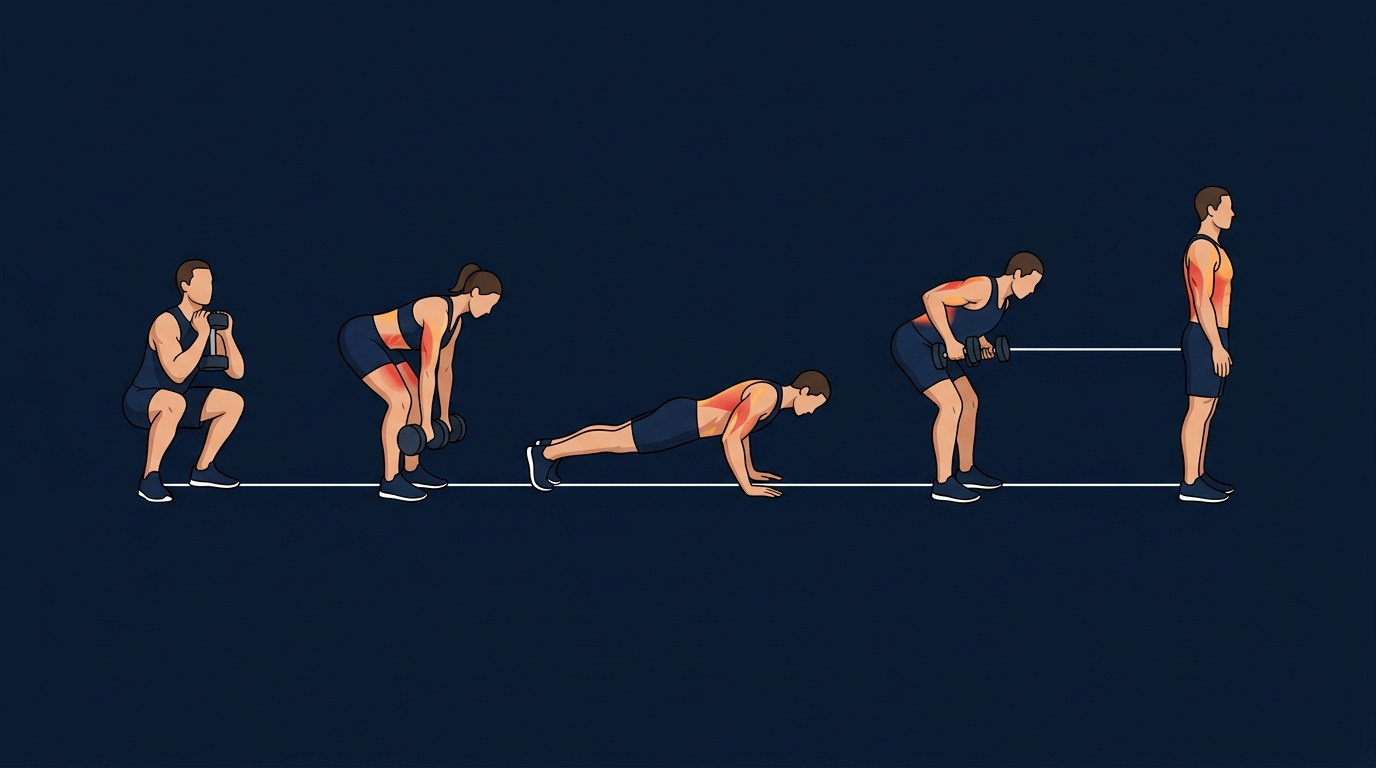
The five movements
Cover five patterns and you have covered every major muscle group:
- Squat: goblet squats, or bodyweight squats to a chair if you are starting out
- Hinge: Romanian deadlifts, or hip bridges from the floor
- Push: push-ups, elevated to a counter or wall as needed
- Pull: bent-over rows with dumbbells or a resistance band
- Core or carry: forearm planks, or carrying a heavy object for distance
Two or three working sets per movement, roughly 8 to 15 reps, stopping a rep or two short of failure. That lands you near 10 hard sets per major muscle group per week, which is the maintenance dose during a deficit. Equipment is not the constraint here. Bodyweight, bands, and a pair of adjustable dumbbells all produce the signal, which is why a home workout routine with no equipment is a legitimate starting point rather than a compromise.
How to progress when the scale is falling
This is the step people skip, and it is the one that decides whether you maintain or gain. Progressive overload means the training has to keep getting harder relative to what you can currently do. On a GLP-1 there is a wrinkle: your body weight is dropping, so bodyweight movements get easier week to week even if you change nothing. Push-ups you could do eight of at the start become easier at a lower body weight without any strength gain having occurred.
So track load and reps, not perceived difficulty. When you can complete the top of your rep range on every set with a rep or two left in reserve, add a little weight or a rep next session. Write it down. On a GLP-1 the scale is actively misleading as a progress tool, and your training log is the honest one.
For a fuller week-by-week build, our GLP-1 muscle preservation workout plan lays out the same structure with a sample week and progression rules. If you would rather have an app handle the structure, we compared the best fitness apps for GLP-1 users against this exact checklist.
Get an evidence-based plan built for you
FitCraft, our mobile fitness app, pairs you with an AI coach who builds you a personalized plan around your goals, schedule, and fitness level. Every FitCraft program is designed by Domenic Angelino, MPH (Brown University) and NSCA-CSCS, with research published in the Journal of Strength and Conditioning Research and Medicine & Science in Sports & Exercise.
Take the Free Assessment Free • 2 minutes • No credit cardCommon Misconceptions
Misconception 1: "You can't build muscle in a calorie deficit."
This gets repeated as though it were settled physiology, and it is too strong. Longland et al. (2016) put men in a 40 percent deficit and the high-protein group still gained 1.2 kg of lean mass in four weeks. The accurate version of the claim is that building muscle in a deficit is harder, slower, and mostly limited to people with untapped adaptive capacity. That is a meaningfully different statement from "impossible", and the difference matters for anyone deciding whether training is worth the effort while on a GLP-1.
Misconception 2: "The medication itself blocks muscle growth."
There is no evidence that GLP-1 receptor agonists directly inhibit muscle protein synthesis or the adaptive response to resistance training. The mechanism is appetite suppression and delayed gastric emptying. Everything downstream, including the lean mass loss, follows from the resulting energy and protein shortfall rather than from a direct anti-anabolic action. That distinction is practical rather than academic: a problem caused by insufficient intake and stimulus can be addressed with intake and stimulus.
Misconception 3: "A protein shake covers it."
Protein without training does not build muscle. The Morton et al. (2018) meta-analysis in the British Journal of Sports Medicine is clear that protein supplementation augments resistance-training-induced gains. The resistance training is the signal; protein is the raw material. Supplying material with no signal tells the body nothing. It works in the other direction too, which is why the Longland groups that trained identically still diverged on protein alone. You need both, and on a GLP-1 both are harder than usual to hit.
What the Research Suggests Going Forward
The evidence base here is lopsided, and it is worth naming that. We have strong randomized data that exercise improves body composition outcomes on a GLP-1 (Lundgren 2021), strong pooled data on what happens without it (Karakasis 2025), and strong general data that muscle gain in a deficit is possible under aggressive conditions (Longland 2016). What we do not yet have is a randomized controlled trial that takes people starting GLP-1 therapy, assigns half of them to a structured resistance training and high-protein protocol, and measures how many end up with net lean mass gain. The three-patient case series is currently the closest thing, and it is not close.
That gap should temper the confidence of anyone promising muscle gain on a GLP-1, including anyone selling a program that promises it. The defensible claim is that lean tissue gain has been documented, that the conditions under which it happened are known and reproducible, and that even falling short of gain leaves you far better off than the untrained default.
Two other open questions deserve flagging. Duration is one: the trial substudies ran roughly 68 to 72 weeks, and people now stay on these medications for years. Whether early lean-mass changes stabilize, recover, or slowly compound is not characterized. Population is the other: trial participants skew younger and healthier than the real-world user base, and older adults, who face the highest sarcopenia risk, are the least studied group.
The practical takeaway does not change while we wait. Train two or three times a week against progressive resistance, eat more protein than feels natural on a suppressed appetite, and measure progress with your training log and simple function tests rather than the scale. If you gain muscle, excellent. If you hold what you have through a large weight loss, you have already beaten the trial average by a wide margin.
References
- Tinsley GM, Nadolsky S. "Preservation of lean soft tissue during weight loss induced by GLP-1 and GLP-1/GIP receptor agonists: A case series." SAGE Open Medical Case Reports 13 (2025): 2050313X251388724. PMC12536186
- Lundgren JR, Janus C, Jensen SBK, et al. "Healthy Weight Loss Maintenance with Exercise, Liraglutide, or Both Combined." New England Journal of Medicine 384.18 (2021): 1719-1730. PMID: 33951361
- Longland TM, Oikawa SY, Mitchell CJ, Devries MC, Phillips SM. "Higher compared with lower dietary protein during an energy deficit combined with intense exercise promotes greater lean mass gain and fat mass loss: a randomized trial." American Journal of Clinical Nutrition 103.3 (2016): 738-746. PMID: 26817506
- Karakasis P, Patoulias D, Fragakis N, Mantzoros CS. "Effect of glucagon-like peptide-1 receptor agonists and co-agonists on body composition: Systematic review and network meta-analysis." Metabolism 164 (2025): 156113. PMID: 39719170
- Neeland IJ, Linge J, Birkenfeld AL. "Changes in lean body mass with glucagon-like peptide-1-based therapies and mitigation strategies." Diabetes, Obesity and Metabolism 26.Suppl 4 (2024): 16-27. DOI: 10.1111/dom.15728
- Morton RW, Murphy KT, McKellar SR, et al. "A systematic review, meta-analysis and meta-regression of the effect of protein supplementation on resistance training-induced gains in muscle mass and strength in healthy adults." British Journal of Sports Medicine 52.6 (2018): 376-384. PMID: 28698222
- Prokopidis K. "Glucagon-like peptide-1 receptor agonists and muscle strength changes in older adults: Risks beyond muscle mass reductions." British Journal of Pharmacology (2026). DOI: 10.1111/bph.70355
Frequently Asked Questions
Can you build muscle while on a GLP-1?
Yes, it is possible, though it is harder than building muscle at maintenance calories and it does not happen by default. A 2025 case series by Tinsley and Nadolsky in SAGE Open Medical Case Reports documented three patients losing substantial weight on GLP-1 or GLP-1/GIP therapy. Two of them actually increased lean soft tissue, by 2.5 percent and 5.8 percent, while losing 26.8 percent and 13.2 percent of body weight respectively. All three trained with resistance exercise 3 to 5 days per week and ate 1.6 to 2.3 grams of protein per kilogram of fat-free mass per day. That is a small case series, not a randomized trial, so treat it as a proof of possibility rather than an expected outcome.
Can you build muscle on Ozempic?
The same answer applies to Ozempic as to any GLP-1, because the mechanism is a caloric deficit rather than anything that acts directly on muscle tissue. Semaglutide does not block muscle protein synthesis. What it does is suppress appetite, which makes it easy to fall short on both total calories and protein, and that is what limits muscle gain. If you lift two or three times a week, progress the load over time, and hit your protein target, muscle gain on Ozempic is realistic for beginners and for people returning after a long layoff. For a lifelong trainee already near their genetic ceiling, maintaining lean mass during the weight loss is the more realistic goal.
Is there a free GLP-1 strength training program?
You do not need a paid or GLP-1 specific program. The evidence-backed template is two to three full-body sessions per week covering five movement patterns: a squat, a hinge, a push, a pull, and a carry or core hold. Two or three sets per exercise, roughly 8 to 15 reps, stopping a rep or two short of failure, and adding a rep or a little load whenever the last set feels easy. That is about 25 to 30 minutes per session and works with bodyweight, resistance bands, or a pair of dumbbells. The full week-by-week structure is laid out in our GLP-1 muscle preservation workout plan.
How much protein do you need to build muscle on a GLP-1?
Clinical guidance for preserving muscle during GLP-1 weight loss sits at 1.2 to 1.6 grams per kilogram of body weight per day. If the goal is to actually add muscle rather than just hold it, the evidence points higher. In the Longland et al. (2016) randomized trial, young men in a 40 percent caloric deficit who ate 2.4 g/kg/day gained 1.2 kg of lean mass over four weeks, while the group eating 1.2 g/kg/day gained only 0.1 kg. The practical barrier on a GLP-1 is appetite, not knowledge. Anchoring every meal around a protein source first, and using liquid protein when solid food is unappealing, is what makes the target reachable. Our review of protein distribution research covers how to spread it across the day.
How long does it take to see muscle gains on a GLP-1?
Strength improves before size does. Most people notice they can do more reps or handle more load within two to four weeks of consistent training, which is largely neural adaptation rather than new muscle tissue. Visible or DXA-measurable changes in lean mass typically take three months or more, and on a GLP-1 they are partly masked because total body weight is falling at the same time. This is why the scale is a poor progress tool here. Track what you lift, your grip strength, and whether you can rise from a chair without using your arms instead.