- The bone-density evidence is thinner than the trend implies. The most-cited positive trial (Snow et al., 2000) had 18 postmenopausal women, trained for five years, and combined the vest with jumping. The largest recent trial (INVEST, 2025, N=150) found that vest use did not prevent hip bone loss during dieting.
- Vests raise the metabolic cost of walking, but not by much per pound. Puthoff et al. (2006) measured meaningful oxygen-uptake and ground-reaction-force increases across vest loads of 10, 15, and 20% of body mass. Looney et al. (2024) showed the relationship is non-linear at heavier loads.
- Task-based use beats passive wearing. A 2026 mini-review of 15 older-adult trials (Luo et al., Frontiers in Public Health) found that vests worn during structured, progressively loaded exercise produce neuromuscular gains. Low-load passive wear-only protocols do not.
- Falls are a real safety signal. One older-adult trial in the same review reported higher fall counts in the vest group. Balance, joint status, and starting fitness matter.
- Reasonable starting dose: 4 to 10% of body weight, worn for 20 to 40 minutes of walking or bodyweight training. Progress load and time slowly. Skip the "wear it all day" advice.
Weighted vests are having a moment. Podcasters have called them the "single most important tool" for midlife bone health. Runners weight up for hill days. Recovery influencers wear them to the grocery store. On TikTok, the "silent walk with a 20-pound vest" is treated as a fix for everything from menopause to metabolism.
The peer-reviewed record is more restrained. There is real, replicated evidence that vest-loaded exercise can build strength and preserve bone in postmenopausal women. There is also a recent large randomized trial that failed to find a bone benefit under one of the exact conditions people buy vests for (protecting bone during weight loss). And there is a lot of daylight between those two data points that the current viral wave tends to skip.
This piece walks through the trials that actually shaped what we know: Snow's 5-year Oregon State cohort, Puthoff's metabolic-cost work, the 2024 US Army treadmill lab data, and the 2025 INVEST trial from Wake Forest. Then it lays out an honest dosing framework for someone who wants to use a vest without overpromising the results.
The Research: What Studies Show
Snow 2000: The 5-Year Bone-Density Signal
The paper that started the modern conversation is Snow, Shaw, Winters, and Witzke (2000) in The Journals of Gerontology: Series A. The Oregon State group followed 18 postmenopausal women for five years. Nine did a supervised vest-plus-jumping program three times per week for 32 weeks each year. Nine served as controls.
Over five years, exercisers gained 1.54% at the femoral neck, dropped 0.24% at the trochanter, and dropped 0.82% at the total hip. Controls lost bone at every site: 4.43% at the femoral neck, 3.43% at the trochanter, 3.80% at the total hip. Vest load progressed from about 4% to roughly 10% of body weight across the study. The exercise itself included jumping (drop jumps and step-ups), not just wearing the vest.
That's a real signal, and it's been the backbone of vest-and-bone claims ever since. Two caveats to hold onto. First, the sample is very small (N=18). Second, the intervention was task-based and impact-loaded. The women were jumping in vests three times a week for five years, not passively wearing them while cooking dinner. The bone gains almost certainly reflect the whole package, not the vest alone.
Puthoff 2006 and Looney 2024: How Much Harder Walking Actually Gets
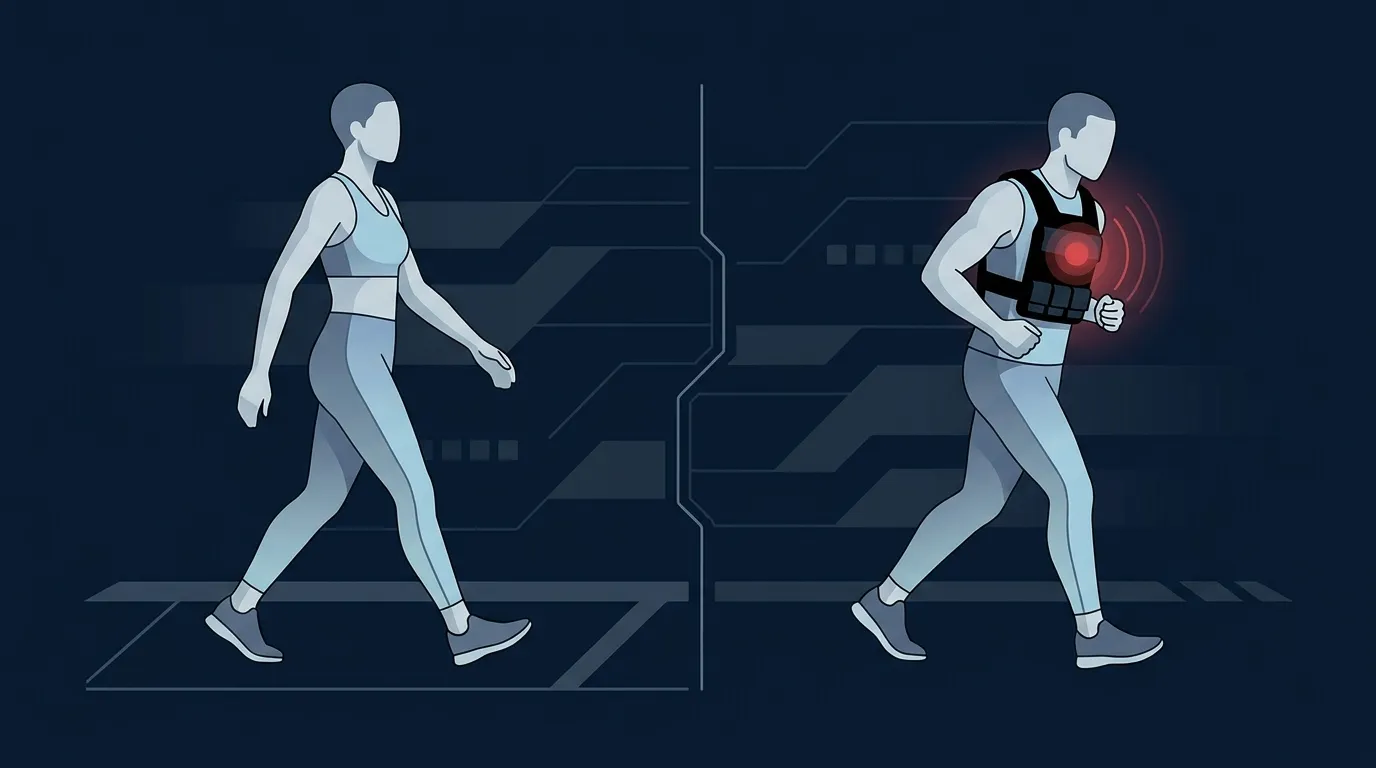
Two studies frame the metabolic story cleanly. Puthoff et al. (2006) in Medicine & Science in Sports & Exercise put ten healthy young adults on a treadmill at multiple speeds with vests loaded at 0, 10, 15, and 20% of body mass. Oxygen uptake and relative exercise intensity rose meaningfully at every non-zero vest load, with a larger effect at faster walking speeds. Vertical ground reaction forces (both the impact and push-off peaks) and loading rate also climbed at every loaded condition, which is part of what makes the vest a plausible bone stimulus.
The more recent Looney et al. (2024) paper, also in MSSE, tested twenty active adults across a much wider load range: 22%, 44%, and 66% of body mass, at walking speeds up to about 4.4 mph. The finding that matters for civilians: metabolic cost rises non-linearly with vest weight. Doubling the load more than doubles the added energy cost, especially at the heavier end. For a 180-pound adult, a 20-pound vest bumps calorie burn on a walk by a modest amount. A 60-pound vest bumps it by a lot, but at that load the vest is a strength stimulus, not a walking one.
The practical takeaway: a walk in a 10% vest is a moderately harder walk. It isn't secretly a run, and it isn't a magical calorie multiplier. If your goal is cardio conditioning, more speed or more hills work faster than more weight.
INVEST 2025: The Trial That Complicates the Story
The largest randomized weighted-vest trial to date is Beavers et al. (2025) in JAMA Network Open, published from the Wake Forest INVEST in Bone Health study. Researchers randomized 150 older adults with obesity (mean age 66, about three-quarters women) to one of three arms for 12 months: caloric restriction alone, caloric restriction plus weighted vest use, or caloric restriction plus supervised progressive resistance training.
Compliance was strong. Vest wearers averaged 7.1 hours per day of vest use, and roughly 82% of the weight they lost was replaced with vest load. Weight loss was similar across the three arms (about 9 to 11% of body weight). The primary outcome was change in hip bone mineral density.
The headline result: neither the vest nor progressive resistance training prevented hip bone loss during weight loss in this population. All three groups lost bone at the hip at similar rates. That's a hard result. It says that for the specific problem people most want to solve with a vest (protecting bone during middle-age or older-adult weight loss), simply wearing weight while dieting is not sufficient. Task-based mechanical loading during actual exercise, and adequate protein and calcium intake, likely matter more than the vest itself.
The Beavers team has also published sex-stratified secondary analyses hinting that women may respond more favorably to the vest than men. Those are exploratory, so the primary trial result is what most trainers should update on. If you use a vest to protect bone during weight loss, use it inside a real strength-and-impact program, and treat the vest itself as a possible helper, not the mechanism.
Luo 2026: What 15 Older-Adult Trials Add Up To
The most recent synthesis is Luo et al. (2026) in Frontiers in Public Health, a mini-review of 15 weighted-vest trials in adults 60 and older. The authors split the literature into two prescription modes: wear-only (worn passively during daily life) and task-based (worn during structured exercise like walking, stair climbing, or strength training).
Task-based, progressively loaded protocols produced measurable neuromuscular gains: better sit-to-stand performance, improved lower-body strength, and, in some trials, preservation of hip BMD in postmenopausal women. Low-load wear-only protocols mostly did not. One included trial recorded higher fall counts in the vest group, which is worth flagging: adding load to a body with iffy balance changes the mechanics of a stumble.
The reviewers were honest about limitations. Sample sizes are usually small, protocols vary widely, and follow-up is short. The current state of evidence supports vests as an adjunct to real training, especially for older women looking to preserve bone and function. It doesn't support the "wear it around the house" advice that circulates on social media.
Why This Matters for Your Fitness
If you're an active adult and you like your walks, adding a vest is a reasonable way to squeeze a little more work out of them. The metabolic cost rises modestly, ground reaction forces go up, and if you're in the specific demographic Snow studied (postmenopausal, willing to add impact work), there's a plausible bone-density case.
If you're a midlife adult trying to protect bone during weight loss, don't rely on the vest alone. The INVEST result is inconvenient for the current messaging, and it's also the largest, best-controlled trial we have. Pair any dieting phase with strength training, adequate protein (about 1.6 grams per kilogram of body weight per day), and enough calcium and vitamin D to support bone remodeling. If you also wear a vest during those workouts, fine. Just don't expect it to carry the load by itself.
And if you're older, deconditioned, or have any concern about balance, treat the vest like any other load added to your body. Start light, walk on flat ground, and skip the "vest all day" idea entirely. The people who benefit most from weighted vests are already fit enough to move well under load. If that isn't you yet, the return on baseline strength and balance work is much higher than adding weight to a fragile system.
How Weighted Vests Work in Practice
The load itself is a mechanical stimulus. Every step is a bit heavier. Every squat, push-up, and lunge asks more of the working muscle. Every impact (a jump, a heel strike, a step onto a curb) is registered by bone as a signal to remodel. That is the entire mechanism. Nothing about a vest is magic. It just makes the exercise you were already doing a little harder.
Two design details matter. First, fit. A good vest sits snug against the torso and doesn't slap. Bouncing weight punishes the low back and shoulders, and it wrecks gait mechanics fast. Second, load distribution. Vests with weight spread evenly across the front and back are gentler on posture than vests with all the load in the front or bunched at the shoulders. The tactical-looking plate carriers popular right now vary widely on both counts.
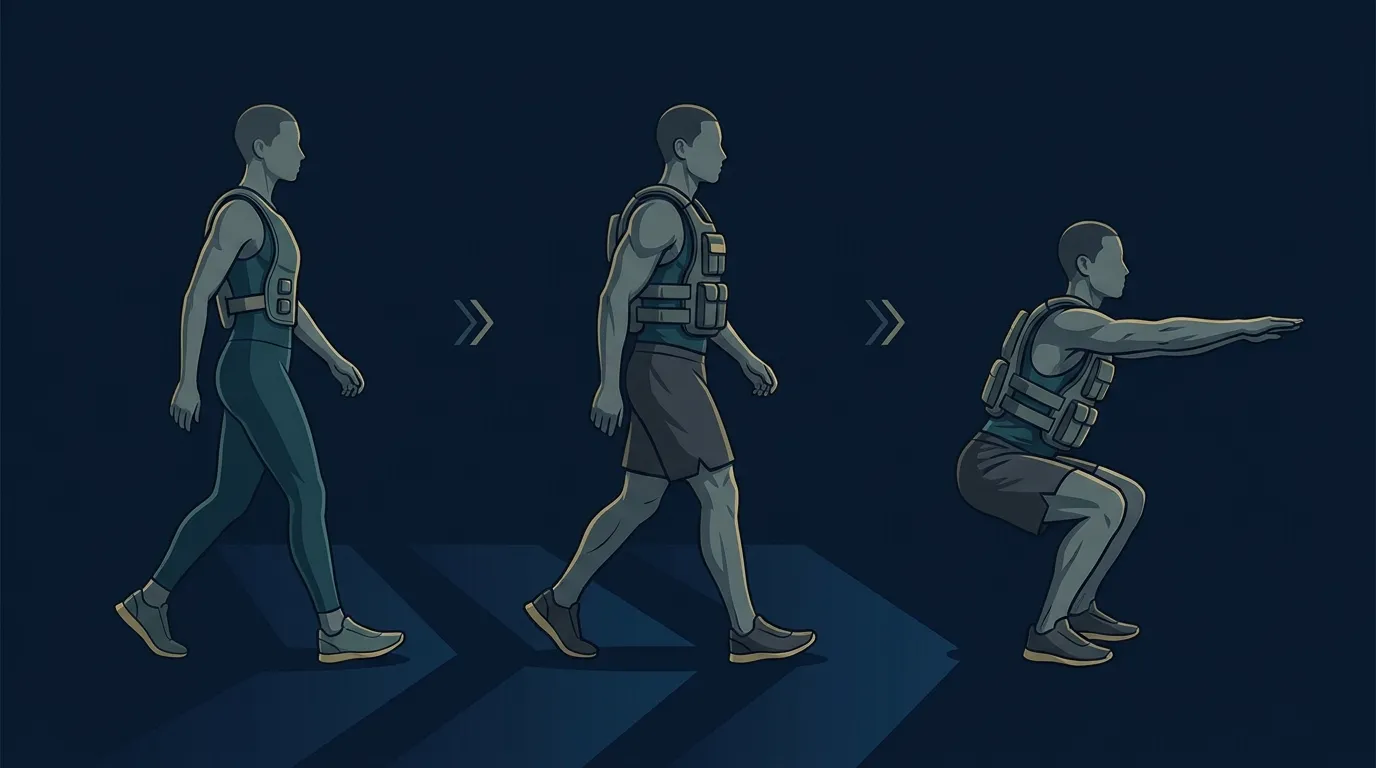
Real-world use falls into three buckets. Loaded walking (the most common use, best for a modest cardio boost). Loaded bodyweight training (push-ups, squats, lunges, step-ups: this is where the strength stimulus is meaningful). Loaded impact work (rare, only appropriate for people already tolerating jumps and step-downs safely). The Snow protocol that produced the bone gains lived mostly in the third bucket.
Get an evidence-based plan built for you
FitCraft, our mobile fitness app, pairs you with an AI coach who builds you a personalized plan around your goals, schedule, and fitness level. Every FitCraft program is designed by Domenic Angelino, MPH (Brown University) and NSCA-CSCS, with research published in the Journal of Strength and Conditioning Research and Medicine & Science in Sports & Exercise.
Take the Free Assessment Free • 2 minutes • No credit cardA Reasonable Starting Progression
Weeks one and two: 4 to 6% of body weight, worn during a normal 20-minute walk, once or twice a week. Check for shoulder and low-back soreness after each walk. If either flares, drop the load.
Weeks three and four: same load, 30 to 40 minutes, twice a week. Add a short set of bodyweight squats or step-ups at the end while still wearing the vest.
Weeks five through eight: 8 to 10% of body weight, 30-minute walk or 15 to 20 minutes of loaded bodyweight training (squats, push-ups, split squats, step-ups), two or three times a week.
Maintenance: 10% of body weight, worn during whatever training you already do. That's it. There is no need to go higher for general fitness. If you want to see the movements that pair well with vest work, our goblet squat, side lunge, and glute bridge pages walk through form.
Common Misconceptions
"Wearing a weighted vest all day will strengthen your bones."
Not really. The mechanotransduction signal that bones respond to is peak strain during loading events, not average daily load. Sitting at a desk in a 15-pound vest sends a very different signal than doing a set of step-ups in the same vest. The Snow protocol that saw bone gains used the vest during three weekly bouts of impact-loaded exercise, not as passive daily wear. The Luo 2026 review confirmed the same pattern: task-based works, wear-only mostly doesn't.
"The heavier the vest, the more benefit."
Only up to a point. Load has to match the person and the movement. Very heavy vests distort gait, punish joints, and shorten workout duration to the point where the total training stimulus drops. The military-style loads in the Looney 2024 data (up to 66% of body mass) are relevant to tactical populations. They are not a template for a 55-year-old adding weight to their morning walk. Between 4% and 10% of body weight covers essentially every civilian use case.
"A weighted vest will replace strength training."
It won't. Adding a vest to walking and bodyweight work is closer to progressive overload for those specific activities than it is to a full strength program. Real strength training builds contractile muscle, tendon stiffness, and the neural coordination that protects joints. A vest is a nice complement. It is not a substitute. For the underlying case, our sarcopenia and resistance training piece covers what real strength work does over time.
What the Research Suggests Going Forward
The literature has landed on a modest, defensible summary. Task-based vest use, especially with impact loading, can preserve bone and improve neuromuscular function in postmenopausal and older adult populations. Loaded walking modestly raises the metabolic cost of the walk. Passive all-day wear has almost no evidence behind it, and the largest recent trial (INVEST 2025) says the vest by itself does not protect bone during weight loss.
What we still don't know: dose-response curves for younger adults, whether vests offer a real hypertrophy stimulus at practical loads, and how well vest programs work outside supervised research environments. Compliance data from the INVEST trial is encouraging (people did wear the vest as prescribed), but real-world adherence to any wearable intervention drops sharply once the study ends.
The honest bottom line: a weighted vest is a solid, if minor, training tool. Wear one during activity you were already going to do. Progress the load slowly. Keep expectations grounded in what the trials actually measured, not in what the algorithm is selling this month. If you'd rather focus on a fully programmed strength-and-cardio approach, our strength training after 60 piece walks through the pattern that has the strongest evidence.
References
- Snow CM, Shaw JM, Winters KM, Witzke KA. Long-term exercise using weighted vests prevents hip bone loss in postmenopausal women. The Journals of Gerontology Series A: Biological Sciences and Medical Sciences. 2000;55(9):M489–M491. PMID: 10995045.
- Puthoff ML, Darter BJ, Nielsen DH, Yack HJ. The effect of weighted vest walking on metabolic responses and ground reaction forces. Medicine & Science in Sports & Exercise. 2006;38(4):746–752. PMID: 16679992.
- Looney DP, Lavoie EM, Notley SR, et al. Metabolic Costs of Walking with Weighted Vests. Medicine & Science in Sports & Exercise. 2024;56(6):1177–1185. PMID: 38291646.
- Beavers KM, Lynch SD, Fanning J, et al. Weighted Vest Use or Resistance Exercise to Offset Weight Loss-Associated Bone Loss in Older Adults: A Randomized Clinical Trial. JAMA Network Open. 2025;8(6):e2516772. PMID: 40540267.
- Luo H, Zhang X, Li H, Yin M, Li Z. Weighted vest interventions in older adults: a mini-review of implementation, benefits, and limitations. Frontiers in Public Health. 2026. doi:10.3389/fpubh.2026.1811712.
Frequently Asked Questions
Do weighted vests actually build bone density?
The strongest positive evidence comes from Snow et al. (2000), which trained 18 postmenopausal women three times per week for five years using weighted vests combined with jumping. Femoral neck bone mineral density rose 1.54% in the exercisers and fell 4.43% in controls. The 2025 INVEST trial (Beavers et al., JAMA Network Open, N=150), the largest randomized trial of weighted vests to date, found that vest use did not prevent hip bone loss during weight loss in older adults. Task-based, impact-loaded protocols show benefit. Passive wearing during dieting does not.
How heavy should a weighted vest be?
Most training studies use loads between 4% and 10% of body weight. Snow's postmenopausal bone-density protocol progressed up to about 10% of body weight over five years. The INVEST protocol titrated the vest up to 10% of body weight to match the participant's dieting weight loss. For a healthy adult starting out, 4 to 8% of body weight for walks of 20 to 40 minutes is a reasonable entry point. Very heavy vests (above 15% of body weight) are used in military and tactical research but are not necessary or recommended for general fitness.
How much does a weighted vest increase calorie burn on a walk?
Puthoff et al. (2006) measured meaningful increases in oxygen uptake and ground reaction forces when healthy young adults walked on a treadmill wearing vests loaded at 10, 15, and 20% of body mass, with larger effects at faster walking speeds. Looney et al. (2024), using loads from 22% to 66% of body mass, showed that metabolic cost rises non-linearly with vest weight. Each additional pound adds a bit more than the previous one. For most people, a 10% vest turns a walk into a moderately harder walk. It does not double calorie burn, and the extra energy expenditure is smaller than an equivalent-duration jog.
Are weighted vests safe for older adults?
For most healthy older adults, yes, with reasonable dosing. A 2026 Frontiers in Public Health mini-review (Luo et al.) of 15 trials in adults over 60 concluded that task-based, progressively loaded protocols are generally well tolerated and produce neuromuscular gains, while low-load passive wear-only protocols show few musculoskeletal benefits. One included trial recorded higher fall counts in the vest group, so balance, joint status, and starting fitness matter. People with osteoporosis, prior fragility fractures, spinal conditions, or balance disorders should clear vest use with a clinician first.
Is a weighted vest better than adding weight to your body through fat or muscle?
For skeletal loading during exercise, external load produces a similar mechanical signal to internal load, which is why weighted vests get studied for bone health during weight loss. For metabolic training adaptations (VO2 max, sustained cardio capacity), added muscle mass is a bigger long-term win because it raises resting metabolic rate 24 hours a day. Vests are a training tool, not a substitute for strength training. The best evidence-based protocols use both: strength training two to three days a week, and impact-loaded activity (with or without a vest) on other days.