You lift your toddler out of the car seat, and your lower back complains for the rest of the day. You kneel to fix something under the sink and need both hands on the counter to get back up. You've worked out before, so why does real life still feel so heavy?
Often the plan was built around machines or body parts instead of the jobs your body does. When a workout feels unrelated to your life, it's easy to skip it, then skip another, then blame yourself. The problem is the plan's design, and you can fix that.
Below are the 8 moves functional strength training is built on, a 3-day plan for dumbbells and body weight, and how to progress each move for months.
What Is Functional Strength Training?
Functional strength training is resistance training chosen for how well it carries over to daily life. La Scala Teixeira and colleagues (2017), writing in Frontiers in Physiology, describe functional training as exercise done to improve how you perform daily tasks. They stress that it trains several abilities together: strength, balance, coordination and power.
In practice that means compound moves, mostly done standing, with free weights or your body weight, planned by movement pattern instead of by muscle group. For the history of the idea and how it differs from HIIT and CrossFit, see our explainer on what functional fitness is.
8 Functional Strength Training Exercises
Each move trains one movement pattern, and together they cover the ways you load your body in a normal week. Most descriptions include an easier way to start.
| # | Exercise | Pattern | Everyday task it trains | Sets x reps |
|---|---|---|---|---|
| 1 | Goblet squat | Squat | Getting up from a low sofa | 3 x 8-12 |
| 2 | Dumbbell Romanian deadlift | Hip hinge | Lifting a heavy box off the floor | 3 x 8-12 |
| 3 | Reverse lunge | Lunge | Kneeling down and standing back up | 3 x 8-10 per leg |
| 4 | Push-up | Horizontal push | Pushing yourself up off the floor | 3 x 6-12 |
| 5 | One-arm dumbbell row | Horizontal pull | Hauling a heavy door or bin toward you | 3 x 8-12 per side |
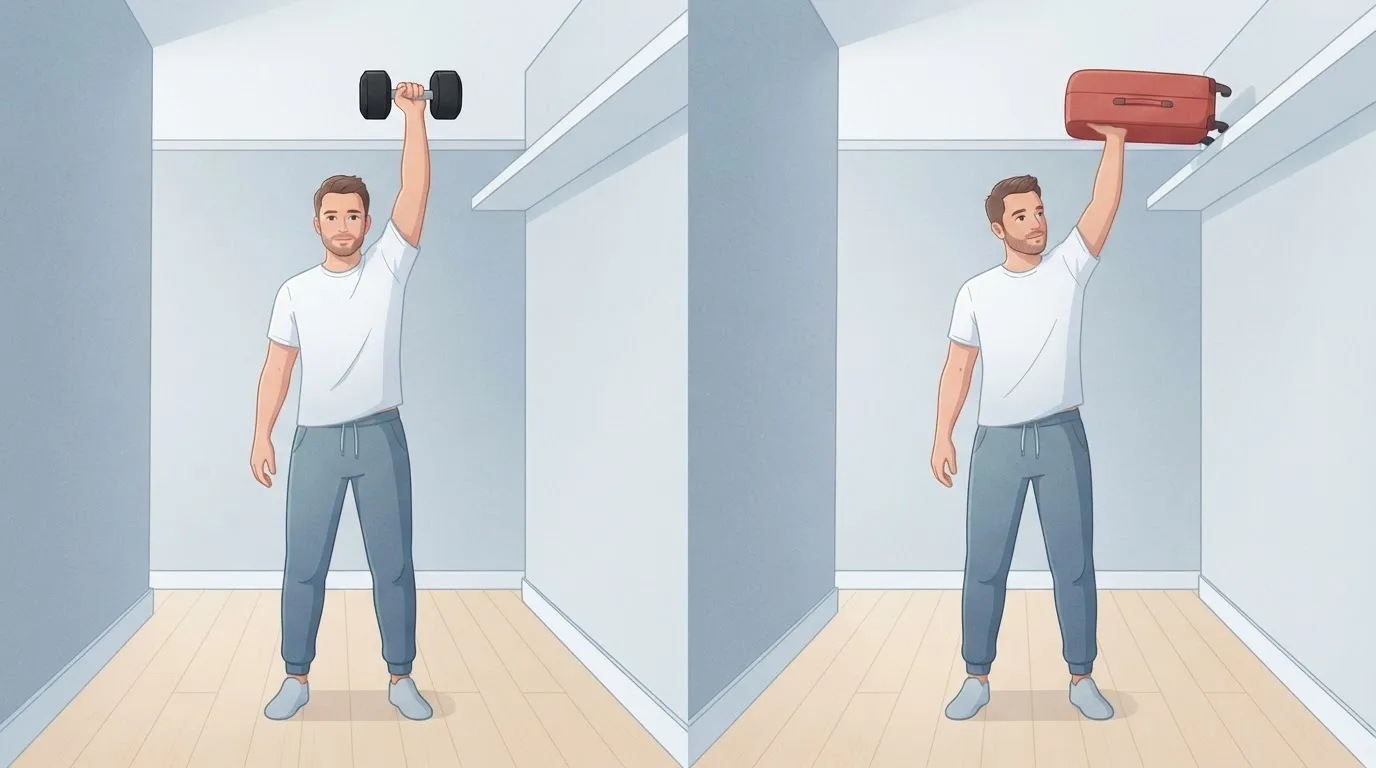
| 6 | Half-kneeling dumbbell press | Overhead push | Putting a heavy pot on a high shelf | 3 x 8-10 per side |
| 7 | Farmer's carry | Carry | Bringing two full shopping bags in from the car | 3 x 30-40 sec |
| 8 | Dumbbell woodchop | Rotation | Shoveling snow or loading a car trunk | 2 x 8 per side |
1. Goblet squat
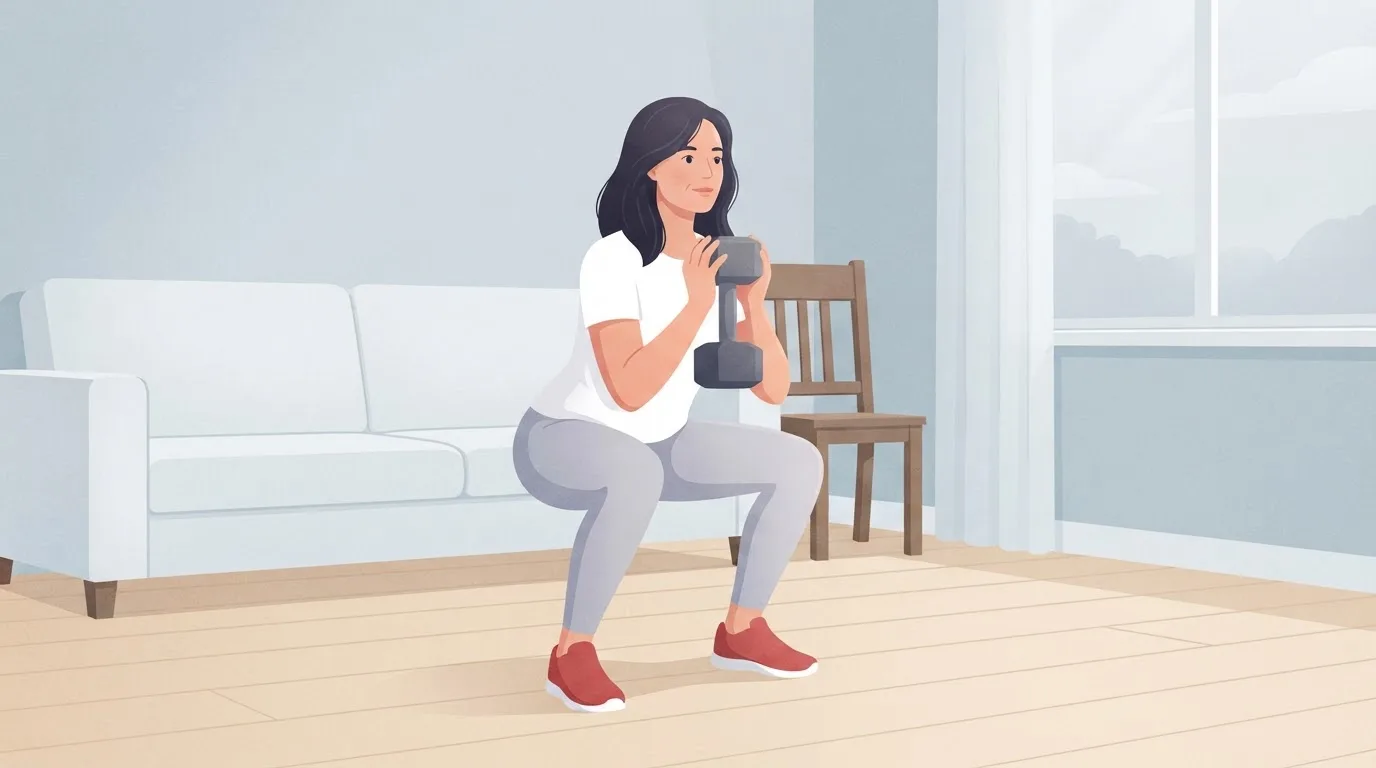
Hold one dumbbell upright against your chest, feet a little wider than your hips. Sit your hips down between your heels until your thighs are about level with the floor, then stand by pushing the floor away, heels down and knees in line with your toes. If depth feels shaky, squat to a chair. Our goblet squat page shows each step.
2. Dumbbell Romanian deadlift
Hold a dumbbell in each hand in front of your thighs. Push your hips back with a soft bend in your knees until you feel a firm stretch behind your thighs, then drive your hips forward to stand, with your back flat the whole time. This hip hinge is the pattern to use when you lift things off the floor, and the Romanian deadlift page includes drills to learn it.
3. Reverse lunge
Step one foot back and lower until both knees bend to about 90 degrees, then push through your front foot to come back up. Stepping back is easier to balance than stepping forward. Hold a chair at first, then hold dumbbells at your sides. The rear lunge page has the full progression.
4. Push-up
Set your hands under your shoulders and keep your body in one line as you lower your chest and press back up. Start with your hands on a kitchen counter, which takes some of your weight, and use a lower surface as you get stronger. Our incline push-up page covers that version.
5. One-arm dumbbell row
Put one hand and the same-side knee on a sturdy chair or bench, let the dumbbell hang, and pull your elbow back toward your hip. Pause at the top, then lower slowly. The support lets your back pull hard before your lower back gets tired. Our supported row page shows the setup.
6. Half-kneeling dumbbell press
Kneel on one knee with the other foot flat in front, holding a dumbbell at the shoulder on the side of the down knee. Squeeze that glute, keep your ribs down, and press straight up until your arm is beside your ear. Kneeling stops you leaning back to cheat the weight up. Then progress to standing, as on our dumbbell shoulder press page.
7. Farmer's carry
Hold a heavy dumbbell in each hand and walk tall for 30 to 40 seconds, shoulders down, with short, steady steps. The one-dumbbell suitcase carry makes your trunk work to stop you leaning toward the weight. Our farmer's carry research review covers what carries do for grip, trunk and posture.
8. Dumbbell woodchop
Hold one dumbbell with both hands beside one hip, then turn your chest and lift it diagonally across your body to above the opposite shoulder, pivoting your back foot. Move under control, starting with no weight. The woodchop teaches you to turn through your hips and upper back rather than your lower back.
Find out what's really holding you back
FitCraft, our mobile fitness app, pairs you with an AI coach who builds you a personalized plan around your goals, schedule, and fitness level. Every FitCraft program is designed by Domenic Angelino, MPH (Brown University) and NSCA-CSCS, with research published in the Journal of Strength and Conditioning Research and Medicine & Science in Sports & Exercise.
Take the Free Assessment Free • 2 minutes • No credit cardWhat Is the Difference Between Traditional Strength Training and Functional Strength Training?
Traditional strength training plans your workout by muscle group or by lift, often on machines, while functional strength training plans it by movement pattern, mostly standing with free weights. Both build strength. Functional training aims that strength at the tasks in your day.
| Feature | Traditional strength training | Functional strength training |
|---|---|---|
| Workout organized by | Muscle group or lift | Movement pattern |
| Typical equipment | Machines, barbells and benches | Dumbbells, kettlebells and body weight |
| Body position | Often seated or lying, with back support | Mostly standing, without support |
| Balance and trunk demand | Low | Moderate to high |
| Best for | Building one muscle, rehab, very heavy loading | Strength you use outside the gym |
Neither style builds more muscle by default. When Schwanbeck and colleagues (2020) randomized 46 young adults to free weights or machines for eight weeks, both groups gained similar muscle and strength. The 2026 ACSM position stand by Currier and colleagues, which pooled 137 systematic reviews, also found that equipment type and exercise complexity didn't consistently change results.
Multi-joint moves do get more out of the same work. Paoli and colleagues (2017) matched the total training volume of 36 active men for eight weeks. The group that did only multi-joint lifts improved VO2max by 12.5% and squat strength by 13.8%, against 5.1% and 8.3% for the group that did only single-joint moves. Our guide to isolation vs compound exercises explains when single-joint work still earns a place.
Functional strength vs gym strength
The two styles differ most in transfer, meaning how well the strength carries over to other movements. In a 1998 trial by Augustsson and colleagues, 24 healthy adults trained twice a week for six weeks with either barbell squats or leg machines. The squat group gained 31% on a squat test and jumped 10% higher. The machine group gained 13% on the squat, and their jump didn't change significantly. Gym strength is real strength, and it shows up most in movements that resemble how you built it.
Does Functional Strength Training Carry Over to Daily Life?
Functional strength training carries over to daily life when it trains the patterns your tasks use, and the best results in trials came from combining real loading with practice of the tasks themselves.
Practice the task and build the strength
Manini and colleagues (2007) tested this in 32 older adults, average age 76, who had started changing how they did everyday tasks. For 10 weeks they did resistance training, task practice, or one day of each per week. All three groups modified their daily tasks less often afterward. Only the groups that practiced tasks got faster at them: 23% for task practice and 18.5% for the mixed group, against a non-significant 2.5% for resistance training alone. Strength rose mainly in the groups that lifted.
The mixed group got most of both benefits from one session of each type a week. The plan below follows the same idea, with loaded patterns that match your day.
In midlife, both styles improved how people moved
Pacheco and colleagues (2013) followed 101 active adults, average age about 55, through 12 weeks of circuits twice a week. One group did conventional exercises without balance demands, such as leg extensions, flys and bench presses, and the other did planks, lunges, push-ups and balance work. Both groups improved on the Functional Movement Screen, a test of seven basic movements, with no significant difference between them. Only the functional group improved on a balance-reach test, and only slightly.
These are small trials, and most of them measured tests rather than real chores. The pattern across them is consistent. You get better at what you practice, and strength makes the practice count. For older adults in particular, our functional fitness explainer covers the trials on daily tasks and falls.
A 3-Day Functional Strength Training Program
This functional strength training program alternates two workouts, A and B, on three non-consecutive days a week. Every pattern comes up at least three times every two weeks, and the hinge, pull and carry come up in every session. That fits the ACSM's 2009 position stand, which recommends 2 to 3 days a week for beginners. Each session takes about 35 minutes, including the warm-up.
| Week | Monday | Wednesday | Friday |
|---|---|---|---|
| Week 1 | Workout A | Workout B | Workout A |
| Week 2 | Workout B | Workout A | Workout B |
Repeat the two-week rotation, and walk or rest on the other days. Any three days work as long as there's a day off between sessions.
Warm-up (5 minutes)
- 1 minute of marching in place or easy step-ups on the bottom stair
- 10 bodyweight squats to a chair
- 10 hip hinges with your hands on your hips
- 8 push-ups against a kitchen counter
- 5 slow reverse lunges on each leg, holding a chair
- One light set of the first exercise in the workout
Workout A
| Order | Exercise | Sets x reps | Rest |
|---|---|---|---|
| 1 | Goblet squat | 3 x 8-12 | 90 sec |
| 2 | Dumbbell Romanian deadlift | 3 x 8-12 | 90 sec |
| 3 | Push-up, on a counter or the floor | 3 x 6-12 | 60-90 sec |
| 4 | One-arm dumbbell row | 3 x 8-12 per side | 60 sec |
| 5 | Farmer's carry | 3 x 30-40 sec | 60 sec |
Workout B
| Order | Exercise | Sets x reps | Rest |
|---|---|---|---|
| 1 | Reverse lunge | 3 x 8-10 per leg | 90 sec |
| 2 | Single-leg Romanian deadlift, one hand on a chair | 2 x 8 per leg | 60 sec |
| 3 | Half-kneeling dumbbell press | 3 x 8-10 per side | 60 sec |
| 4 | Bent-over dumbbell row | 3 x 8-12 | 60-90 sec |
| 5 | Suitcase carry | 3 x 30 sec per side | 60 sec |
| 6 | Dumbbell woodchop | 2 x 8 per side | 45 sec |
Workout B uses one-sided versions of the same patterns. The single-leg deadlift trains the hinge and your balance together.
How hard each set should feel
End each set when you could still do 2 or 3 more good reps. A 2024 analysis by Robinson and colleagues found that strength gains were similar across a wide range of reps left in reserve, while muscle growth improved as sets ended closer to failure. If building muscle is also a goal, take the last set of each move a little closer to failure.
Short on time? Do the first three exercises of the day plus the carry. That's about 20 minutes and still covers a squat or lunge, a hinge, a push or press, and a carry.
How to Progress: Building Functional Strength Week by Week
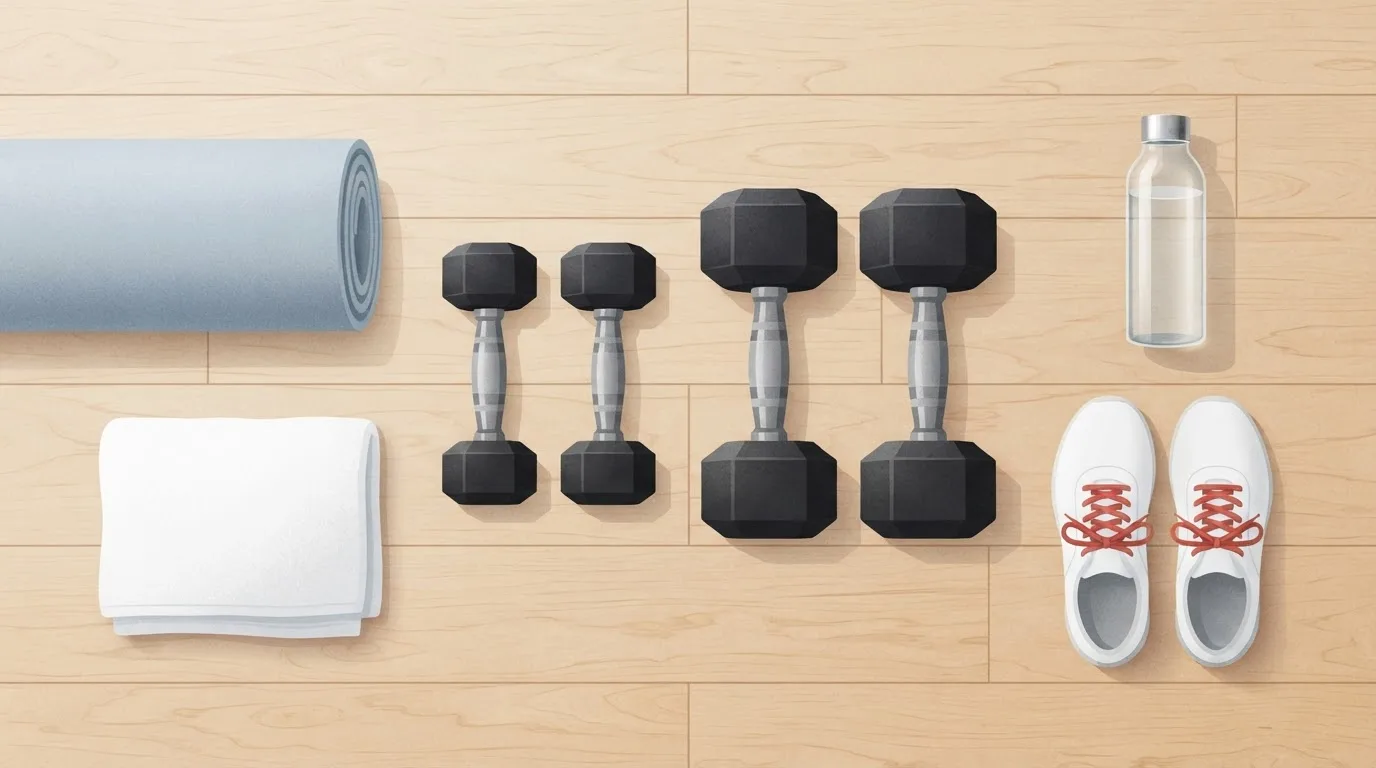
Building functional strength means adding a little challenge every week or two, usually in this order: more reps, then more weight, then a harder version of the move.
When you can do the top of the rep range on every set of a move, use more weight next session and drop back to the bottom of the range. The ACSM's 2009 stand recommends a 2 to 10% increase in load once you can do one or two reps more than your target.
Home dumbbells often jump in bigger steps than that, such as from 15 to 20 pounds. Bridge the gap with a slower 3-second lowering, a 1-second pause at the hardest point, or the one-leg or one-arm version of the move. Our guide to progressive overload for beginners lists every variable you can change.
| Pattern | Start here | Then | Then |
|---|---|---|---|
| Squat | Squat to a chair | Goblet squat | Split squat with your rear foot on a chair |
| Hinge | Hip hinge with hands on your hips | Dumbbell Romanian deadlift | Single-leg Romanian deadlift |
| Lunge | Split squat holding a chair | Reverse lunge with dumbbells | Step-up onto a knee-high step |
| Push | Push-up on a counter | Push-up on a low step or the floor | Floor push-up with a 3-second lowering |
| Pull | One-arm row, light | One-arm row, heavier | Row with a 2-second pause at the top |
| Press | Half-kneeling press, light | Standing dumbbell press | Dumbbell push press |
| Carry | Farmer's carry, 20 sec | Farmer's carry, 40 sec | Heavy suitcase carry, 40 sec per side |
| Rotation | Woodchop with no weight | Dumbbell woodchop | Half-kneeling woodchop with a pause |
As you get stronger, lower each rep under control and lift with intent. The 2026 ACSM stand found that power training, with a fast lifting phase, improved physical function, which helps with quick efforts like taking the stairs briskly.
What to Expect in the First 8 Weeks
Your first two weeks are mostly learning. Strength rises fast at the start because your nervous system gets better at using the muscle you have. In a classic 8-week study, Moritani and deVries (1979) found that neural factors explained most of the early gain, and muscle growth became the main driver after 3 to 5 weeks.
Around weeks 3 to 5, your reps climb and the stairs feel easier. This is also when most people drift, because the novelty wears off before the visible changes arrive. When you miss a session, do the next workout in the rotation instead of starting over. By weeks 6 to 8, most people are ready for heavier dumbbells on the squat, hinge and carry.
If you'd like a plan built and run for you, FitCraft plans dumbbell and bodyweight strength workouts, and a 3D AI coach demonstrates every exercise on an interactive model and says your name during the workout. Your workouts adjust as you progress, and streaks and leaderboards help you keep showing up. Our ranking of the best strength training apps compares it with the alternatives.
The Bottom Line
Functional strength training is ordinary strength training aimed at your life. You squat, hinge, lunge, push, pull, carry and turn, with enough load to get stronger. The trials above saw changes within 6 to 12 weeks of two or three sessions a week.
Working out consistently is hard, but it doesn't have to be. As Tim put it, "I didn't think an app could replace my trainer. My AI coach proved me wrong." Pick your three days for next week and put Workout A on the first one.
Frequently Asked Questions
What is the 3-3-3 rule for strength training?
The 3-3-3 rule is an informal gym shorthand that usually means 3 exercises, 3 sets each, 3 days a week. No study has tested those exact numbers, but 2 to 3 sessions a week matches the ACSM's advice for beginners. For functional training, pick a squat or lunge, a hip hinge, and a push or pull, and change the three across the week.
What is the 5 4 3 2 1 workout method?
The 5 4 3 2 1 method usually means descending reps: 5 reps, then 4, 3, 2 and 1, with more weight on each set. It comes from heavy strength training, so it suits experienced lifters more than beginners. For a first functional plan, sets of 8 to 12 reps are easier to learn and progress.
What are the only 5 exercises you'll ever need?
No five exercises cover everything, but a squat, a hip hinge, a push, a pull and a loaded carry come close. Those five patterns train nearly every major muscle and match most of the lifting, pushing and carrying in a normal week. Add a lunge and a rotation move when you can.
What are five exercises I can do every day at home?
Bodyweight squats, glute bridges, incline push-ups against a counter, a plank and a brisk walk are five exercises you can do at home every day. Keep them easy enough that you could repeat them tomorrow. Save harder dumbbell sessions for two or three days a week, with a rest day between them.
Should I choose Functional or Traditional Strength Training on Apple Watch?
Choose Functional Strength Training for sessions like the plan on this page: standing moves, carries and circuits with short rests. Choose Traditional Strength Training for slower, heavier sets with long rests. Apple's list of Apple Watch workout types names both without describing either, so pick the one that best matches what you did.
Is functional strength training lifting weights?
Usually, yes. Most functional strength training uses dumbbells, kettlebells or your body weight, and the load is what builds the strength. What makes it functional is the choice of moves, such as squats, hinges, lunges, pushes, pulls and carries.