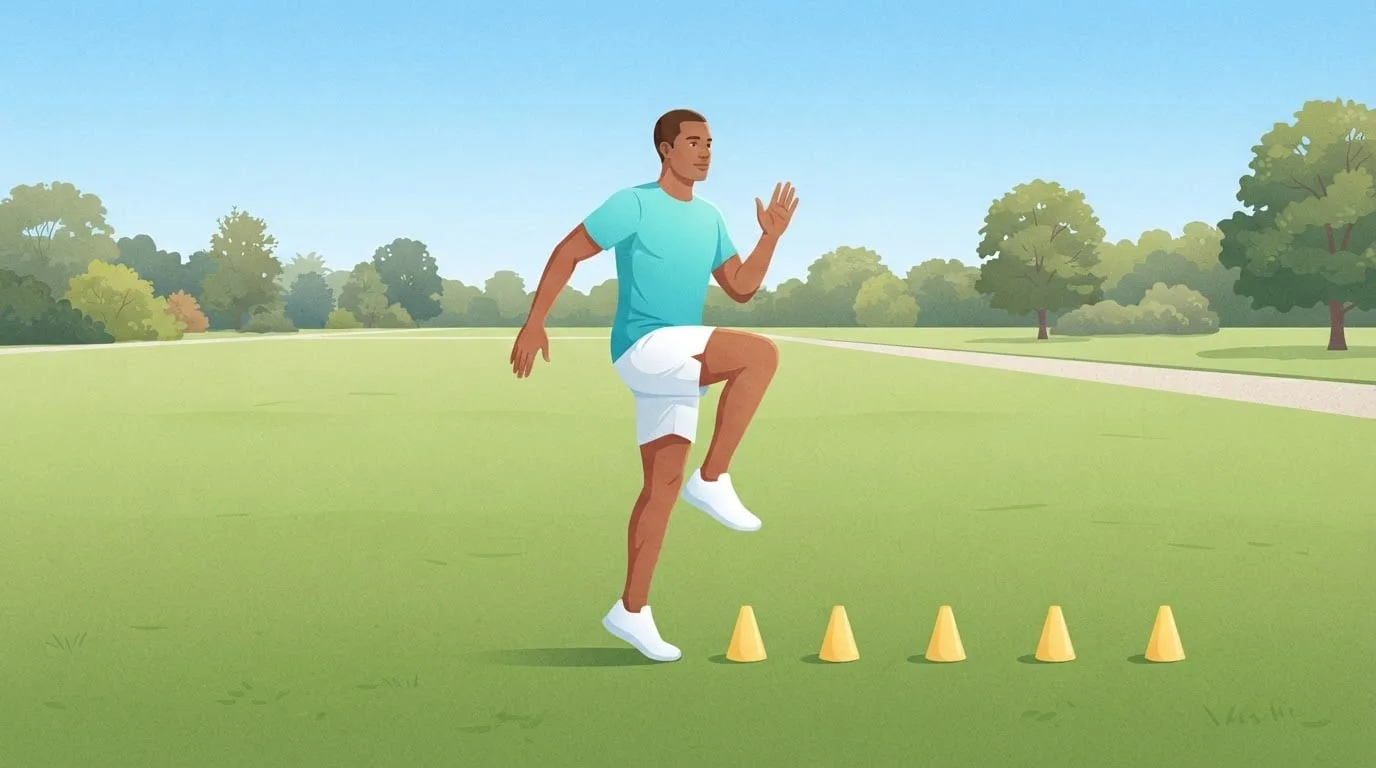
Running form drills look a little silly from the outside: skipping with your knees up, flicking your heels, hopping on stiff ankles. Most runners have seen a club group do them before a race and wondered whether they'd help, or tried a few from a video and felt uncoordinated and self-conscious after the first set. If you came here for running technique drills or form running exercises that actually make your stride feel lighter, you're in the right place.
The frustration is that most drill lists just name the drills. They don't tell you what each one is for, how many to do, where they fit in your week or whether any of it works. So drills become a ritual you do for a while and then quietly drop, and your running feels the same.
This guide fixes that. You'll get 10 drills with a cue and a dose for each, the research on what drills do and don't train, a 10-minute beginner session, a version for your living room and a 6-week plan. If you want the bigger picture first, our guide on how to improve running form ranks the form changes that matter most. This page is the practice manual for the drills that support them.
The 10 Best Running Form Drills at a Glance
Each drill exaggerates one piece of the running stride so you can feel it at a slow speed. The table gives the job and the dose. The sections below explain how to do each one.
| # | Drill | What it rehearses | Dose |
|---|---|---|---|
| 1 | A-march | Knee lift and a foot that lands under the hip | 2 x 20 m |
| 2 | A-skip | The same pattern with rhythm and a quick ground contact | 2-3 x 20 m |
| 3 | B-skip | Pulling the foot down and back under you instead of reaching | 2 x 20 m |
| 4 | High knees | Quick turnover with a tall trunk | 2 x 15 m |
| 5 | Butt kicks | A fast, compact recovery of the lower leg | 2 x 15 m |
| 6 | Ankle dribbles | Short, light contacts directly under the body | 2 x 15 m |
| 7 | Straight-leg runs | Landing under the hip and pushing the ground back | 2 x 20 m |
| 8 | Pogo hops | Springy, stiff ankles and a short contact time | 2 x 15 hops |
| 9 | Carioca | Hip rotation and coordination | 2 x 20 m each way |
| 10 | Strides | Putting the pieces together at running speed | 4-6 x 80-100 m |
How to Do Each Running Form Drill
Do every drill tall and relaxed, at a speed slow enough to do it well. Walk back to the start between sets. A drill done fast and sloppy rehearses fast and sloppy.
1. A-march
Walk forward while lifting one knee to hip height with the toes pulled up toward your shin. Then drive that foot straight down so it lands under your hip, as the other knee rises. Swing the opposite arm forward with each knee. The A-march is the slow-motion version of the A-skip, and it's the best place to learn the pattern before you add rhythm. If you've done marching in place, it's the same movement, with a stronger downward strike, traveling forward.
2. A-skip
Turn the march into a skip: a small hop on the standing leg each time the other knee comes up. Keep the hop low. The work is the downward strike, where the foot paws the ground under your hip and you're pushed forward. Common mistake: skipping for height. Bouncing up looks athletic but trains the opposite of what you want, which is a quick contact that moves you forward.
3. B-skip
Start with an A-skip. At the top of the knee lift, let the lower leg swing out in front, then sweep the whole leg down and back so the foot lands under your hip in a pulling motion. Think of scraping the ground backward. The B-skip asks a lot of the hamstrings, so skip it if a hamstring is sore or recently strained, and keep the leg extension small at first. Most runners need a couple of weeks of A-skips before the B-skip feels smooth.
4. High knees
Run forward slowly with short, quick steps, lifting each knee toward hip height and landing lightly on the balls of your feet under your hips. Stay tall: the most common fault is leaning back to get the knees higher. Cover 15 meters in lots of steps, not a few big ones. Our page on the high knee run shows the traveling version and the muscles it works.
5. Butt kicks
Jog forward slowly and let each heel flick up toward your buttocks, with the knee pointing down at the ground rather than forward. The point is a fast, folded recovery of the lower leg, which shortens the lever your hip has to swing forward. Keep the contacts quick and light. Butt kicks are also called heel flicks. If full kicks feel awkward, start with half butt kicks, where the shin only comes up to about level with the floor.
6. Ankle dribbles
Take tiny steps with your legs nearly straight, rolling each foot from the ball down toward the heel and back up, so the foot lands just ahead of the other ankle. You'll move forward slowly with very fast feet. Ankle dribbles, also called ankling, teach the foot to land under you with almost no braking. Keep your trunk tall and your shoulders loose. They feel easy, which is why runners skip them, and they're one of the best drills for heavy, loud runners.
7. Straight-leg runs
Run forward with your legs nearly straight, like a pair of scissors. Swing each leg forward from the hip, then pull it down and back so the foot strikes under your hip on the ball of the foot. Your glutes and hamstrings do the work. The cue is to push the ground behind you rather than reach for it. Lean back and you'll overstride, so stay tall and let the strides stay short.
8. Pogo hops
Stand tall with feet hip-width apart and hop in place off the balls of your feet, keeping your knees soft but mostly straight. Spend as little time on the ground as you can, as if the floor were hot. The hops are only an inch or two high. Pogo hops train the calf and Achilles tendon to act like a spring, storing energy as you land and giving it back as you push off. Our calf hops page covers the single-leg progression. Start with two feet and add one-leg hops after a few weeks.
9. Carioca
Move sideways with the trailing leg crossing in front of the lead leg, then behind it, in a steady rhythm. Let your hips rotate while your shoulders stay facing forward, and keep your arms out for balance. Carioca, also called the grapevine, is the least running-specific drill on the list. It earns its place as a coordination and hip-mobility warm-up, especially for trail runners and anyone who also plays field sports.
10. Strides
A stride is a run of 80 to 100 meters that builds smoothly to a fast but relaxed pace, holds it briefly, then eases off. Walk back to recover fully before the next one. Take one cue from the drills into each stride: quick feet in the first, tall trunk in the second, feet landing under you in the third. Strides are the bridge between drills and running, so never finish a drill session without them.
What Running Form Drills Actually Train (and What They Don't)
Drills are coaching tradition, and the lab has only recently started to test what they do. The most direct study comes from Abran and colleagues (2024), in Sports Biomechanics. They had 17 long-distance runners perform five popular drills, the A-skip, B-skip, bounding, heel flicks and straight-leg running, and compared them with running at 3.88 meters per second, about a 6:55 mile. They measured the ankle, the midfoot and the big toe joint.
- The forces were similar. The turning forces at the ankle, midfoot and toe joints didn't differ between any drill and running.
- The range wasn't. A-skips, B-skips and heel flicks bent the ankle, midfoot and toe joints less than running did.
- Only bounding asked for more. Bounding produced more positive ankle power than running. A-skips and B-skips produced less positive power at the midfoot.
So most drills load the foot and ankle at roughly running levels but through a shorter range and with less push. They're partial rehearsals, not a stronger version of running. That's useful to know. Skips are a gentle way to practise where your foot lands, bounding is the one drill that overloads the ankle, and none of them replaces running itself.
Skipping drills spare the knee and load the ankle
Skipping also shifts load between joints. Roelker and colleagues (2022), in the Journal of Applied Biomechanics, modeled five young adults running and skipping at 2.5 meters per second on an instrumented treadmill. Running produced higher knee and kneecap contact forces. Skipping produced higher ankle contact forces and asked more of the calf muscles, while hip forces were the same. Five people is a small sample, but the pattern is practical: if your knees grumble, skips are a kind drill, and if you're coming back from an ankle or Achilles problem, ease into them.
Do Running Technique Drills Make You Faster? The Evidence
No controlled trial we could find has tested a classic drill routine on its own against running times. The closest evidence comes from plyometric training, which uses the same hops, bounds and skips at higher volume, and it's mostly positive but small.
- Recreational runners: Turner, Owings and Schwane (2003), in the Journal of Strength and Conditioning Research, randomized 18 regular but not highly trained runners. Six weeks of plyometrics on top of normal running improved running economy, the oxygen cost of running at a given pace, while VO2 max didn't change.
- Trained runners: Spurrs, Murphy and Watsford (2003), in the European Journal of Applied Physiology, split 17 male runners into a plyometric group and a control group for 6 weeks. The plyometric group's 3-km time improved by 2.7 percent, economy improved at every speed tested and lower-leg stiffness rose. The control group didn't change.
- Highly trained runners: Saunders and colleagues (2006), in the same journal as Turner, studied 15 highly trained runners. Compared with the 8 controls, the 7 who added three 30-minute plyometric sessions a week for 9 weeks improved economy by 4.1 percent at 18 km/h, but not at 14 or 16 km/h.
Pooled together, the effect shrinks. Eihara and colleagues (2022), in Sports Medicine - Open, combined 22 studies. Plyometric training had a trivial average effect on running economy, with a confidence interval that crossed zero, while heavy resistance training had a small, clearer effect. Our review of the plyometric training research covers jumping, sprinting and safety in more depth.
What this means for you: the springy drills, pogo hops and bounding, are the ones with a plausible route to running faster, through stiffer, more elastic calves and Achilles tendons. The skipping drills are coordination practice. Strength work twice a week probably does more for your economy than any drill, so do both.

Find out what's really holding you back
FitCraft, our mobile fitness app, pairs you with an AI coach who builds you a personalized plan around your goals, schedule, and fitness level. Every FitCraft program is designed by Domenic Angelino, MPH (Brown University) and NSCA-CSCS, with research published in the Journal of Strength and Conditioning Research and Medicine & Science in Sports & Exercise.
Take the Free Assessment Free • 2 minutes • No credit cardProper Long Distance Running Form: What the Drills Rehearse
Proper long distance running form isn't one perfect stride. Studies that film runners in 3D point to a short list of features that go with lower energy cost and faster times: little braking at each landing, little up-and-down bounce, a shin close to vertical when the foot touches down and a fairly upright trunk. Our running form guide walks through that research and the cues that change it. Here's how the drills map onto those features:
| Form feature | Drills that rehearse it | Cue to take into your run |
|---|---|---|
| Foot landing under the body, not out in front | A-march, A-skip, straight-leg runs, ankle dribbles | "Put your foot down under you." |
| Short, light ground contacts | Pogo hops, ankle dribbles, high knees | "Quiet, quick feet." |
| Pulling the foot back rather than reaching | B-skip, straight-leg runs | "Push the ground behind you." |
| Tall trunk with a slight lean from the ankles | High knees, A-skip, strides | "Run tall." |
| Compact leg recovery | Butt kicks, A-skip | "Heel up, knee forward." |
| Relaxed arm swing, forward and back | Every drill, especially strides | "Loose hands, elbows back." |
On a long run, take one cue at a time and use it in short blocks of a minute or two, then let your attention drift back to the road. The attention research in the running form guide found that runners used more oxygen when they focused on their own movement, so a cue works best in small doses.
Running Form Drills for Beginners: A 10-Minute Starter Session
If you're new to running drills, start with the low-impact ones and give yourself two weeks before adding skips. Do this session before two of your easy runs each week, after 5 minutes of brisk walking or very easy jogging.
- A-march: 2 x 20 meters. Slow and tall.
- Half butt kicks: 2 x 15 meters at a gentle jog.
- Ankle dribbles: 2 x 15 meters with tiny, fast steps.
- High knees: 2 x 10 meters at half speed, knees to about waist height.
- Strides: 3 x 60 meters, building only to a comfortable quick pace.
Walk back after every set, and stop the session if your coordination falls apart. That's the cue to rest, not to push. If this all feels new because you only started running recently, our how to start running guide sets up the runs these drills sit in front of.
Running Form Drills at Home (No Track Needed)
You don't need a track or a field for most drills. Running form drills at home work well in a living room, garage or yard, with running shoes on and a firm, non-slip surface. Do the in-place versions in sets of 15 to 20 seconds:
- Marching in place: lift each thigh to hip height and strike the foot down under you.
- High knees in place: quick and light, trunk tall, arms swinging forward and back.
- Butt kicks in place: heels to the buttocks, knees pointing at the floor.
- Pogo hops: 2 sets of 15, as low and quick as you can.
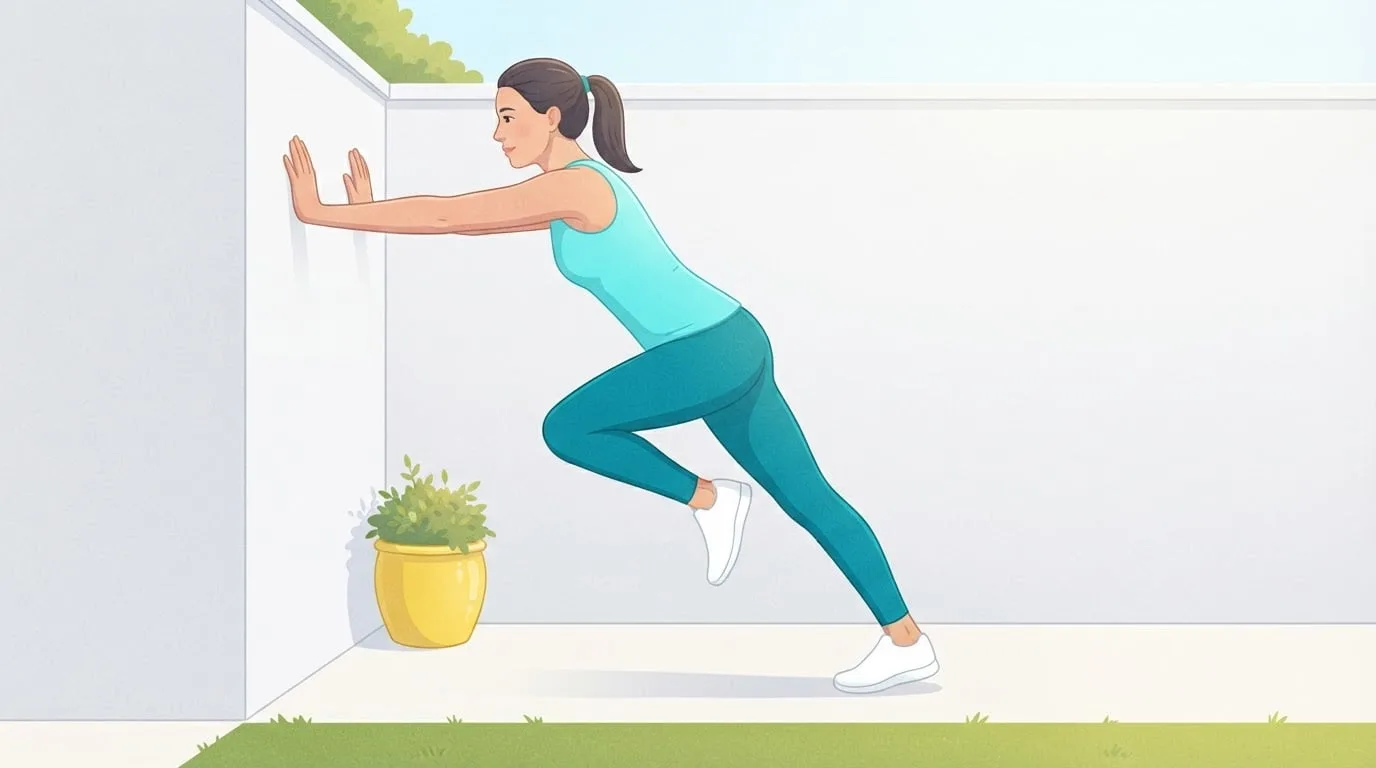
- Wall drill: stand arm's length from a wall, place your hands on it and lean forward from the ankles in a straight line. Drive one knee up to hip height with the toes pulled up, hold for a second, then switch legs. Progress to quick switches in sets of three.
- Runner's balance: stand on one foot in a running posture, other knee forward, for 20 to 30 seconds per side, keeping the standing hip level.
The wall drill is the home version of the A-march: the lean puts you in your running angle without moving, so you can feel the knee lift and the foot under your hip.
Running form exercises that support the drills
When people search for running form exercises, they often mean strength work rather than drills. Both matter. Drills teach the pattern, and strength lets you hold it on mile ten when you're tired. Two short sessions a week of split squats, single-leg Romanian deadlifts, calf raises and side planks covers the hips, calves and trunk that keep your form together. The running form guide linked above includes a full dumbbell and bodyweight table.
Running Warm Up Drills: Where Drills Fit Before a Run
Drills double as running warm up drills, and that's the easiest way to make them a habit. Put them after 5 to 10 minutes of easy jogging, when your muscles are warm, and before the main run. The order matters a little: start with marches and the slow drills, move to skips and high knees, and finish with hops and strides, so the intensity rises as you go.
- Before an easy run: a 6 to 8 minute set of 4 drills plus 3 strides.
- Before intervals, tempo runs or a race: the full 10 to 12 minute set, with 4 to 6 strides, so your legs have already run fast once.
- Before a long run: a few minutes of marches and ankle dribbles is enough. Save the hops.
Structured warm-ups built on running drills, balance and jumps have cut injuries in team-sport trials. Our dynamic warm-up guide covers that evidence and adds leg swings and mobility moves you can do first.
A 6-Week Running Form Drills Plan
Do drills twice a week before easy runs, or once before an easy run and once before a faster session. Keep the rest of your running the same.
| Weeks | Drills (sets x distance) | Strides |
|---|---|---|
| 1-2 | A-march, half butt kicks, ankle dribbles, high knees: 2 x 15-20 m each | 3 x 60 m, comfortable |
| 3-4 | A-skip, butt kicks, ankle dribbles, high knees, pogo hops (2 x 10): 2 x 20 m each | 4 x 80 m, building to quick |
| 5-6 | A-skip, B-skip, straight-leg runs, pogo hops (2 x 15), carioca: 2 x 20 m each | 4-6 x 100 m, fast but relaxed |
Once the drills feel smooth, you can add short bounding sets, 2 or 3 x 20 meters of long, springy strides, once a week. Bounding is the most demanding drill on the ankle, so it comes last.
Six weeks of drills is easy to plan and harder to do, because a 10-minute warm-up is the first thing that gets cut when you're short on time. Consistency is what makes a pattern stick, which is where a workout app that keeps you motivated can help. FitCraft builds you a personalized plan, an AI coach demonstrates exercises such as high knees and butt kicks on an interactive 3D model, and streaks and calendar tracking reward the weeks you show up.
Common Running Drill Mistakes
- Doing them tired. Drills after a hard run rehearse your worst form. Do them fresh.
- Going for height or speed. High skips and frantic high knees look impressive. Small, quick and tall is the goal.
- Leaning back. Leaning back to lift the knees higher teaches the overstriding posture you're trying to lose.
- Too many drills. Four to six drills done well beat twelve done half-heartedly.
- Skipping the strides. Without strides, the drill pattern stays in the drill. Strides carry it into your run.
- Rushing the hops. Pogo hops and bounding load the Achilles tendon hard. Build volume over weeks, and stop if you feel pain at the back of the heel.
The Bottom Line
Running form drills are a short rehearsal, not a magic fix. Pick 4 to 6 drills, do them for 8 to 12 minutes after an easy jog two or three times a week, and always finish with strides. The skipping drills teach where your foot should land, and the hopping drills build springier calves and Achilles tendons. Strength work and steady running do the rest.
You don't need to look like an elite runner in a drill line. You need a few minutes, a patch of grass or floor, and enough weeks in a row for the pattern to become yours.
Frequently Asked Questions
How often should you do running form drills?
Two or three times a week is enough. Each session takes 8 to 12 minutes after an easy jog, using 4 to 6 drills and finishing with a few strides. Keep at least one easy day between sessions that include pogo hops or bounding, because those load the calves and Achilles tendons hard.
Do running drills actually improve running form?
Running drills rehearse parts of good form, but no controlled trial has shown that a drill routine on its own changes how people run. Lab data show drills only partly match running mechanics. They work best as short practice followed by strides and easy running, where the pattern actually has to change.
Should you do running drills before or after a run?
Do running drills before a run, after 5 to 10 minutes of easy jogging, while you're fresh. Drills practised on tired legs rehearse sloppy mechanics. The best days are before an easy run or as part of the warm-up for a faster session.
What are the best running form drills for beginners?
The A-march, half butt kicks, ankle dribbles, high knees at a gentle pace and short strides are the best running form drills for beginners. They teach the foot to land under the body without much impact. Add A-skips after two weeks, and leave B-skips and bounding until the basics feel easy.
What is the difference between running drills and running form exercises?
Running drills are exaggerated pieces of the running stride, such as A-skips and butt kicks, done over 15 to 20 meters. Running form exercises usually means the strength work that supports form, such as single-leg squats, calf raises and side planks. Runners do best with both: drills for rehearsal and strength work for the capacity to hold good form when tired.
Can you do running form drills at home?
Yes. Marching in place, high knees in place, butt kicks, pogo hops and a wall drill all fit in a living room or yard. Wear running shoes and use a firm, non-slip floor. Practise the traveling drills like A-skips on a path or a quiet street when you can.