Wheel pose (Urdhva Dhanurasana) is an advanced yoga backbend that combines a hand-supported press, deep spinal extension, shoulder flexion, hip extension, and front-body opening. It engages the glutes, hamstrings, spinal erectors, deltoids, triceps, and core while stretching the chest, abdominals, hip flexors, lats, and front shoulders. The defining cue is simple: press through the hands and feet, then lift the chest through the arms instead of jamming the lower back. Start with bridge, cobra, cat-cow, shoulder mobility, and short elevated-wheel holds before attempting the full pose.
Wheel pose is a full-body backbend with real stakes. You need shoulder range, wrist tolerance, hip extension, thoracic mobility, leg drive, and enough core control to keep the arch spread across the body. If one link is missing, the pose usually borrows motion from the lower back.
Quick Facts: Wheel Pose
- Equipment needed: Yoga mat
- Difficulty: Advanced
- Modality: Yoga backbend and inversion
- Body region: Full body, with spine, shoulders, hips, and wrists emphasized
- FitCraft quest category: Yoga
Muscles Engaged & Stretched
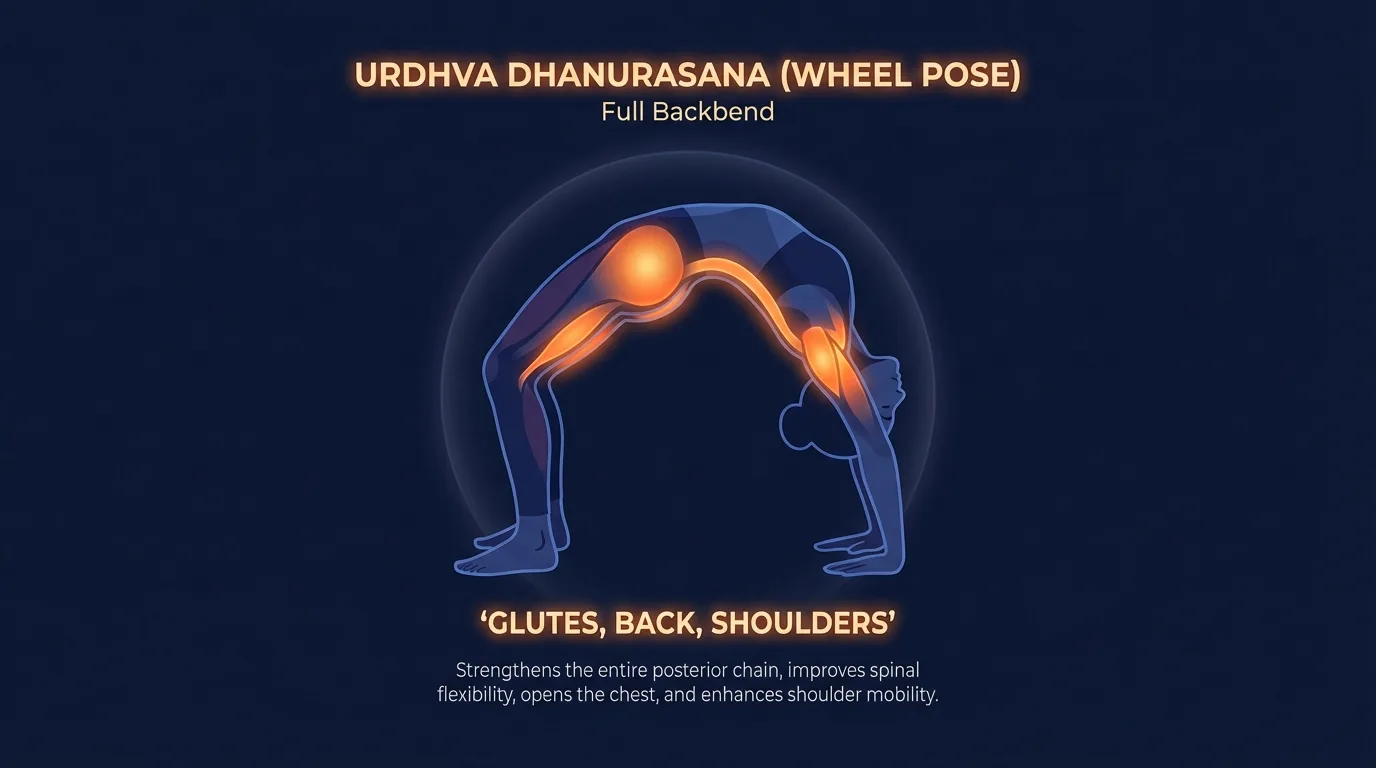
Primary movers: the glutes, hamstrings, spinal erectors, deltoids, and triceps drive the lift. The legs press into the floor to extend the hips, the spinal erectors hold the backbend, and the arms press through elbow extension as the chest rises.
Secondary movers: the quadriceps help keep the knees organized, the upper trapezius and serratus anterior assist shoulder positioning, and the calf complex stabilizes the feet against the mat. The chest and lats are not primary lifters here, but their mobility strongly limits how open the pose can feel.
Stabilizers: the deep neck flexors and extensors, rotator cuff, scapular muscles, transverse abdominis, obliques, and pelvic stabilizers work isometrically to keep the head, shoulders, ribs, pelvis, and knees organized while the body arches.
Mechanism: wheel pose is both a deep backbend and a partial inversion. The pose loads wrist extension, shoulder flexion, spinal extension, hip extension, and front-body length at the same time, so clean mechanics matter more than depth. No exercise-specific PubMed, PMC, or DOI citation is included in the verified FitCraft citation library for wheel pose, so this section uses mechanism-based anatomy instead of a proxy citation.
Step-by-Step: How to Do Wheel Pose
- Set up on your back. Lie on your back with knees bent, feet flat, and heels close enough that you can brush them with your fingertips. Keep the feet hip-width and parallel so the legs can drive the lift.
- Plant the hands by the ears. Bend your elbows and place your palms beside your ears with fingers pointing toward your shoulders. Set the elbows shoulder-width instead of letting them drift wide.
- Press to the crown lightly. Exhale and press through your feet and hands to lift your hips, then pause with the crown of the head barely touching the mat. Use this as an alignment checkpoint without loading the neck.
- Lift into the arch. Press the floor away, straighten the arms as much as your shoulders allow, and lift the chest through the arms. Engage the glutes, hamstrings, and thighs so the arch spreads across the whole body.
- Hold, breathe, and exit. Hold only while the breath stays calm and the lower back feels spacious. To come down, tuck the chin, bend the elbows, and lower slowly one vertebra at a time before resting with knees bent.
Get this exercise in a personalized workout
FitCraft, our mobile fitness app, uses its AI coach Ty to program yoga poses like this into your plan at the right volume and intensity, based on your level, goals, and equipment. Ty was designed and trained by Domenic Angelino, MPH (Brown University) and NSCA-CSCS, with research published in the Journal of Strength and Conditioning Research and Medicine & Science in Sports & Exercise.
Take the Free Assessment Free • 2 minutes • No credit card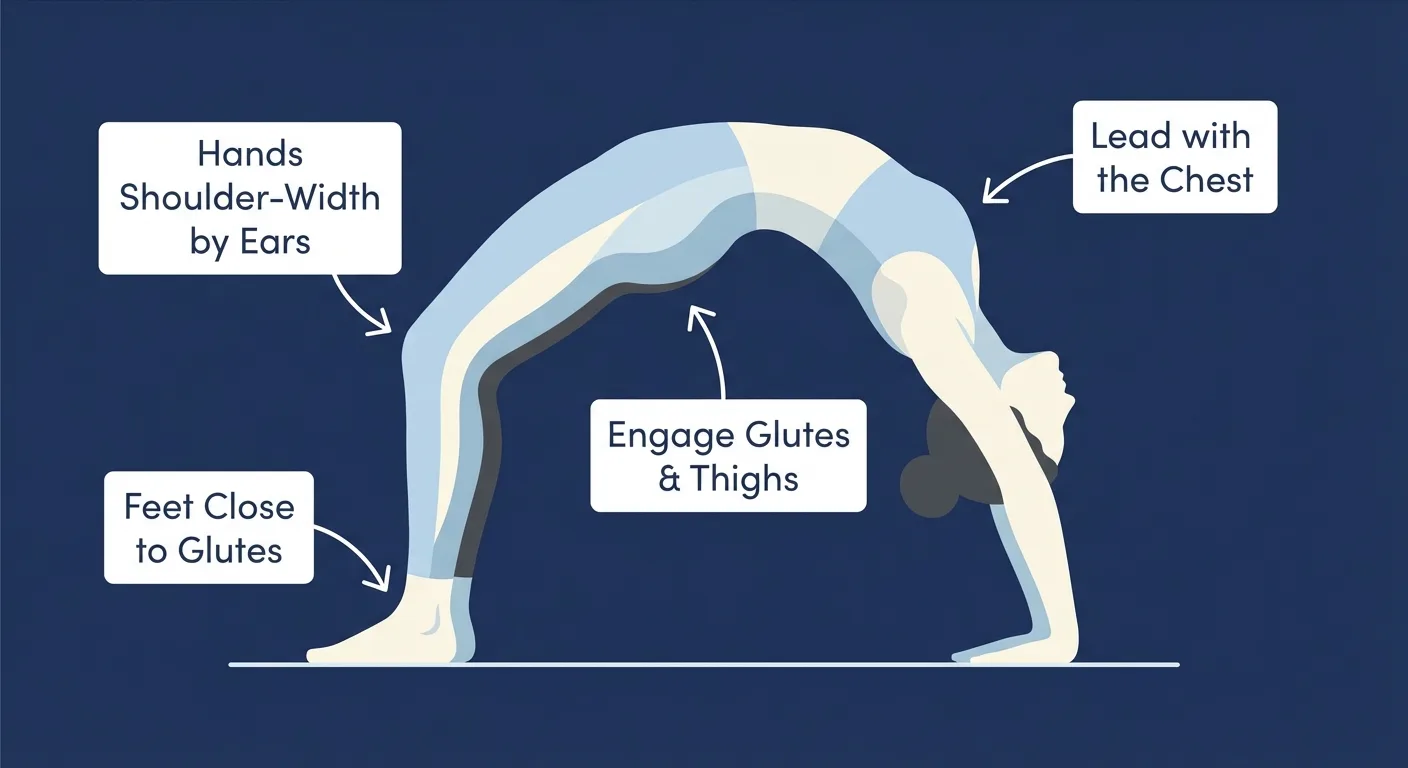
Common Mistakes (And How to Fix Them)
Dumping Into the Lower Back
What it looks like: the arch comes almost entirely from the lumbar spine while the glutes and thighs stay quiet.
Why it's a problem: the lower back takes the whole pose instead of sharing load with the hips, thoracic spine, and shoulders.
The fix: squeeze the glutes, drive the knees forward, and lift the chest through the arms. If the lower back still pinches, come down and use bridge or cobra pose that day.
Elbows Flaring Out
What it looks like: the elbows bow out to the sides before or during the press.
Why it's a problem: flared elbows make it harder to straighten the arms and often push the load into the wrists and lower back.
The fix: set the hands beside the ears, keep the elbows shoulder-width, and use elevated wheel until your shoulders can open without forcing the press.
Feet Drifting Forward
What it looks like: the feet slide away from the hips as you try to lift.
Why it's a problem: the longer base reduces leg drive and increases the demand on spinal extension.
The fix: reset the feet before each attempt. Keep them hip-width, parallel, and close enough that the knees can track forward as you lift.
Holding Your Breath
What it looks like: you press up, brace hard, and stop breathing.
Why it's a problem: breath holding raises strain and makes the front body guard against the stretch.
The fix: use shorter holds. Come down when the breath turns sharp, then rest in a neutral position before another attempt.
Loading the Head During the Checkpoint
What it looks like: you pause on the crown of the head with meaningful weight on the neck.
Why it's a problem: wheel pose is not a head-supported pose, and the cervical spine should not be the base of the movement.
The fix: touch the crown lightly only long enough to check hand and elbow position. If you cannot continue the press without neck pressure, lower and regress.
Wheel Pose Variations: Regressions and Progressions
Bridge Pose
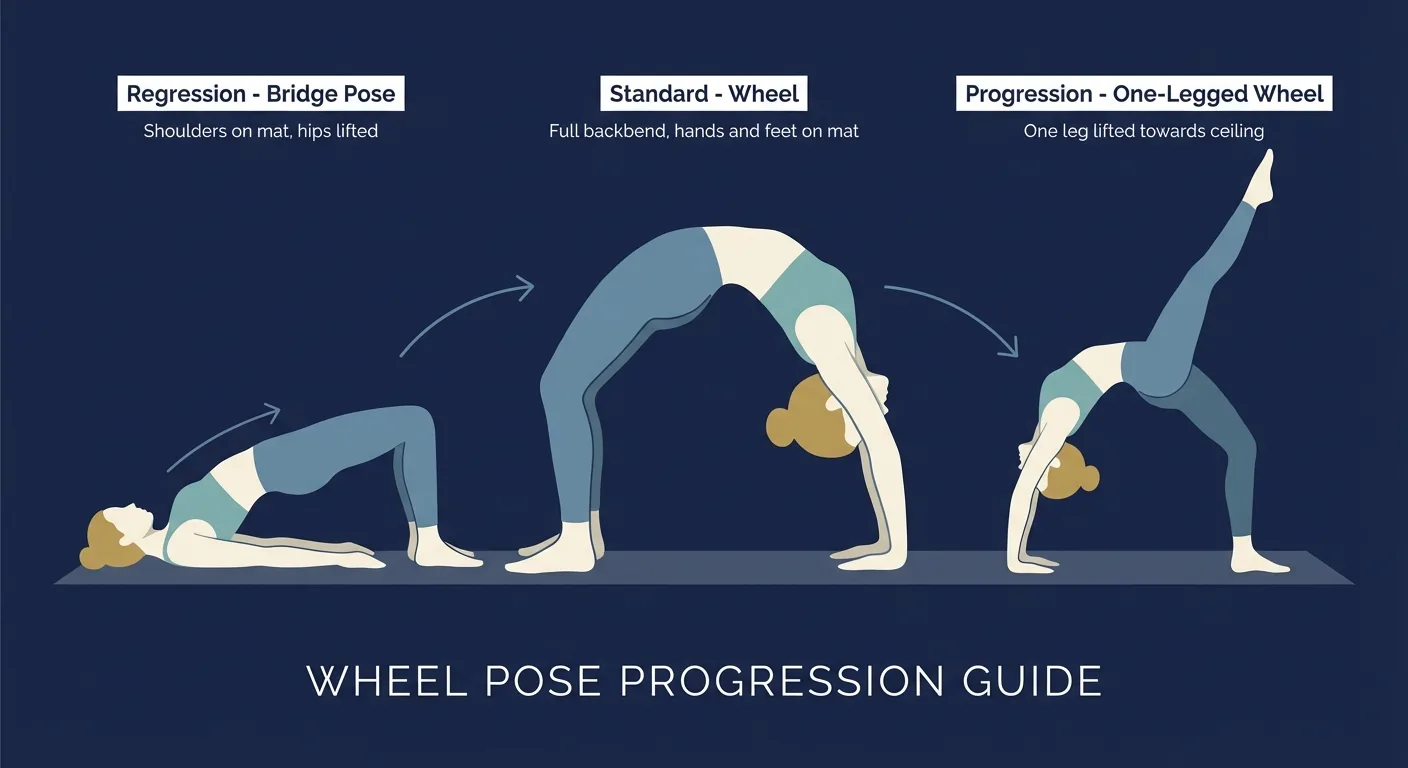
Bridge is the main regression. The shoulders stay on the floor while the hips lift, so you can learn glute engagement and spinal extension without the full wrist and shoulder demand of wheel.
Elevated Wheel
Place the hands on sturdy yoga blocks or a low step. The higher hand position reduces the shoulder-flexion requirement and lets you practice the press without forcing depth.
Standard Wheel Pose
Press through both hands and feet, lift the chest through the arms, and hold for a few calm breaths. This is the version most people mean when they say Urdhva Dhanurasana.
One-Legged Wheel
From a stable wheel, shift weight evenly through the hands and one foot, then lift the other leg. This advanced progression adds hip control, anti-rotation demand, and a much smaller base of support.
When to Avoid or Modify Wheel Pose
Wheel pose is safe for many healthy, well-prepared adults, but it is a deep backbend and partial inversion. Always consult your physician or a qualified physical therapist before practicing it if you have any medical concern, and use a modified pose when the full shape changes your breathing or creates sharp symptoms.
- Active lower back pain, disc symptoms, or spondylolisthesis. Full wheel can concentrate extension in the lumbar spine. Use cobra pose, cat-cow, or glute bridges until backbending is pain-free.
- Wrist pain or recent wrist injury. Wheel loads the wrists in deep extension. Build tolerance with wrist stretch and elevated wheel before floor attempts.
- Shoulder impingement or limited overhead range. If the arms cannot reach overhead without rib flare or pain, use shoulder rolls, rotator cuff stretch, and elevated wheel.
- Uncontrolled hypertension, glaucoma, recent eye surgery, or elevated intraocular pressure. The inverted component can increase pressure in the head and eyes. Get medical clearance before practicing.
- Pregnancy, especially second or third trimester. Deep backbends and inversions can change abdominal pressure, balance, and blood flow. Work only with a clinician and prenatal-qualified instructor.
- Active migraine, sinus infection, or cardiovascular disease. Pressure changes and intense bracing can worsen symptoms. Choose gentler mobility until you are cleared.
Related Exercises
Use these movements to build the shoulder range, spinal control, leg drive, and bracing wheel pose depends on:
- Easier backbend preparation: Cobra Pose, Cat-Cow, and Glute Bridges build extension tolerance before full wheel.
- Shoulder mobility: Downward Dog, Shoulder Rolls, Rotator Cuff Stretch, and Seated Rear Delt Stretch prepare the overhead position.
- Core foundation: Forearm Planks, Hand Planks, and Hollow Holds help keep the ribs and pelvis organized.
- Posterior-chain support: Superman Holds and Back Extensions train controlled spinal extension without the full inversion component.
- Adjacent yoga backbend: Camel Pose trains a kneeling backbend with less wrist loading than wheel.
- Advanced inversion comparison: Shoulder Stand Pose is a separate inversion pattern with more neck-specific safety demands.
How to Program Wheel Pose
Wheel pose programming should progress by setup quality, breath control, and hold time. The broader ACSM progression model supports gradual increases in training demand matched to the practitioner's level (Ratamess et al., 2009), but full wheel still needs a yoga-specific safety filter: form and calm breathing come first.
| Level | Sets x Hold | Rest between sets | Frequency |
|---|---|---|---|
| Beginner | 1-2 bridge or elevated-wheel holds of 5-15 seconds | 60-90 seconds or full breath recovery | 2-3 sessions/week |
| Intermediate | 2-3 elevated or full-wheel holds of 15-45 seconds | 60-120 seconds | 3-4 sessions/week |
| Advanced | 2-4 full-wheel holds of 45-90 seconds, or short one-legged variations | 90-180 seconds | 3-5 sessions/week if recovery stays good |
Where in your workout: practice wheel near the end of a yoga session, after the shoulders, spine, wrists, hips, and core are warm. Prepare with shoulder openers, cat-cow, cobra, bridge, and a few neutral-spine resets.
Form floor over time targets: end the hold when the lower back pinches, elbows flare, wrists hurt, breath tightens, or the exit starts to feel rushed. A short clean hold beats a longer hold with symptoms.
How FitCraft Programs This Exercise
FitCraft keeps advanced yoga work tied to your current level instead of treating every pose as a target you should force. Ty can place yoga poses into a broader plan, scale volume and intensity, and keep prerequisite mobility work in front of harder positions.
For a pose like wheel, that means earning the shape with bridge strength, shoulder mobility, wrist tolerance, and calm breathing before chasing a deeper arch.
Frequently Asked Questions
What muscles does Wheel pose work?
Wheel pose engages the glutes, hamstrings, spinal erectors, deltoids, triceps, and shoulder stabilizers while stretching the hip flexors, abdominals, chest, lats, and front shoulders. The pose asks the legs and arms to press into the floor while the spine extends and the chest opens.
Can I do Wheel pose with lower back pain?
No. Active lower back pain, disc symptoms, spondylolisthesis, or pain that increases with backbending is a strong reason to skip full wheel. Use cobra pose, cat-cow, glute bridges, or clinician-approved mobility work until extension feels pain-free.
What is the difference between Bridge and Wheel pose?
Bridge keeps the shoulders and upper back on the floor while the hips lift, so the shoulder and wrist demand is low. Wheel presses through both hands and feet, lifts the head and torso, and creates a much deeper backbend that requires more shoulder flexion, wrist extension, and upper-body strength.
How do I progress from Bridge to Wheel pose?
Build a comfortable bridge first, then add shoulder mobility with downward dog, rotator cuff stretch, and shoulder rolls. Next, practice elevated wheel with hands on blocks or a low step. Move to full wheel only when the arms can press without elbow flare and the lower back stays comfortable.
Why can't I straighten my arms in Wheel pose?
Bent arms usually point to limited shoulder flexion, tight lats or pecs, weak triceps, or elbows that flare away from the midline. Use elevated wheel, downward dog, shoulder rolls, and rotator cuff mobility before forcing the full pose.