At first glance the Cossack squat looks like a side lunge. The difference shows at the bottom: your hips sink much lower over the bent leg, and the straight leg rests on its heel with the toes pointing at the ceiling instead of keeping its foot flat.
That bottom position is why the exercise takes more than leg strength. You need enough flexibility in your hips, ankles and inner thighs to sit low with the bent-leg heel flat, plus the control to stand back up without bouncing.
Treat depth as something you build. Hold a kitchen counter or sink part way while you learn, then add range, a pause at the bottom or a dumbbell at your chest once every rep looks the same on both sides.
Quick Facts: Cossack Squat
- Equipment needed: None for the main version; a kitchen counter or door frame to hold helps while you learn, and one dumbbell held at the chest is the harder version
- Difficulty: Advanced, because sinking deep on one leg while the other stays straight takes a lot of hip, knee and ankle mobility and inner-thigh flexibility (holding a support or sinking part way makes it easier)
- Modality: Strength and mobility
- Body region: Front of the thighs, glutes, inner thighs and outer hips
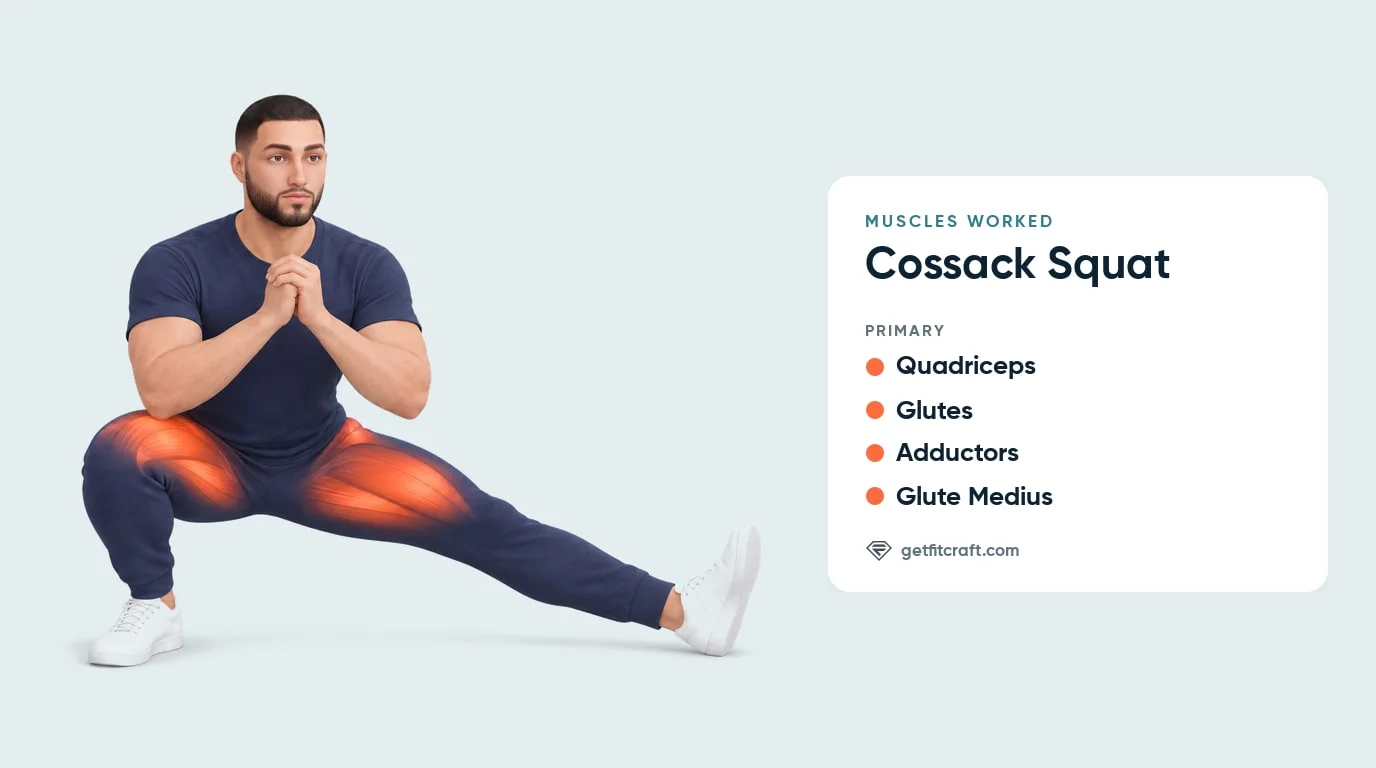
Cossack Squat Muscles Worked
Primary muscles: the quadriceps, the glutes, the adductors and the glute medius. Most of the work happens on the bent leg. Its quadriceps, along the front of the thigh, control the knee as it folds deeply and travels forward over the toes, then straighten it to stand you up. The glutes manage the deep bend at your hip, which in the full version drops your hips below the knee, and they help drive you up out of the bottom.
The inner thighs: the adductors lengthen under load as you sit into one leg. That is the long pull you feel along the inside of the straight leg while it rests on its heel. They then help bring you back to the middle. Working through that stretch while you hold your weight is a big part of why this move builds mobility as well as strength.
The outer hip: on the bent-leg side, the glute medius steadies the knee so it tracks your toes and does not cave inward while your weight moves across.
Where you should feel it: mostly in the front of your bent thigh and in your glutes, with your inner thighs working and a stretch along the inside of the straight leg. You should not feel it in your knee or your lower back.
We could not find a study that measured muscle activity in the Cossack squat, so this section explains what each muscle does in the movement instead of quoting activation numbers.
Step-by-Step: How to Do a Cossack Squat
New to the Cossack squat? Stand facing a kitchen counter or a door frame and hold it lightly, so your hands can help lower you and help you back up.
Step 1: Set a Wide Stance
Stand with your feet wide apart, about one and a half to two times shoulder width, with your toes pointing forward or turned out a little. Clasp your hands together in front of your chest, or reach them forward if that helps your balance. Stand tall and brace your core.
Form tip: start at the narrower end of that range. A wider stance stretches the inner thighs more and makes the exercise harder.
Step 2: Sit Into One Leg
Shift your weight toward one side and sit your hips down and back into that leg. Bend the knee so it points the same way as your toes. Unlike in a side lunge, the knee is allowed to travel forward over the toes here, as long as it never caves inward.
Form tip: keep the whole bent foot flat, heel included. If the heel lifts, you have gone deeper than you can control today, so stop a little higher.
Step 3: Keep the Other Leg Straight, Toes Up
As you sink, the other leg stays straight and its foot rolls back onto the heel, so the toes point up. The amount of roll depends on how open your hips are, and it often needs to roll less as your hips loosen up with practice.
Form tip: if the straight leg starts to bend, you have reached your depth for today.
Step 4: Sink Only as Deep as You Can Control
Lower over about two or three seconds with your chest up and your back flat. A slight forward lean from the hips is fine, but do not let your back round. The full version takes your hips below the bent knee, yet any depth you can hold with good form counts. Pause briefly at the bottom, and breathe in on the way down.
Form tip: if the front of your bent hip feels pinched, do not sink as deep. Any pain in your hip, knee or groin means stop.
Step 5: Stand Up in the Middle and Switch Sides
Push through the whole bent foot to stand back up in the middle, breathing out as you rise. Then lower to the other side. Alternate every rep, and try to match your depth and your reps on both sides.
Form tip: rise smoothly instead of bouncing out of the bottom, and keep breathing on every rep.
Get a personalized lower-body workout
FitCraft, our mobile fitness app, does not include the Cossack squat, but it uses an AI coach to program lower-body exercises such as side lunges, sumo squats and curtsy lunges into your plan at the right volume and intensity, based on your level, goals, and equipment. Every FitCraft program is designed by Domenic Angelino, MPH (Brown University) and NSCA-CSCS, with research published in the Journal of Strength and Conditioning Research and Medicine & Science in Sports & Exercise.
Take the Free Assessment Free · 2 minutes · No credit card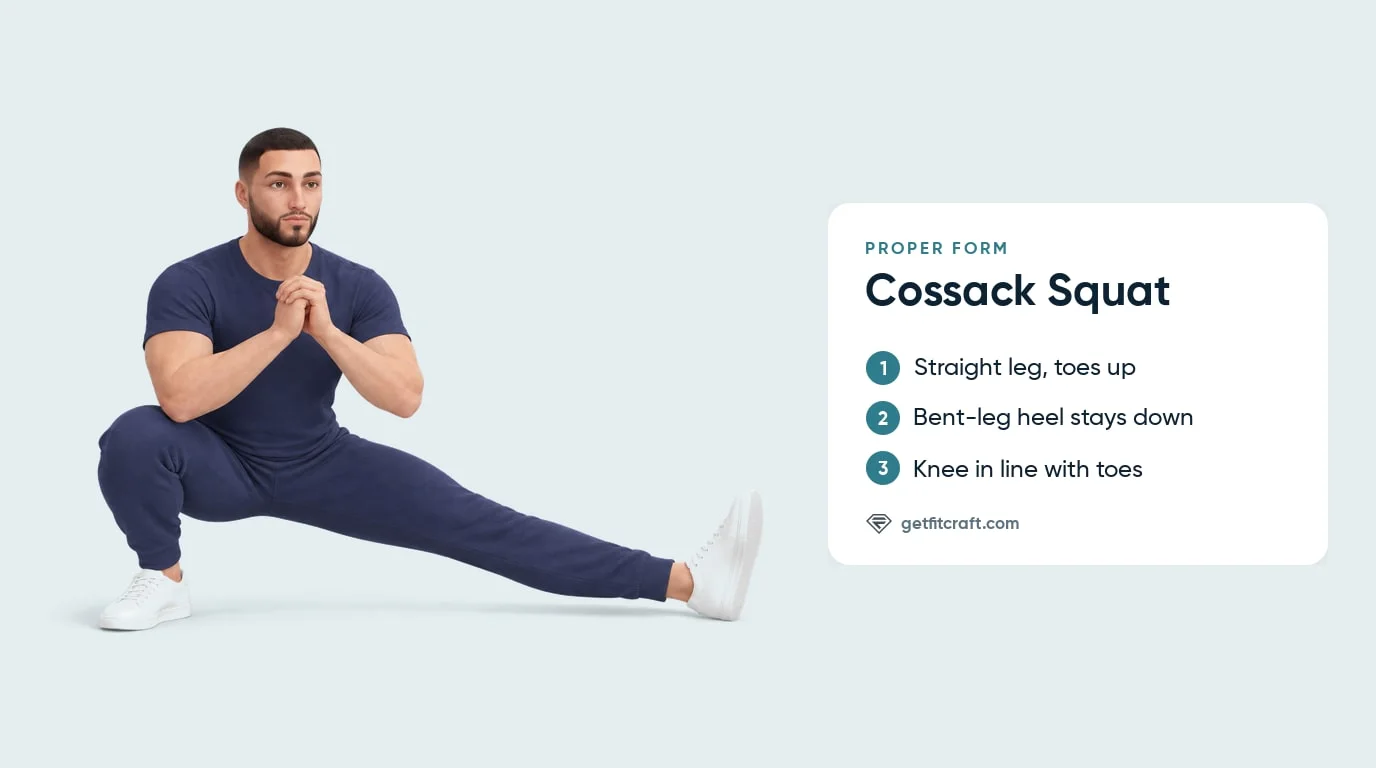
Cossack Squat Mistakes and How to Fix Them
These faults usually show up at the bottom of the rep, when you go deeper than you can control. Fix the position first and let the range grow over time.
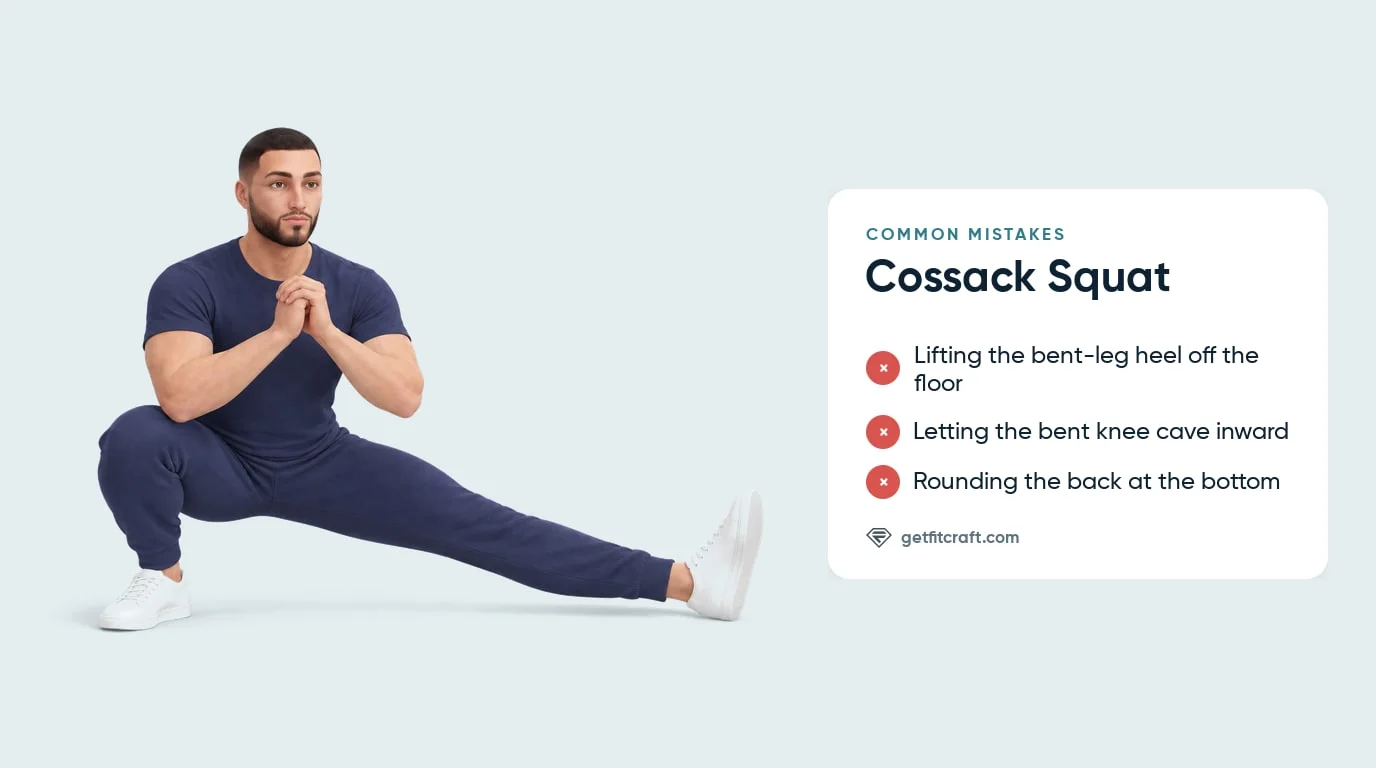
- Lifting the bent-leg heel. The heel comes up when the depth runs ahead of your ankle and hip mobility. Stop at the depth where the whole foot stays flat, and hold a support if that helps.
- Letting the bent knee cave inward. Point the knee the same way as your toes for the whole rep. If it keeps drifting in, sink less deep and hold a support.
- Rounding your back at the bottom. Keep your chest up and your back flat, with no more than a slight lean forward from the hips. Rounding usually means you have gone too low, so stop where your back still stays flat.
- Bending the straight leg. A straight leg with the toes up is what makes this a Cossack squat. If that knee starts to bend, do not sink as deep.
- Sinking deeper than you can control. Going lower than you can hold makes the heel lift, the knee cave or the back round. Any controlled depth counts, so add range a little at a time.
- Dropping or bouncing into the bottom. Lower over about two or three seconds and pause briefly before you stand up. Never bounce out of the bottom.
Three things look like faults but are not: toes that point forward or turn out a little, a bent knee that moves forward over the toes, and a straight-leg foot that rolls only part way onto its heel. All three are fine as long as the knee tracks your toes and the other leg stays straight.
Cossack Squat Variations: Easier and Harder Versions
Make it easier with support or less depth. Make it harder with a pause, a wider stance, a dumbbell or a low shift from side to side.
Supported Cossack Squat (Easier)
Hold a kitchen counter or a door frame in front of you and use your hands to help you down and back up. A resistance band anchored at chest height to a sturdy post works the same way: hold it in both hands and lean back on it lightly.
Part-Depth Cossack Squat (Easier)
Sink only part way, as deep as your heel stays down and your back stays flat, and add a little depth over time. If the stretch along your inner thigh feels too strong, bring your feet a little closer together.
Bodyweight Cossack Squat (Advanced)
This is the standard version taught on this page: hands clasped at your chest, feet planted wide, standing up in the middle between sides. Stay with it until both sides look the same, with the heel down, the knee tracking the toes and the other leg straight.
Paused Cossack Squat (Harder)
Hold the bottom for a second or two on every rep, heel down and chest up, before you stand. The pause takes away any bounce.
Wider-Stance Cossack Squat (Harder)
Set your feet a little wider than before. The inner thigh of the straight leg has to stretch further, so widen only once the standard stance feels easy.
Goblet Cossack Squat (Harder)
Hold one dumbbell upright against your chest with both hands. Most guides show a kettlebell held the same way, and a dumbbell does the same job. A light weight acts as a counterbalance that can make it easier to stay upright, so a light goblet hold may feel easier than none. A heavier dumbbell makes the exercise harder.
Low Cossack Shift (Harder)
Once the paused and goblet versions feel easy, stay low and shift from one side to the other without standing up in between.
Cossack Squat vs Side Lunge
The side lunge is the easier lateral move and a good one to learn first. The two exercises work similar muscles, but they differ in four ways.
| What changes | Side lunge | Cossack squat |
|---|---|---|
| Feet | Start hip-width apart and step out and back on every rep | Stay planted wide for the whole set |
| Depth | Stops with the bent shin about vertical and the knee over the second toe | Much deeper: the full version takes the hips below the bent knee, and that knee may travel forward over the toes |
| Straight leg | Stays long with its foot flat on the floor | Rolls back onto its heel with the toes pointing up |
| Mobility needed | Less range, so less hip and ankle mobility | Far more hip, knee and ankle mobility and inner-thigh flexibility |
The side lunge column follows the ACE exercise library's side lunge. The side lunge lean mixes the two: your feet stay planted wide as in a Cossack squat, but the lean is shallower and both feet stay flat.
When to Avoid or Modify Cossack Squats
A stretch along your inner thigh and a burn in your thighs and glutes are normal during Cossack squats. Stop right away if you feel pain in a joint, your groin, your lower back or your neck. The conditions below call for a check with a doctor or physical therapist before you start, because they can give you advice that fits your body and history.
- Knee pain or a knee injury. At the bottom, the bent knee folds deeply and moves forward over the toes. See a doctor or physical therapist before you do Cossack squats, and ask them which exercises suit you. Any knee pain during a rep means stop.
- Groin strain or inner-thigh pain. The inner thigh of the straight leg stretches under load as you sink. Get it checked by a doctor or physical therapist first, and ask them when this exercise is right for you. Any groin pain means stop.
- Hip pain or a known hip condition. The bent hip folds deeply in the full version. Ask a doctor or physical therapist whether Cossack squats suit you before you try them. Any hip pain during a rep means stop.
- Lower-back pain, sciatica, or a disc problem. Your back has to stay flat while your hips sink low. Skip Cossack squats while your back hurts, and see a doctor or physical therapist before you do them. Any lower-back pain means stop.
- Recent knee, hip, ankle, or groin surgery. Get clearance from your surgeon first, and ask them or your physical therapist when and how to start.
- Balance problems, dizziness, or frequent falls. The big shift from side to side can lead to a fall. Check with your doctor or physical therapist before you try it, and keep a sturdy support within reach. If you feel dizzy or light-headed, stand up slowly, hold on and rest.
- Uncontrolled high blood pressure or heart disease. Ask your doctor whether Cossack squats are right for you and how hard you should push. Breathe steadily through every rep instead of holding your breath.
- Pregnancy or early postpartum. Ask your doctor or midwife whether Cossack squats suit you at your stage, and which version to use. Any pain in your back, belly, pelvis or groin means stop.
Related Exercises
Use these to build up to the Cossack squat or to train the same areas from a different position:
- Easier side-to-side moves: the Side Lunge Lean keeps the feet planted wide with a shallower lean, and Side Lunges step out to a vertical shin. Both teach the sideways weight shift before you add Cossack depth.
- Wide stance with a reach: the Side Lunge Toe Touch adds a cross-body reach toward the foot of the bent leg, with both feet flat.
- Wide stance on two legs: Sumo Squats work the glutes, quads and glute medius from a wide, toes-out stance with both knees bending.
- The goblet hold: Goblet Squats teach the dumbbell-at-the-chest hold used in the goblet Cossack squat.
- One leg at a time: Split Squats and Bulgarian Split Squats load one leg from a front-to-back stance instead of a side-to-side one.
- Outer hip: Fire Hydrants and Curtsy Lunges work the glute medius, the muscle that keeps your bent knee in line.
- Inner-thigh flexibility: Butterfly Pose stretches the adductors along your inner thighs from a seated position.
How to Program Cossack Squats
For beginners, the American College of Sports Medicine position stand on resistance training recommends 8 to 12 reps per set and training 2 to 3 days a week (Ratamess et al., 2009). It does not cover the Cossack squat, so use the table below as a practical place to start, not as figures from the position stand.
| Version | Sets × Reps | Rest between sets | Frequency |
|---|---|---|---|
| Easier (holding a support, or part depth) | 2-3 × 8-12 per side | 60-90 seconds | 2-3 sessions/week |
| Advanced (bodyweight, hands clasped at the chest) | 2-3 × 6-10 per side | 60-90 seconds | 2-3 sessions/week |
| Harder (a pause, a wider stance, a goblet dumbbell, or the low shift) | 3 × 6-8 per side | 90-120 seconds | 2-3 sessions/week |
Progress in this order: add depth first, then a pause at the bottom or one dumbbell held at your chest, and save the low shift for when both of those feel easy. A 2020 article on warm-ups for young athletes in the NSCA's Strength and Conditioning Journal lists Cossack squats as a warm-up move for competent, older youth athletes, at 1 set of 4 per side. It saves loaded Cossack squats for experienced, well-trained athletes who have already done simpler side-to-side hip work such as lateral band walks (Myburgh et al., 2020).
Where in your workout: a few slow reps per side fit a warm-up before lower-body training, and full sets fit after your main leg exercises. If you hold a dumbbell, do your sets earlier in the session, while your legs are fresh.
Form floor over rep targets: end the set when the bent-leg heel lifts, the knee caves inward, your back rounds or the straight leg bends. A few clean reps on each side are worth more than a full set of sloppy ones.
Cossack Squats and FitCraft
Cossack squats reward patience. Your hips and ankles loosen up with practice, so let the depth come a little at a time instead of forcing it.
The FitCraft app does not include the Cossack squat, so use the versions above to plan it yourself: a support or part depth while you learn, the bodyweight version once both sides look the same, then a pause, a wider stance or a dumbbell at your chest. The app's closest exercises are the side lunge lean and the side lunge, which train the sideways weight shift with both feet flat.
FitCraft builds its plans from dumbbell, bodyweight and a handful of band exercises. Each exercise comes with a 3D demo that shows the form, and the app is gamified.
Frequently Asked Questions
What do Cossack squats work?
Cossack squats work the quadriceps, glutes, adductors and glute medius. The front of your bent thigh and your glutes lower you into the deep squat and push you back up. Your inner thighs work under a long stretch as you sink, and on the bent-leg side your outer hip holds that knee in line with your foot. Because the stretch happens under load, the move trains hip mobility and leg strength at the same time.
What is the difference between side lunges and Cossack squats?
A side lunge starts with your feet hip-width apart, steps out and back on every rep, and stops with the bent shin about vertical while the other foot stays flat. In a Cossack squat your feet stay planted wide for the whole set, you sink much deeper, the bent knee may travel forward over your toes, and the straight leg rolls onto its heel with the toes up. That extra depth asks far more of your hips, ankles and inner thighs, so the side lunge is the easier one to learn first.
Are Cossack squats harder than squats?
Usually, yes. A regular squat shares the work between both legs, while a Cossack squat shifts most of your weight onto one bent leg as the other stays straight. Sinking deep with that heel flat also takes hip, ankle and inner-thigh flexibility, which comes with practice. Holding a kitchen counter or sinking only part way makes it easier while you build it.
What can I do instead of a Cossack squat?
If you cannot reach the depth yet, build up with two easier side-to-side moves. The side lunge lean keeps your feet planted wide but uses a shallower lean with both feet flat, and the side lunge steps out and stops with the bent shin about vertical. You can also keep the Cossack squat and make it easier by holding a kitchen counter or sinking only part way. If pain is the reason you want a substitute, see a doctor or physical therapist first.
Can I do Cossack squats with knee pain?
Not while your knee hurts. A burn in your thighs and glutes and a stretch along your inner thigh are normal, but stop right away if you feel pain in your knee or any other joint, your groin, your lower back or your neck. If you have knee pain or a knee injury, see a doctor or physical therapist before you do Cossack squats, and ask them which exercises suit you.
How low should you go in a Cossack squat?
Sink only as deep as you can control with your bent-leg heel flat, your back flat and the other leg straight. The full version takes your hips below the bent knee, but any controlled depth counts, and depth comes with practice. If the heel lifts or the straight leg starts to bend, stop a little higher; that is your depth for today.
Should the toes on the straight leg point up?
Yes. In the classic Cossack squat, the straight leg's foot rolls back onto its heel as you sink, so the toes point up at the ceiling. How far it rolls depends on your hips, and it often needs to roll less as they loosen up. A foot that rolls less is fine, as long as that leg stays straight.