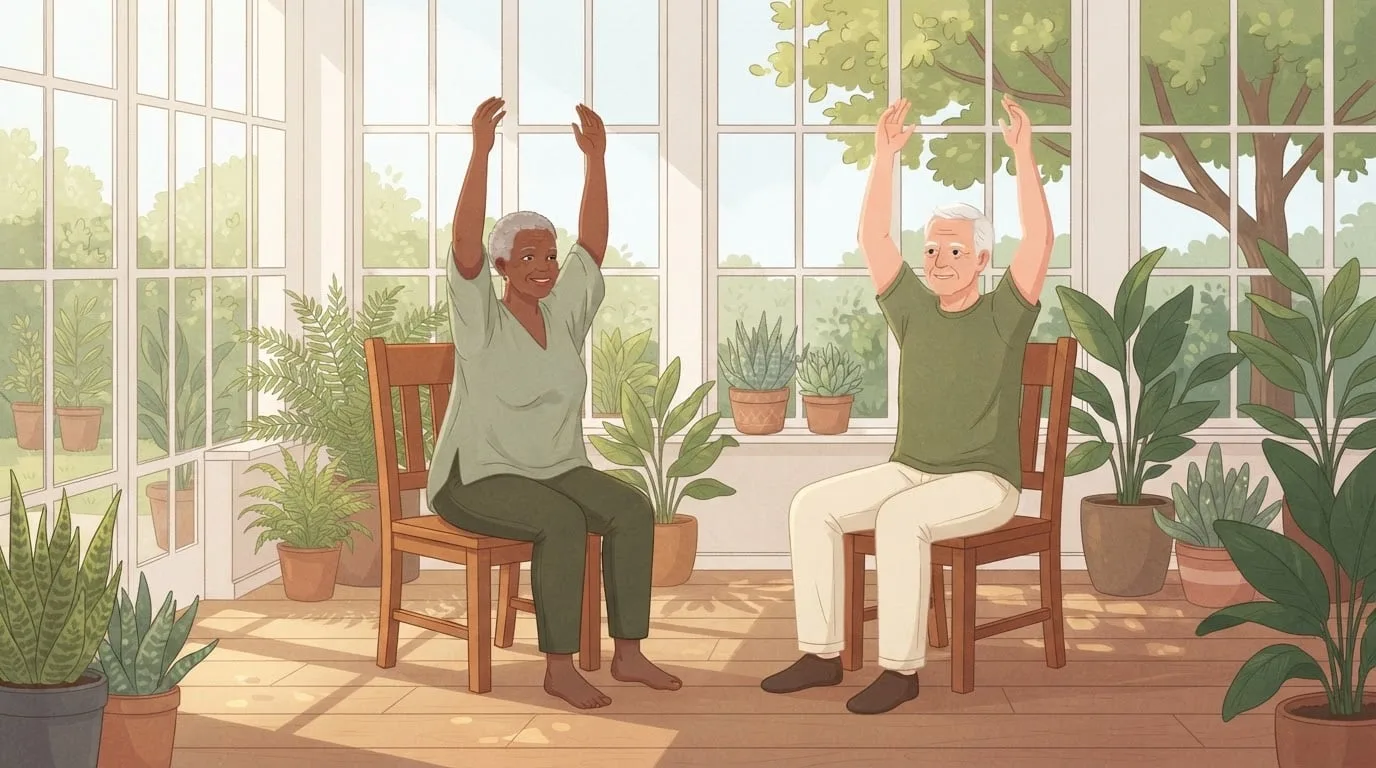
Maybe your doctor suggested yoga for your balance. Maybe a friend swears by her Tuesday class. Then you watch a video, and the teacher drops to the floor, folds in half and balances on one leg. You start to wonder how your knees, your back or your new hip would cope.
That worry is fair. Yoga for the elderly isn't the same class done slower. Bones thin, replaced joints have limits, and a fall costs more at 75 than at 35. Most beginner classes aren't built around any of that, so people either push through poses that don't suit them or decide yoga isn't for them.
Gentle yoga for seniors works when the routine is built around a chair, the poses keep the spine long, and you know which shapes to skip. This guide covers beginning yoga for seniors from that angle: the best type to choose, a supported routine, and what the research on balance, falls, bones and joint replacements means for your practice. For the general basics of starting yoga, from props to pose names, see our guide to yoga for beginners at home.
What Is the Best Type of Yoga for Seniors?
The best type of yoga for seniors is a slow, prop-supported hatha class or chair yoga, with every standing pose done beside a chair or wall. The style name on the timetable matters less than how the class is run. Here's how the common options compare for older bodies:
- Gentle hatha. Slow, one pose at a time, with time to set up. It's a good default if you can get down to the floor and back up.
- Chair yoga. Every pose is done sitting or standing with a hand on the chair. It suits people with knee or hip arthritis, shaky balance or trouble with the floor.
- Iyengar-style classes. These use props and careful alignment, which helps older students. They also hold poses for a long time, and the biggest falls trial below used this style.
- Restorative and yin. These are long, passive holds. They're relaxing, but yin's long seated forward folds round the spine, so skip them if you have osteoporosis.
- Hot yoga and fast flows. Leave these for later. Heat adds strain to the exercise, and quick drops to the floor and back up can leave you dizzy.
Two features matter more than the label. First, the class should move you between poses, not only hold you still, because moving balance is what the falls research rewards. Second, the teacher should offer a chair or wall version of every standing pose without being asked. A good test is to ask before you sign up: "How do you adapt this class for someone with osteoporosis or a hip replacement?" A clear answer tells you the teacher has worked with older students.
A Gentle Yoga Routine for Seniors, With a Chair
This routine of ten senior yoga poses takes about 20 minutes. It starts seated, moves to standing with the chair as support, and ends seated, so you never need to get down to the floor. Use a sturdy chair without wheels, pushed against a wall so it can't slide. Practice barefoot on a non-slip surface, or in flat shoes with good grip, since socks slip.
| # | Pose | Position | What it trains |
|---|---|---|---|
| 1 | Seated mountain with slow breathing | Seated | Posture and a calm start |
| 2 | Seated cat-cow, small range | Seated | Gentle spine warm-up |
| 3 | Seated side bend | Seated | Side of the trunk and ribs |
| 4 | Seated chest opener | Seated | Upper back extension |
| 5 | Chair pose from the chair | Sit to stand | Thigh and hip strength |
| 6 | Mountain pose with heel raises | Standing, both hands on the chair | Calves and ankles |
| 7 | Supported warrior 2 | Standing, one hand on the chair | Leg strength in a wide stance |
| 8 | Moving balance taps | Standing, hands on the chair | Balance while shifting weight |
| 9 | Supported warrior 3 prep | Standing, hands on the chair | One-leg balance and the back of the hips |
| 10 | Seated rest with long breaths out | Seated | Heart rate and breathing settle |
1. Seated mountain with slow breathing (2 minutes)
Sit on the front half of the seat with your feet flat and hip-width apart and your knees over your ankles. Rest your hands on your thighs and lengthen up through the top of your head. Breathe in through your nose for a count of four and out for a count of six. A longer breath out helps your body settle.
2. Seated cat-cow, small range (90 seconds)
Keep your hands on your thighs. As you breathe in, lift your chest and draw your shoulders back. As you breathe out, let your back round only a little. If you have osteoporosis, keep the rounding very small or skip it and repeat only the lift. Our seated cat-cow guide shows both halves of the move.
3. Seated side bend (1 minute each side)
Hold the side of the seat with your left hand and reach your right arm up and over toward the left. Keep both sit bones heavy on the chair and your chest facing forward, with no twist. Hold for three slow breaths, come back to center and repeat. The seated side bend page has an easier version with your hand on your head.
4. Seated chest opener (1 minute)
Lift your arms out to the sides, bend your elbows to about 90 degrees and squeeze your shoulder blades gently together. Lift your breastbone and keep your eyes looking straight ahead rather than up. Hold for three breaths, rest your arms and repeat four times. This spine-lengthening shape is the kind of movement the osteoporosis research below favors.
5. Chair pose from the chair (90 seconds)
Sit near the front of the seat with your feet slightly behind your knees. Reach your arms forward, lean your chest forward over your feet and stand up slowly. Then sit back down with control, as if the chair were a little farther away than it is. Do five to eight slow repeats, then try hovering just above the seat for one breath. Chair pose is the strength move of this routine.
6. Mountain pose with heel raises (90 seconds)
Stand behind the chair with both hands on the backrest. Stand tall with your weight spread across both feet. Rise slowly onto the balls of your feet, pause, and lower for a count of three. Do eight to ten. These calf raises train the ankle muscles that catch you when you trip.
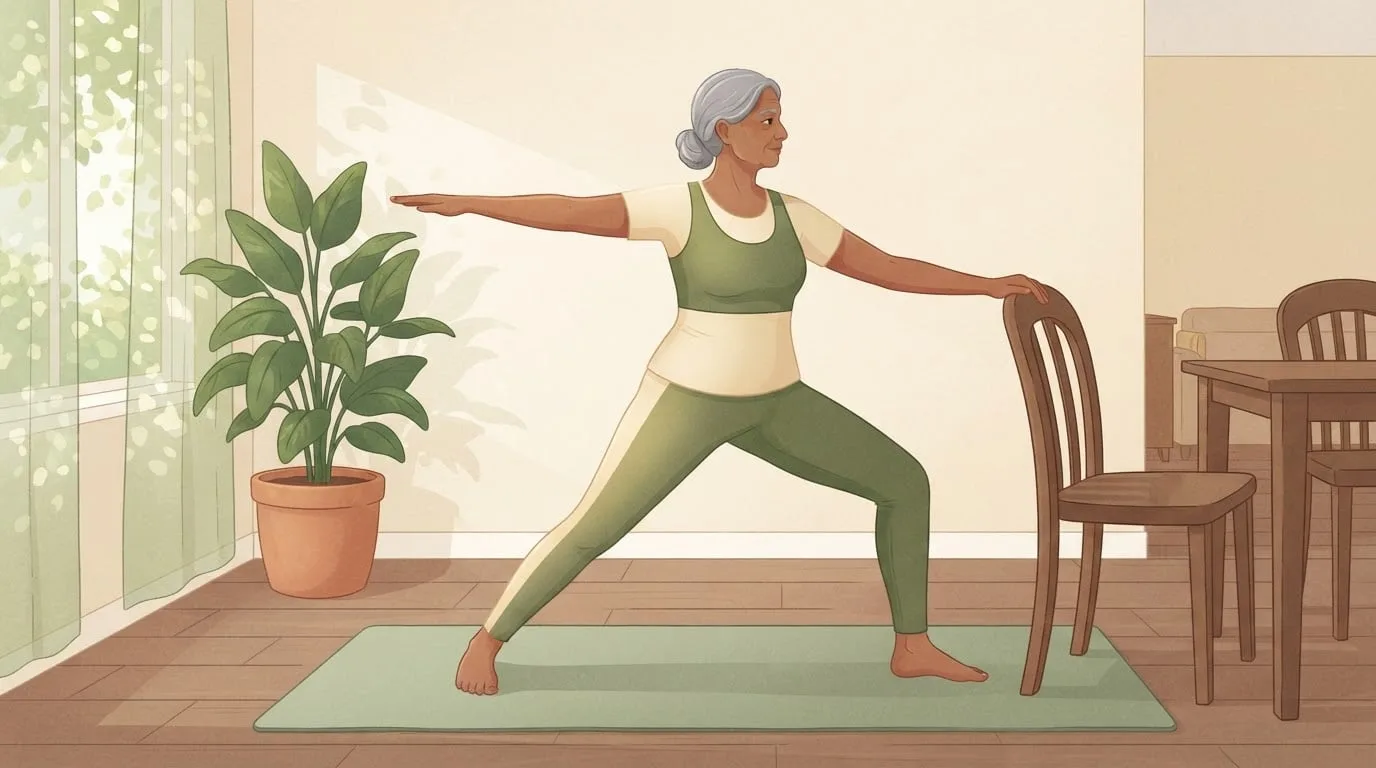
7. Supported warrior 2 (1 minute each side)
Stand side-on to the chair with your near hand on the backrest. Step your far foot out wide, turn that foot out and bend the knee over the ankle, keeping the other leg straight. Reach your free arm out at shoulder height and breathe for three to five breaths. A shorter stance makes this warrior pose easier.
8. Moving balance taps (3 minutes)
Stand behind the chair with both hands on the backrest. Shift your weight onto your left foot and tap your right toes forward, then out to the side, then behind you, and return to the middle. Do five rounds, then switch sides. When it feels easy, hold on with one hand, then with just your fingertips. Shifting your weight like this trains balance on the move, which the falls research suggests matters more than holding still.
9. Supported warrior 3 prep (1 minute each side)
Keep both hands on the backrest and step back so your arms are straight. Hinge forward a little from your hips with a flat back, then lift one foot a few inches off the floor behind you. Hold for three breaths and lower. Keep the hinge small if you've had a hip replaced from the back. The full warrior 3 comes much later, if at all.
10. Seated rest with long breaths out (2 minutes)
Sit back down and let your hands rest in your lap. Close your eyes if that feels comfortable, and let each breath out run a little longer than the breath in. Stay for two minutes before you stand up, and stand slowly. Pausing here helps if you tend to feel light-headed when you stand.
Find out what's really holding you back
FitCraft, our mobile fitness app, pairs you with an AI coach who builds you a personalized plan around your goals, schedule, and fitness level. Every FitCraft program is designed by Domenic Angelino, MPH (Brown University) and NSCA-CSCS, with research published in the Journal of Strength and Conditioning Research and Medicine & Science in Sports & Exercise.
Take the Free Assessment Free • 2 minutes • No credit cardDoes Yoga Improve Balance and Prevent Falls in Older Adults?
Yoga improves balance a little in older adults, but the one large trial that counted falls found more of them, not fewer. Most of the other benefits people expect from yoga, such as flexibility, back pain relief and lower stress, come from trials of middle-aged beginners, and our yoga for beginners at home guide covers them. Balance and falls are where the evidence for older adults stands on its own.
Balance and mobility: small to medium gains
Youkhana and colleagues (2016), in Age and Ageing, pooled six good-quality trials of physical yoga in 307 people aged 60 and over. Yoga had a small effect on balance tests and a medium effect on mobility tests such as walking and standing up. The authors were careful to add that better test scores don't prove yoga prevents falls. Someone had to test that directly.
Falls: the trial that found the opposite
That test was the SAGE trial. Oliveira and colleagues (2025), in The Lancet Healthy Longevity, randomized 700 Australians aged 60 and over who weren't doing yoga. Their average age was 67, and 81% were women. One group was offered 80 supervised one-hour Iyengar-based classes, twice a week for a year, and was encouraged to practice at home on two more days. The other group attended two workshops on seated breathing and stretching.
The yoga group fell more: 0.87 falls per person per year against 0.64 in the comparison group, a fall rate about a third higher. They also did about an hour more planned activity a week, felt more confident about their balance and met more of their personal goals. Six people had muscle or joint problems linked to the classes, and none were serious. Most classes moved online during the COVID-19 pandemic.
The authors have suggested two likely reasons. More confidence and more activity put people in more situations where falls happen, without enough gain in balance to protect them. And a program built on holding fixed poses, taught over video by cautious instructors, may not train the quick, moving balance that saves you from a trip. Their conclusion was blunt: this program shouldn't be recommended for fall prevention in its current form.
What does cut falls
Exercise that challenges balance, in a big enough dose. Sherrington and colleagues (2017), in the British Journal of Sports Medicine, pooled 88 trials with 19,478 people. Overall, exercise cut the rate of falls in older people living at home by 21%. Programs that challenged balance and added up to more than 3 hours a week cut falls by 39%. Our review of the balance training and falls research goes through those trials in detail.
So treat yoga as one part of your balance work, not all of it. Keep the moving balance taps in every session, practice standing on one leg near a chair on other days, and add strength training twice a week. Our list of the best balance exercises for seniors gives you options from easiest to hardest.
Chair Yoga for Seniors: What It Does and What It Doesn't
Chair yoga is safe and can ease arthritis pain, but on its own it doesn't seem to train balance. Two trials show both sides.
Park and colleagues (2017), in the Journal of the American Geriatrics Society, randomized 131 older adults with hip or knee arthritis who couldn't do standing exercise. Half did chair yoga, twice a week for 45 minutes over eight weeks. The other half attended a health education program on the same schedule. Chair yoga reduced pain interference, meaning how much pain got in the way of daily life, and that effect was still there three months later. Pain scores, walking speed and fatigue also improved during the program but faded after it ended. Balance didn't change.
The Gentle Years Yoga trial, published by Tew and colleagues (2024) in Health Technology Assessment, was larger. It randomized 454 adults aged 65 and over with at least two chronic conditions to a 12-week chair-based yoga course or usual care. Their average age was 73.5, and the typical participant had three conditions. Over a year, quality of life, mood, loneliness and falls were no different between the groups, though the pain items of one questionnaire improved. No serious adverse events were linked to the classes, and most participants found them acceptable.
Put together, chair yoga is a sensible start if you can't stand for long, have painful knees or hips, are coming back from surgery or simply feel unsteady. Treat it as a starting point rather than the whole plan. Once the seated poses feel easy, add the standing poses from the routine above with a hand on the chair. For seated strength work with progressions, our guide to chair exercises for seniors picks up where chair yoga stops.
Yoga With Osteoporosis: Keep the Spine Long
If you have osteoporosis or low bone density, the main yoga caution is rounding the spine forward under load. The evidence is older and smaller than the falls research, but it points one way.
Sinaki and Mikkelsen (1984), in the Archives of Physical Medicine and Rehabilitation, followed 59 women with spinal osteoporosis and back pain for one to six years. Each was taught back extension exercises, flexion exercises, both or none. New wedge or compression fractures of the spine showed up in 16% of the extension group and 89% of the flexion group. The groups weren't randomized and were small, but the result shaped clinical advice for decades.
Yoga has its own cases. Sinaki (2013), in Pain Practice, described three healthy, pain-free people with low bone mass who started yoga to protect their bones. Each developed new pain or a spine fracture after yoga poses that flexed the spine. Three cases can't give a risk figure, but they show how it happens.
Spine-lengthening work may help posture. Greendale and colleagues (2009), in the Journal of the American Geriatrics Society, randomized 118 adults aged 60 and over with a forward-rounded upper back. Hour-long yoga classes three times a week for 24 weeks improved one measure of the curve by 4.4% and another by 5% compared with a control group that met for a seminar once a month. The main curve measurement, physical performance and quality of life didn't change, so it's a modest result.
In practice, with osteoporosis or a past spine fracture:
- Skip loaded rounding. That means seated forward folds where you pull toward your toes, plow, full roll-downs and deep rounded child's pose.
- Hinge, don't curl. When you bend forward, fold from the hips with a flat back and stop at chair height.
- Twist gently, sitting tall. A small upright twist is different from a deep twist with a rounded back.
- Favor extension and standing poses. Chest openers, mountain pose, the warriors and bridge keep the spine long.
Yoga isn't a strong bone builder on its own. Strength training has much better evidence, as our pages on bone density exercises at home and whether yoga counts as strength training explain.
Yoga After a Hip, Knee or Shoulder Replacement
Most people can return to gentle yoga after a joint replacement, but a replaced hip has positions it doesn't forgive, and that risk doesn't fully go away with time. First, find out from your surgeon which approach was used, because the limits differ.
Hips
Adrados and colleagues (2018), in Arthroplasty Today, reported two hip dislocations during yoga years after surgery. One woman dislocated 17 years after a posterior (from the back) replacement while moving into a shoulder stand. The other, aged 90, dislocated 9 years after anterior (from the front) replacements of both hips during a standing forward fold. They cited motion data showing that average yoga positions went past the usual posterior limit of 90 degrees of hip bending in pigeon and seated twists. Warrior 1 and crescent lunge went past the usual anterior limit of 10 degrees of backward hip extension.
- Posterior approach: keep your knees lower than your hips when seated, skip deep forward folds and pigeon, and don't cross the operated leg over the midline or turn the foot inward.
- Anterior approach: go easy on deep lunges where the back hip stretches far behind you, and on turning the leg out hard.
- Either way: skip shoulder stands and plow.
The good news is that experienced practitioners do get back to it. Yun and colleagues (2021), in Cureus, followed 14 yoga teachers who had 19 hips replaced from the front. All of them returned to practicing and teaching, after about two months on average, with no complications over about five years. These were flexible, experienced teachers, so use the result as encouragement, not as a timeline.
Knees and shoulders
After a knee replacement, kneeling is often the uncomfortable part. Pad your knee with a folded blanket, or swap kneeling poses for standing and seated ones, and don't force a deep knee bend in child's pose. For shoulders, Hoffman and colleagues (2025), in JSES International, followed 15 regular yoga practitioners, average age 69, after a total shoulder replacement. Nine of 15 were back to yoga by six months and all 15 by a year. Go slowly with poses that put your weight on your hands, such as downward dog and plank.
Which Yoga Poses Should Seniors Avoid?
Seniors should avoid inversions, loaded spinal rounding and unsupported one-leg balances at first, and keep head-down poses short with glaucoma or high blood pressure. Injury risk climbs with age. In US emergency-department data from Swain and McGwin (2016), the 2014 yoga injury rate for people 65 and older was about five times that of adults aged 18 to 44, a pattern our beginners' guide covers in more detail. Here's what to skip or change:
- Headstands, shoulder stands and plow. They load the neck and round the spine, and plow folds the hips deeply.
- Long head-down poses if you have glaucoma. Jasien and colleagues (2015), in PLoS One, measured eye pressure in 20 people, half with glaucoma. Downward dog raised it from about 17 to 28 or 29 mmHg within a minute, and a standing forward fold raised it to about 26 or 27. Pressure returned to normal within two minutes of sitting up. Use a chair-height version that keeps your head above your heart.
- Seated forward folds and full roll-downs with osteoporosis. Hinge from the hips instead, as described above.
- Deep twists with a rounded back. Sit tall and twist a little.
- One-leg balances without support in your first weeks. Keep a chair or wall within reach until you can stand on one leg for 10 seconds without wobbling.
- Fast transitions from the floor to standing. Come up in stages and pause seated if you feel light-headed.
Treat sharp pain, dizziness, chest pain or sudden shortness of breath as a stop sign, not something to breathe through. Strong but tolerable stretch is fine. Pinching in a joint is not.
Is 70 Too Old to Start Yoga?
No, 70 isn't too old to start yoga, and plenty of trials have taught it to people older than that. The Gentle Years Yoga trial's participants averaged 73.5 years, and the ones interviewed for its process reports ranged from 66 to 91. The SAGE trial recruited people over 60 who weren't doing yoga at the time, and Greendale's kyphosis trial enrolled people over 60 too. Starting late mostly changes the order you learn things in: chair first, then standing with support, then the floor if you want it.
How to get down to the floor and back up
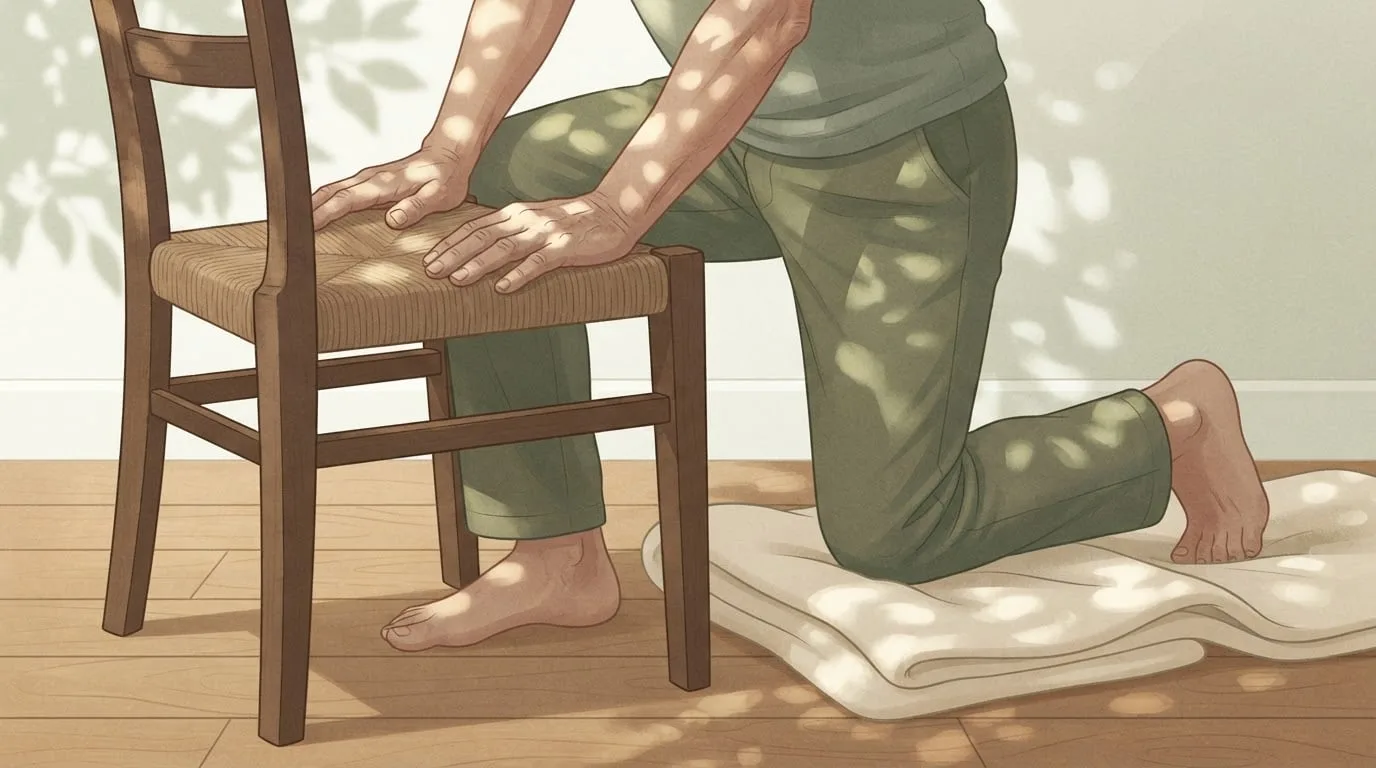
Getting down to the floor and back up is worth practicing even if you never do floor yoga, because it's how you'd get up after a fall. Practice next to a sturdy chair with a folded blanket on the floor in front of it.
- Stand facing the chair and put both hands on the seat.
- Step one foot back and lower that knee onto the blanket, then lower the other knee.
- Move your hands to the floor one at a time, and sit to one side if you want to rest.
- To get up, come onto your hands and knees and bring one foot forward so you're half kneeling.
- Put both hands on the chair seat and push through your front foot to stand.
If you're over 80 or have been inactive for years, start with chair yoga and do the routine above seated only for the first two weeks. Add one standing pose a week after that. A slower start doesn't put you behind. It's what lets you keep going.
How Often Should Seniors Do Yoga?
Most seniors should do yoga two or three times a week, alongside two strength sessions and some walking. The World Health Organization's 2020 guidelines, summarized by Bull and colleagues in the British Journal of Sports Medicine, ask adults 65 and over to do varied activity that emphasizes balance and strength on 3 or more days a week. They also call for 150 to 300 minutes of moderate aerobic activity. Yoga fits into the balance part of that week.
| Day | Session | About how long |
|---|---|---|
| Monday | Chair-supported yoga routine | 20 to 30 minutes |
| Tuesday | Strength training with bodyweight or light dumbbells | 30 minutes |
| Wednesday | Walk, plus one-leg stands at the kitchen counter | 30 minutes |
| Thursday | Chair-supported yoga routine | 20 to 30 minutes |
| Friday | Strength training | 30 minutes |
| Saturday | Walk, or a gentle yoga class | 30 to 60 minutes |
| Sunday | Rest or an easy walk | As you like |
Count the yoga, the balance practice and the balance parts of your strength sessions, and that week comes close to the 3 hours of balance-challenging exercise linked to the biggest drop in falls. For the strength days, our senior strength training plan takes you from seated moves to dumbbells. If you want the evidence behind session counts for other goals, our breakdown of how often you should do yoga covers it.
The hard part is rarely the first week. It's week three or four, when the novelty fades and nobody is expecting you on the mat. FitCraft is built for that problem. Its workouts include yoga and mobility alongside strength and cardio with bodyweight and dumbbells. An AI coach, a 3D character who says your name, demonstrates each exercise on an interactive 3D model you can zoom in on. Your workouts adjust as you progress, and streaks and calendar rewards make showing up feel like progress. If you're comparing options, we've reviewed the best fitness apps for seniors, including the free chair yoga choices.
The Bottom Line
Yoga for seniors is safe and worthwhile when it's built around a chair, keeps the spine long and respects replaced joints. Trials in people over 60 show small gains in balance, medium gains in mobility and relief from arthritis pain. They don't show that yoga alone prevents falls. Pair it with moving balance work and strength training, and the evidence is on your side.
As one FitCraft user, Katie, put it: "I've tried everything. This is the first time I've stuck with something past two weeks." You don't need to touch your toes or stand on your head. Twenty supported minutes, twice a week, is a real practice.
Frequently Asked Questions
Is 70 too old to start yoga?
No, 70 isn't too old to start yoga. The Gentle Years Yoga trial enrolled 454 adults with an average age of 73.5 and a median of three chronic conditions, and reported no serious adverse events linked to its chair-based classes. Start with seated poses, add standing poses with a hand on a chair, and practice getting down to the floor only once standing work feels steady.
What is the best type of yoga for seniors?
The best type of yoga for seniors is a slow, prop-supported hatha class or chair yoga, with every standing pose done beside a chair or wall. Pick a class that moves you between poses rather than only holding still, because moving balance is what the falls research rewards. Skip hot rooms, fast flows and headstands.
Is there a free yoga app for seniors?
Yes, several apps offer free yoga for older adults, including chair yoga. You can download FitCraft and start training for free. Its workouts include yoga and mobility, and a 3D AI coach demonstrates each exercise on an interactive model. Whatever app you use, pick one that shows a chair or wall version of each standing pose.
What exercises should seniors not do?
In yoga, seniors should skip headstands, shoulder stands and plow, avoid rounding the spine under load if they have osteoporosis, and keep head-down poses short if they have glaucoma or high blood pressure. After a hip replacement, follow your surgeon's limits on deep hip bending, crossing the leg and deep lunges. Do one-leg balances beside a chair.
What is the number one exercise to do as you get older?
No single exercise wins, but exercise that challenges your balance, done with strength training, has the best evidence for keeping older adults on their feet. Across 88 trials, programs that challenged balance and added up to more than 3 hours a week cut falls by 39%. Yoga can supply part of that time if it includes moving balance work.
Is chair yoga good for seniors?
Chair yoga is a safe, useful option for seniors who can't stand for long or get to the floor. In a trial of 131 older adults with hip or knee arthritis, eight weeks of chair yoga reduced how much pain got in the way of daily life, and the effect lasted three months. It didn't improve balance, so add standing poses beside the chair when you can.
Can you do yoga if you have osteoporosis?
Yes, most people with osteoporosis can do yoga if they keep the spine long and skip poses that round it under load, such as seated forward folds, plow and deep rounded twists. In a study of women with spinal osteoporosis, 89% of those given flexion exercises had new spine fractures, compared with 16% of those given extension exercises. Ask your doctor which poses suit your bones.