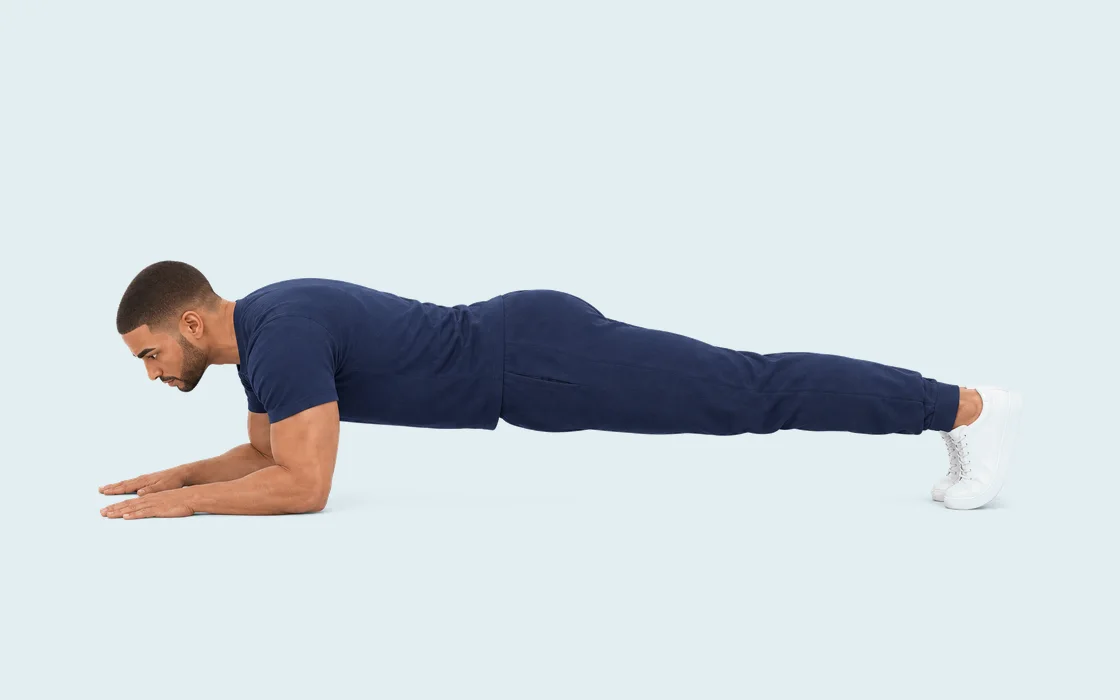
 Max hold
This 30 day plank challenge times every hold for you. Day 1 and day 30 are tests: one forearm plank held until your form breaks, about 3 minutes with the warm-up and stretch. At Intermediate the first training day is 3 forearm planks of 20 seconds and 2 side planks of 20 seconds, about 6 minutes, and day 29 is 3 forearm planks of 60 seconds, 2 side planks of 50 seconds, 30 seconds of plank jacks and a 45-second hand plank, about 11 minutes. Days 5, 10, 15, 20 and 25 are rest days of about 2 minutes. Pick from four levels, and your day-1 time tells you whether another level fits better.

This 30 day plank challenge times every second for you. Press Start and the page runs the holds and the rests, so your eyes stay on the floor instead of on a stopwatch. Day 1 and day 30 measure how long you can hold one forearm plank, so the month starts and ends with your own number rather than one off a chart. A training day takes about 6 to 11 minutes at Intermediate.
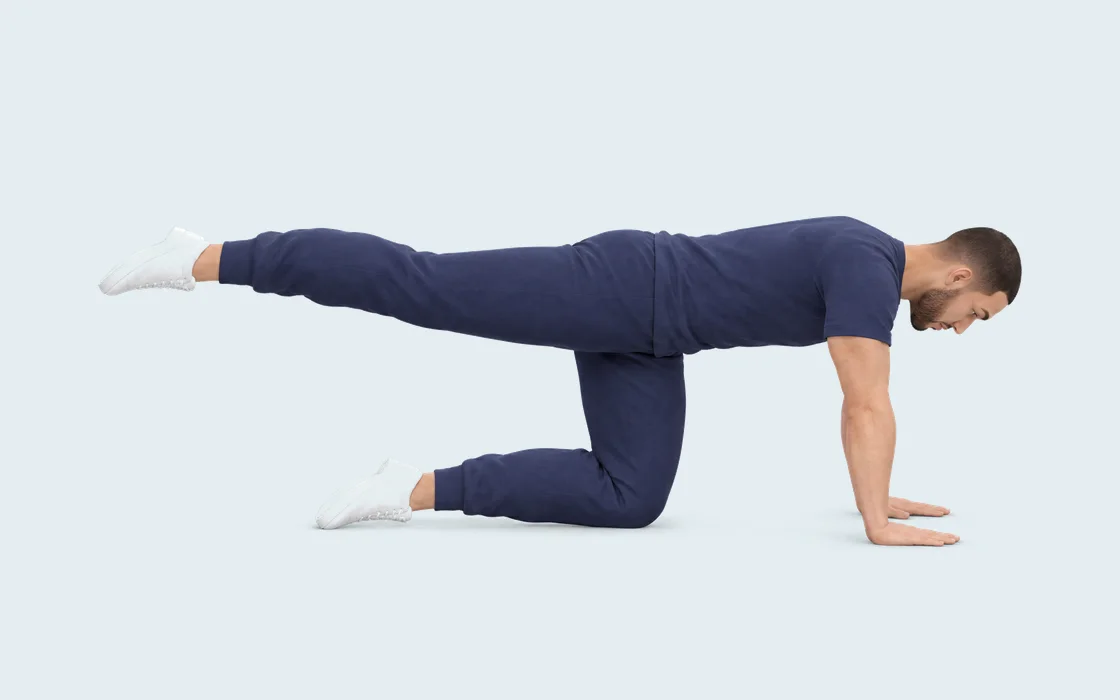
Each session is a 1-minute warm-up of bird dogs and downward dog, the day's planks with timed rests, and a 1-minute stretch of cobra pose and the half kneeling stretch. Everything after the test runs on the clock, so there is nothing to count.
How the test, the holds and the rest days fit together
The test. Day 1 is a single forearm plank held for as long as you can keep a straight line. The clock counts up and beeps every 30 seconds, so you never need to lift your head to check it. Tap Done when your hips start to drop, your lower back aches or your shoulders creep toward your ears. That time is your day-1 result. A test day takes about 3 minutes with the warm-up and stretch, longer if you hold past a minute. Day 30 repeats the test, and the finish screen shows both times together when both tests were at the same level.
The holds. Between the tests, every level does three forearm planks a day, a few seconds longer every few days, and brings in other moves along the way:
- Beginner (about 4 to 8 minutes a day): forearm planks from day 2, then a hand plank from day 11 and a side plank from day 21.
- Intermediate (about 6 to 11 minutes a day): forearm planks and side planks from day 2, then plank jacks from day 11 and a hand plank from day 21.
- Advanced (about 7 to 14 minutes a day): forearm planks and side planks from day 2, then hollow holds from day 11 and plank jacks from day 21.
- Expert (about 9 to 18 minutes a day): forearm planks, side planks and hollow holds from day 2, then spider planks from day 11.
Side planks switch sides halfway, so the seconds shown cover both sides: on day 29 at Intermediate, a 50-second side plank is 25 seconds a side. Plank jacks and spider planks are timed work, so keep moving at a pace you can control until the clock runs out.
The rest days. Days 5, 10, 15, 20 and 25 keep only the warm-up and the stretch, about 2 minutes, so your shoulders and core recover while the streak carries on.
Between the two timed tests, days 2 to 29 give you four weeks of plank training, which matches the program length in the FitCraft app.
The 30 day plank challenge chart, day by day
The table lists all 30 days at every level. A cell such as "3 x 20 s" means three holds of 20 seconds, and the number in brackets is the whole session in minutes, with the warm-up, rests and stretch included. Intermediate builds like this:
- Day 2: 3 forearm planks of 20 seconds and 2 side planks of 20 seconds, about 6 minutes.
- Day 11: 3 forearm planks of 35 seconds, 2 side planks of 30 seconds and 20 seconds of plank jacks, about 8 minutes.
- Day 21: 3 forearm planks of 45 seconds, 2 side planks of 40 seconds, 25 seconds of plank jacks and a 20-second hand plank, about 9 minutes.
- Day 29: 3 forearm planks of 60 seconds, 2 side planks of 50 seconds, 30 seconds of plank jacks and a 45-second hand plank, about 11 minutes.
| Day | Beginner | Intermediate | Advanced | Expert |
|---|---|---|---|---|
| Day 1 | Test (3 min) | Test (3 min) | Test (3 min) | Test (3 min) |
| Day 2 | 3 x 15 s (4 min) | 3 x 20 s + 2 x 20 s (6 min) | 3 x 30 s + 2 x 30 s (7 min) | 3 x 45 s + 2 x 40 s + 2 x 20 s (9 min) |
| Day 3 | 3 x 15 s (4 min) | 3 x 20 s + 2 x 20 s (6 min) | 3 x 35 s + 2 x 30 s (7 min) | 3 x 50 s + 2 x 40 s + 2 x 20 s (10 min) |
| Day 4 | 3 x 20 s (4 min) | 3 x 25 s + 2 x 25 s (6 min) | 3 x 35 s + 2 x 35 s (7 min) | 3 x 50 s + 2 x 45 s + 2 x 20 s (10 min) |
| Day 5 | Rest (2 min) | |||
| Day 6 | 3 x 20 s (4 min) | 3 x 25 s + 2 x 25 s (6 min) | 3 x 40 s + 2 x 35 s (7 min) | 3 x 55 s + 2 x 45 s + 2 x 25 s (10 min) |
| Day 7 | 3 x 20 s (4 min) | 3 x 25 s + 2 x 25 s (6 min) | 3 x 40 s + 2 x 35 s (7 min) | 3 x 60 s + 2 x 50 s + 2 x 25 s (11 min) |
| Day 8 | 3 x 20 s (4 min) | 3 x 30 s + 2 x 25 s (7 min) | 3 x 45 s + 2 x 35 s (8 min) | 3 x 60 s + 2 x 50 s + 2 x 25 s (11 min) |
| Day 9 | 3 x 25 s (5 min) | 3 x 30 s + 2 x 30 s (7 min) | 3 x 45 s + 2 x 40 s (8 min) | 3 x 65 s + 2 x 55 s + 2 x 25 s (11 min) |
| Day 10 | Rest (2 min) | |||
| Day 11 | 3 x 25 s + 15 s (5 min) | 3 x 35 s + 2 x 30 s + 20 s (8 min) | 3 x 50 s + 2 x 40 s + 2 x 15 s (9 min) | 3 x 70 s + 2 x 55 s + 2 x 30 s + 2 x 30 s (13 min) |
| Day 12 | 3 x 25 s + 15 s (5 min) | 3 x 35 s + 2 x 30 s + 20 s (8 min) | 3 x 50 s + 2 x 40 s + 2 x 15 s (9 min) | 3 x 70 s + 2 x 60 s + 2 x 30 s + 2 x 30 s (14 min) |
| Day 13 | 3 x 25 s + 15 s (5 min) | 3 x 35 s + 2 x 30 s + 20 s (8 min) | 3 x 55 s + 2 x 40 s + 2 x 15 s (10 min) | 3 x 75 s + 2 x 60 s + 2 x 30 s + 2 x 30 s (14 min) |
| Day 14 | 3 x 30 s + 20 s (6 min) | 3 x 40 s + 2 x 35 s + 20 s (8 min) | 3 x 55 s + 2 x 45 s + 2 x 20 s (10 min) | 3 x 80 s + 2 x 65 s + 2 x 30 s + 2 x 35 s (14 min) |
| Day 15 | Rest (2 min) | |||
| Day 16 | 3 x 30 s + 20 s (6 min) | 3 x 40 s + 2 x 35 s + 25 s (8 min) | 3 x 60 s + 2 x 45 s + 2 x 20 s (10 min) | 3 x 85 s + 2 x 65 s + 2 x 35 s + 2 x 35 s (15 min) |
| Day 17 | 3 x 30 s + 20 s (6 min) | 3 x 40 s + 2 x 35 s + 25 s (8 min) | 3 x 65 s + 2 x 45 s + 2 x 20 s (11 min) | 3 x 85 s + 2 x 65 s + 2 x 35 s + 2 x 35 s (15 min) |
| Day 18 | 3 x 35 s + 20 s (6 min) | 3 x 45 s + 2 x 40 s + 25 s (9 min) | 3 x 65 s + 2 x 50 s + 2 x 20 s (11 min) | 3 x 90 s + 2 x 70 s + 2 x 35 s + 2 x 35 s (15 min) |
| Day 19 | 3 x 35 s + 20 s (6 min) | 3 x 45 s + 2 x 40 s + 25 s (9 min) | 3 x 70 s + 2 x 50 s + 2 x 20 s (11 min) | 3 x 95 s + 2 x 70 s + 2 x 35 s + 2 x 35 s (16 min) |
| Day 20 | Rest (2 min) | |||
| Day 21 | 3 x 35 s + 25 s + 20 s (7 min) | 3 x 45 s + 2 x 40 s + 25 s + 20 s (9 min) | 3 x 70 s + 2 x 50 s + 2 x 25 s + 30 s (12 min) | 3 x 95 s + 2 x 75 s + 2 x 35 s + 2 x 40 s (16 min) |
| Day 22 | 3 x 35 s + 25 s + 25 s (7 min) | 3 x 50 s + 2 x 40 s + 25 s + 25 s (10 min) | 3 x 75 s + 2 x 50 s + 2 x 25 s + 30 s (12 min) | 3 x 100 s + 2 x 75 s + 2 x 40 s + 2 x 40 s (16 min) |
| Day 23 | 3 x 40 s + 25 s + 25 s (7 min) | 3 x 50 s + 2 x 45 s + 25 s + 25 s (10 min) | 3 x 75 s + 2 x 55 s + 2 x 25 s + 35 s (13 min) | 3 x 10⁵ s + 2 x 80 s + 2 x 40 s + 2 x 40 s (17 min) |
| Day 24 | 3 x 40 s + 25 s + 30 s (7 min) | 3 x 55 s + 2 x 45 s + 25 s + 30 s (10 min) | 3 x 80 s + 2 x 55 s + 2 x 25 s + 35 s (13 min) | 3 x 10⁵ s + 2 x 80 s + 2 x 40 s + 2 x 40 s (17 min) |
| Day 25 | Rest (2 min) | |||
| Day 26 | 3 x 40 s + 25 s + 30 s (7 min) | 3 x 55 s + 2 x 45 s + 30 s + 35 s (10 min) | 3 x 80 s + 2 x 55 s + 2 x 25 s + 40 s (13 min) | 3 x 110 s + 2 x 85 s + 2 x 40 s + 2 x 40 s (17 min) |
| Day 27 | 3 x 40 s + 30 s + 35 s (8 min) | 3 x 55 s + 2 x 45 s + 30 s + 40 s (11 min) | 3 x 85 s + 2 x 55 s + 2 x 30 s + 40 s (13 min) | 3 x 115 s + 2 x 85 s + 2 x 45 s + 2 x 45 s (18 min) |
| Day 28 | 3 x 45 s + 30 s + 35 s (8 min) | 3 x 60 s + 2 x 50 s + 30 s + 40 s (11 min) | 3 x 85 s + 2 x 60 s + 2 x 30 s + 45 s (14 min) | 3 x 115 s + 2 x 90 s + 2 x 45 s + 2 x 45 s (18 min) |
| Day 29 | 3 x 45 s + 30 s + 40 s (8 min) | 3 x 60 s + 2 x 50 s + 30 s + 45 s (11 min) | 3 x 90 s + 2 x 60 s + 2 x 30 s + 45 s (14 min) | 3 x 120 s + 2 x 90 s + 2 x 45 s + 2 x 45 s (18 min) |
| Day 30 | Test (3 min) | Test (3 min) | Test (3 min) | Test (3 min) |
New to planks? Beginner starts with 3 forearm planks of 15 seconds, about 4 minutes. If 15 seconds on your toes is too much, hold the same planks with your knees down, one straight line from head to knees, until that feels steady. Print or save as PDF puts your 30 days on paper with a box to tick each day.

Which level to pick: let your day-1 hold decide
| Level | Planks |
|---|---|
| Beginner | Forearm plank, Hand plank and Side plank |
| Intermediate | Forearm plank, Side plank, Plank jacks and Hand plank |
| Advanced | Forearm plank, Side plank, Hollow hold and Plank jacks |
| Expert | Forearm plank, Side plank, Hollow hold and Spider plank |
The test is the same forearm plank at every level. After the day-1 test, the page compares your time with a range for the level you picked:
- Tested on Beginner: over 60 seconds suggests Intermediate.
- Tested on Intermediate: under 20 seconds suggests Beginner, and over 90 seconds suggests Advanced.
- Tested on Advanced: under 45 seconds suggests Intermediate, and over 150 seconds suggests Expert.
- Tested on Expert: under 90 seconds suggests Advanced.
Inside the range, the page tells you the level fits. The ranges overlap, so a 70-second hold suits Intermediate or Advanced: go lower if the end of your hold was shaky. The page opens on Intermediate, a fair first guess if you have planked before. If you have not, start on Beginner.
Proper plank form, and the mistakes that end a hold early
Set your forearms flat and parallel, elbows straight under your shoulders. Tuck your toes, lift, and make one line from head to heels. Squeeze your glutes a little, push the floor away so your shoulders stay off your ears, and look at the floor just past your hands. Every second counts only while that line holds. The mistakes that break it:
- Hips sinking. Your lower back takes the weight your abs should carry. End the hold here, on test days too.
- Hips piked high. It feels easier because the line is gone. Lower them level with your shoulders.
- Shoulders shrugged. Press through your forearms and lengthen your neck.
- Head craning up to watch the timer. Keep it in line with your spine. The beeps tell you the time.
- Holding your breath. Breathe steadily through every hold. The blood pressure part below explains why.
The other moves follow the same rules. Side plank: elbow under shoulder, feet staggered, hips lifted, chest not rolling forward. Hand plank: straight arms with wrists under shoulders; if your wrists are sore, do that set on your forearms. Plank jacks: from a forearm plank, hop the feet wide and back, landing softly with hips level. Hollow hold: on your back, lower back flat, arms overhead, legs just off the floor, and stop when your back lifts. Spider plank: bring one knee toward the same elbow without twisting your hips, then switch.
Build on your plank habit with a plan made for you
The FitCraft app builds workouts around your goals, shows every move with a 3D AI coach and adjusts as you progress. Earn XP, keep your streak and level up. Free version available.
Take the Free Assessment Free • 2 minutes • No credit cardWhat the research says about plank times, including how rare a 4 minute plank is
One large set of forearm plank norms comes from Strand and colleagues (2014), who timed 471 college students holding a plank until they quit or lost the position. The median hold was 110 seconds for men and 72 seconds for women. The 90th percentile was 201 seconds for men and 142 seconds for women, so a 4-minute plank (240 seconds) was beyond the top tenth of both groups. It is rare, and this plan never asks for it: the longest planned hold, on the last training day at Expert, is 120 seconds.
Most of those students did not stop because of their abs: 32% named their legs and 32% their arms, against 21% who named their abdominals. Tired shoulders on day 1 are normal. Students active more than five times a week held about 150 seconds on average, an association in a one-time survey rather than proof of cause.
How long should a 40 year old be able to plank? No study gives a solid answer. The Strand students were about 20, and the authors wrote that their norms still needed testing in other age groups. Comparing you with yourself is fairer. McGill, Childs and Liebenson (1999) timed 75 young healthy adults on back extension, trunk flexion and side bridge holds, and repeat tests agreed closely, with reliability above 0.97. The forearm plank was not one of their tests, but a timed hold looks like a steady number to track against your own.

Can planks help lose belly fat? What 30 days can and cannot change
Not on their own. In Vispute and colleagues (2011), 24 sedentary adults either did seven abdominal exercises, 2 sets of 10 reps, five days a week for six weeks, or did nothing extra, with everyone eating the same as before. The exercise group did more curl-ups on the retest, 47 against 32, but lost no more belly fat, waist size or body fat. A plank works the same muscles without moving, so there is no reason to expect a better result. Fat comes off the whole body when you eat a little less than you burn for weeks; our guide to the best exercises to lose belly fat covers what moves that number.
A month of this plan can change how long you hold a straight line, how steady your hips stay and the habit of getting on the floor for 6 to 11 minutes. After 23 days of practising the exact position, your day-30 hold is likely to beat day 1. It cannot change the fat over your stomach or the look of your abs. Our review of plank benefits research covers what planks do train.
A hold also raises blood pressure while you hold it. Jones and colleagues (2026) measured it continuously in 62 healthy adults, average age 27, during a plank to fatigue. In 97% of them the plank was stopped when diastolic pressure passed 115 mmHg, the American College of Sports Medicine limit, after about 50 seconds on average. Nobody had a problem, but the rise is fast. Over weeks it is a different story: Edwards and colleagues (2023) pooled 270 trials with 15,827 people and found isometric training lowered resting blood pressure by about 8 mmHg systolic and 4 mmHg diastolic, with the wall squat ranked best for systolic pressure. That supports planned isometric programs (see isometric exercise and blood pressure), not the idea that a plank challenge lowers blood pressure.
Starting on January 1: the plank month week by week
Start on New Year's Day and day 30 lands on January 30.
- Week 1 (days 1 to 7). The test, then short holds. You may feel it in your shoulders, arms and legs as much as your stomach. Day 5 is the first rest day.
- Week 2 (days 8 to 14). Every level adds a new move on day 11, and at Intermediate that day takes about 8 minutes. As the planks start to feel familiar, hips tend to sag without you noticing. Check the line.
- Week 3 (days 15 to 21). Each Intermediate forearm plank reaches 45 seconds by day 19. Day 21 brings the last new move for Beginner, Intermediate and Advanced.
- Days 22 to 30. The longest sessions, a last rest on day 25, and the retest.
Missed a day? Do not double up. The page opens on your next unfinished day, so the plan waits for you. After a longer break, tap the last day you finished on the grid and repeat it first. Our piece on the streak effect explains why one missed day feels worse than it is.
After day 30, compare your two tests. If your time went up and the last week felt solid, start the next level from day 1. For planks as one part of a wider routine, try the 30 day workout challenge or the fitness test. Once a clean 2-minute plank feels easy, make your planks harder rather than longer.
Who should check with a doctor before planking
- High blood pressure, heart disease or a past stroke. Blood pressure climbs within the first minute of a plank. Get your doctor's go-ahead, and ask whether to skip the max-hold tests.
- Anyone who holds their breath when straining. Narloch and Brandstater (1995) measured arterial pressure by catheter in 10 male athletes doing a maximal double-leg press. With the breath held it averaged 311/284 mmHg, against 198/175 when they breathed out slowly. A plank is far lighter, but keep breathing.
- Pregnancy, the months after birth, or a gap down the middle of your stomach. Follow your care team, and see our guides to diastasis recti exercises and postpartum fitness.
- Back pain. End the hold when your lower back aches rather than burns, and try the knee version. Our guide to the best exercises for lower back pain has gentler starting points.
- Shoulder or wrist injuries. Stay on your forearms and swap any hand plank for a forearm plank.
Stop if you feel chest pain, dizziness, a headache during a hold or sharp joint pain. Soreness that grows each day means an extra rest day or a lower level.
Related reading
References
- Strand SL, Hjelm J, Shoepe TC, Fajardo MA. "Norms for an isometric muscle endurance test." Journal of Human Kinetics. 2014;40:93-102. doi:10.2478/hukin-2014-0011
- McGill SM, Childs A, Liebenson C. "Endurance times for low back stabilization exercises: clinical targets for testing and training from a normal database." Archives of Physical Medicine and Rehabilitation. 1999;80(8):941-944. doi:10.1016/S0003-9993(99)90087-4
- Vispute SS, Smith JD, LeCheminant JD, Hurley KS. "The effect of abdominal exercise on abdominal fat." Journal of Strength and Conditioning Research. 2011;25(9):2559-2564. doi:10.1519/JSC.0b013e3181fb4a46
- Jones MD, Tan E, Woo J, Bui E, Wong R, Fotheringham A, Schutte AE, Parmenter BJ. "Acute blood pressure responses to plank and wall sit isometric exercise in adults." Journal of Hypertension. 2026;44(2):288-294. doi:10.1097/HJH.0000000000004191
- Narloch JA, Brandstater ME. "Influence of breathing technique on arterial blood pressure during heavy weight lifting." Archives of Physical Medicine and Rehabilitation. 1995;76(5):457-462. doi:10.1016/S0003-9993(95)80578-8
- Edwards JJ, Deenmamode AHP, Griffiths M, Arnold O, Cooper NJ, Wiles JD, O'Driscoll JM. "Exercise training and resting blood pressure: a large-scale pairwise and network meta-analysis of randomised controlled trials." British Journal of Sports Medicine. 2023;57(20):1317-1326. doi:10.1136/bjsports-2022-106503
How this differs from a typical 30 day plank challenge chart
Most charts give everyone the same single plank on day 1 and add a few seconds every day until the last week asks for a single hold of two minutes or more. That schedule ignores where you start. Someone who can hold two minutes is bored for weeks, and someone who can hold 20 seconds hits a wall around day 10, often with sagging hips. Many charts also leave out rest days or treat them as optional.
Here the month starts with a test of your own longest hold, and that number suggests a level. Each day splits the work into three shorter forearm planks with timed rests, adds side planks for most levels, and brings in new moves on day 11 and day 21, depending on your level, so the work changes shape as well as length. Every fifth day is a rest day. The page times every hold and switch, so you can watch the floor instead of a clock.
Frequently Asked Questions
What happens if you plank every day for 30 days?
Your plank time will most likely go up, because you practise the same position many times and the trunk, shoulders and legs get used to holding it. This plan has 23 training days, and at Intermediate they add up to about 46 minutes of forearm planks alone. What a month will not do is melt belly fat or rebuild your body. Rest days on days 5, 10, 15, 20 and 25 give your shoulders and core a break.
What is the proper way to perform a plank position?
Put your forearms flat on the floor with your elbows straight under your shoulders, tuck your toes and lift so your body makes one straight line from head to heels. Squeeze your glutes a little, keep your shoulders away from your ears, look at the floor just past your hands and keep breathing. End the hold when your hips start to drop.
Can planks help lose belly fat?
Not by themselves. In a six-week trial by Vispute and colleagues, adults who did abdominal exercises five days a week lost no more belly fat or waist size than a group that did no exercise, although their ab endurance improved. Fat comes off the whole body when you eat a little less than you burn for weeks. Planks build the muscles under the fat.
How rare is a 4 minute plank?
Quite rare. In one set of plank norms from 471 college students, the 90th percentile was 201 seconds for men and 142 seconds for women. A 4-minute hold is 240 seconds, so it was past the top tenth for both groups. This plan never asks for one: its longest planned hold is 120 seconds, on the last training day at Expert.
How long should a 40 year old be able to plank?
There is no trustworthy age-40 norm, so be careful with charts that give one. One large set of plank norms comes from 471 college students around 20 years old, whose median holds were 110 seconds for men and 72 seconds for women. The authors said their numbers still needed testing in other age groups. At 40, the fairest yardstick is your own day-1 time against your day-30 time.
Can you get a six pack from planking?
Not from planking alone. Whether your stomach muscles show depends mostly on how much fat sits over them, and ab exercise did not shrink belly fat in a six-week trial. Planks make the muscles underneath stronger and steadier. Visible abs come from lower body fat over months, through eating habits and overall activity, with core work on top.
Do I have to plank every day for the challenge?
No. The plan rests every fifth day, so days 5, 10, 15, 20 and 25 are rest days. On those days you only do the warm-up and the stretch, about 2 minutes. If life gets in the way, the plan waits: the page always opens on your next unfinished day, so you can finish the 30 days over a few extra calendar days.
Is planking safe if you have high blood pressure?
Ask your doctor first. A plank raises blood pressure while you hold it: in a 2026 study of 62 healthy adults, almost all reached the diastolic safety limit of 115 mmHg after about 50 seconds of planking. If your doctor agrees, keep to the planned holds instead of the max tests, breathe the whole time and stop if you feel dizzy, get a headache or feel chest pain.