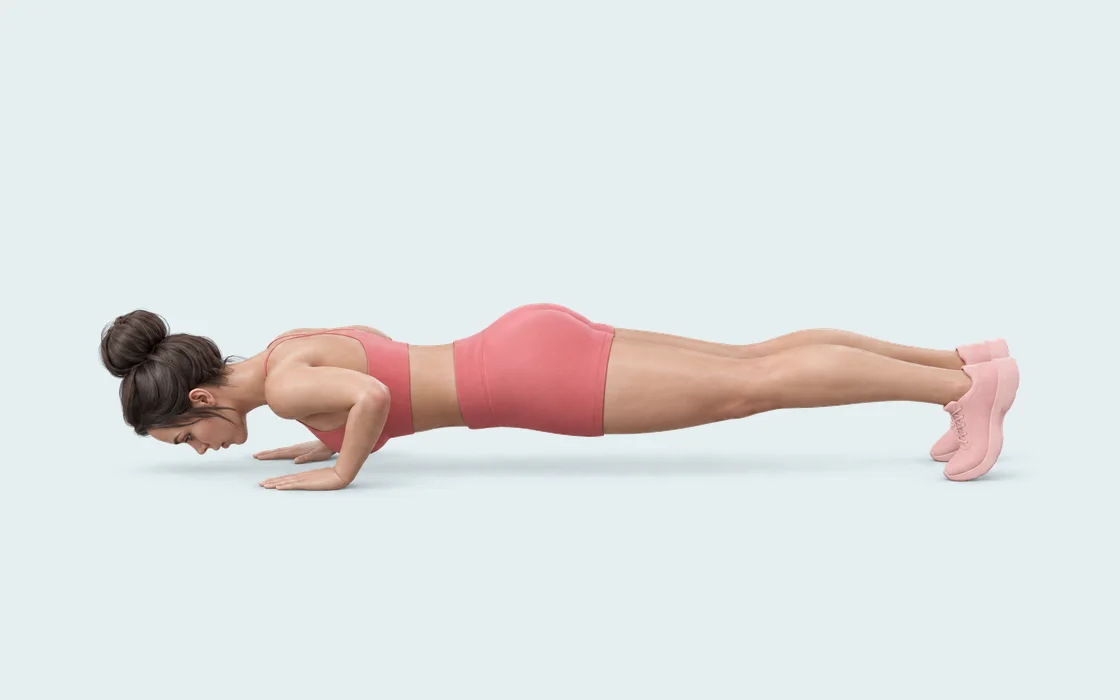
 Max reps
This free 30 day push up challenge opens and closes with a max test: one set of as many clean push-ups as you can, about 3 minutes, on day 1 and day 30. Between them come 21 training days at your level and a 2-minute rest day every fourth day. At Intermediate, day 2 is 20 push-ups and 10 kneeling push-ups, about 7 minutes, and day 29 is 70 push-ups and 20 kneeling push-ups, about 13 minutes. Beginner trains incline push-ups on a counter; Expert adds decline and diamond push-ups. In a 4-week trial by Kotarsky and colleagues (2018), push-up training raised strength with no measurable change in muscle thickness.

The 30 day push up challenge on this page begins and ends with a test. On day 1 you do one set of as many clean push-ups as you can and save the number. The 21 training days that follow build at your level, with a rest day every fourth day, and on day 30 you take the same test again. A training day takes about 7 to 13 minutes at Intermediate, warm-up and stretch included. Your day 1 number also suggests which of the four levels fits you.
How the 30 day push up challenge works
The month has three kinds of days:
- Test days (day 1 and day 30). One all-out set with good form: tap Done when your form slips, then enter your count. About 3 minutes.
- Training days (21 of them). The day's push-ups, split into short sets with a timed rest between them.
- Rest days (days 4, 8, 12, 16, 20, 24 and 28). No push-ups. The page runs only the warm-up and the stretch, about 2 minutes, so your streak stays alive.
Days 2 to 29 are four weeks of push-up training between your two tests, the same length as a program in the FitCraft app.
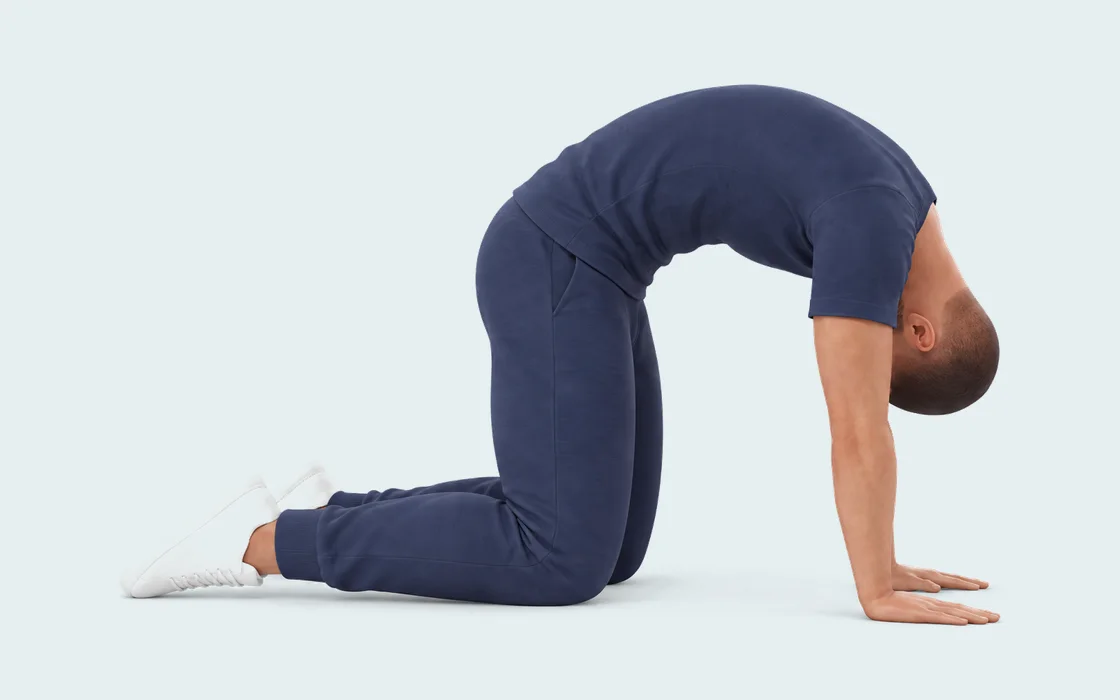
Every session opens with a 1-minute warm-up of cat-cow and downward dog and closes with a 1-minute stretch of cobra pose and a tricep and lat stretch. In between, you do each set at your own pace and tap Done, and the rest counts down by itself.
The minutes grow with the reps, though not on every single day, because bigger sets mean fewer rests between them. At Intermediate, day 2 is 20 push-ups and 10 kneeling push-ups, about 7 minutes, and day 29, the last training day, is 70 push-ups and 20 kneeling push-ups, about 13 minutes.
The 30 day push-up chart, day by day
Here is the full plan at all four levels, the same one the tool above runs. Each cell gives the day's reps and, in brackets, the whole session's minutes. A plus sign joins the level's moves in order: push-ups first, then kneeling push-ups at Intermediate, wide grip push-ups at Advanced, or decline and diamond push-ups at Expert.
| Day | Beginner | Intermediate | Advanced | Expert |
|---|---|---|---|---|
| Day 1 | Test (3 min) | Test (3 min) | Test (3 min) | Test (3 min) |
| Day 2 | 20 (5 min) | 20 + 10 (7 min) | 40 + 10 (9 min) | 50 + 15 + 10 (13 min) |
| Day 3 | 20 (5 min) | 25 + 10 (8 min) | 45 + 10 (10 min) | 55 + 15 + 10 (13 min) |
| Day 4 | Rest (2 min) | |||
| Day 5 | 25 (5 min) | 25 + 10 (7 min) | 45 + 10 (10 min) | 55 + 20 + 10 (13 min) |
| Day 6 | 25 (5 min) | 30 + 10 (9 min) | 50 + 15 (11 min) | 60 + 20 + 15 (15 min) |
| Day 7 | 30 (6 min) | 30 + 10 (9 min) | 50 + 15 (11 min) | 65 + 20 + 15 (15 min) |
| Day 8 | Rest (2 min) | |||
| Day 9 | 30 (6 min) | 35 + 15 (10 min) | 55 + 15 (11 min) | 70 + 20 + 15 (15 min) |
| Day 10 | 30 (6 min) | 35 + 15 (10 min) | 60 + 15 (12 min) | 70 + 25 + 15 (16 min) |
| Day 11 | 35 (7 min) | 40 + 15 (10 min) | 60 + 15 (12 min) | 75 + 25 + 15 (16 min) |
| Day 12 | Rest (2 min) | |||
| Day 13 | 35 (7 min) | 40 + 15 (10 min) | 65 + 20 (12 min) | 80 + 25 + 20 (16 min) |
| Day 14 | 40 (7 min) | 45 + 15 (11 min) | 65 + 20 (12 min) | 80 + 25 + 20 (16 min) |
| Day 15 | 40 (7 min) | 45 + 15 (10 min) | 70 + 20 (12 min) | 85 + 30 + 20 (17 min) |
| Day 16 | Rest (2 min) | |||
| Day 17 | 40 (7 min) | 50 + 15 (11 min) | 75 + 20 (13 min) | 90 + 30 + 20 (17 min) |
| Day 18 | 45 (7 min) | 50 + 15 (11 min) | 75 + 20 (13 min) | 90 + 30 + 20 (17 min) |
| Day 19 | 45 (7 min) | 55 + 15 (12 min) | 80 + 25 (13 min) | 95 + 30 + 25 (18 min) |
| Day 20 | Rest (2 min) | |||
| Day 21 | 50 (8 min) | 55 + 15 (12 min) | 80 + 25 (13 min) | 100 + 35 + 25 (20 min) |
| Day 22 | 50 (8 min) | 60 + 20 (13 min) | 85 + 25 (14 min) | 105 + 35 + 25 (20 min) |
| Day 23 | 50 (8 min) | 60 + 20 (13 min) | 90 + 25 (15 min) | 105 + 35 + 25 (19 min) |
| Day 24 | Rest (2 min) | |||
| Day 25 | 55 (8 min) | 65 + 20 (13 min) | 90 + 25 (14 min) | 110 + 35 + 25 (19 min) |
| Day 26 | 55 (8 min) | 65 + 20 (13 min) | 95 + 30 (14 min) | 115 + 40 + 30 (21 min) |
| Day 27 | 60 (8 min) | 70 + 20 (13 min) | 95 + 30 (14 min) | 115 + 40 + 30 (20 min) |
| Day 28 | Rest (2 min) | |||
| Day 29 | 60 (8 min) | 70 + 20 (13 min) | 100 + 30 (15 min) | 120 + 40 + 30 (20 min) |
| Day 30 | Test (3 min) | Test (3 min) | Test (3 min) | Test (3 min) |
Read the minutes first and the reps second. Day 15 at Intermediate is 45 push-ups and 15 kneeling push-ups, about 10 minutes. Those 45 push-ups come as 4 sets of 11 or 12 with 60 seconds of rest between them, so no single set is anywhere near the day's total.
New to push-ups? Start at Beginner. Every rep there is an incline push-up with your hands on a sturdy counter, table or bench. Pick a height where the last set feels hard but your body stays straight; the lower the surface, the harder the push-up.

Day 1 and day 30: the max push-up test
The test is one set, done twice: at the start of the month and at the end. These steps keep the number honest:
- Let the 1-minute warm-up run first, so your shoulders and wrists have moved before the first rep.
- Set your hands under your shoulders and make your body one straight line from head to heels. At Beginner, set up at the counter you will train on.
- Lower until your chest is within a few inches of the floor, then press back up to straight arms. Every rep goes to the same depth.
- Keep going without resting at the top. When your hips sag or your chest stops getting that low, the set is over, so tap Done.
- Enter only the clean reps. The rep where your form broke does not count.
Your day 1 number also checks your level. On Intermediate, under 5 push-ups suggests Beginner and over 20 suggests Advanced. On Advanced, under 15 suggests Intermediate and over 35 suggests Expert. On Expert, under 30 suggests Advanced. Beginner tests incline push-ups, and over 25 suggests the floor at Intermediate. These lines mark where each plan fits, not fitness norms; for norms, see how many push-ups you should be able to do.
On day 30, if you tested at the same level both times, the page shows both numbers together. Note them somewhere else too, because the page saves only in this browser.
Which level to pick, and the moves at each one
| Level | Moves |
|---|---|
| Beginner | Incline push-ups |
| Intermediate | Push-ups and Kneeling push-ups |
| Advanced | Push-ups and Wide grip push-ups |
| Expert | Push-ups, Decline push-ups and Diamond push-ups |
Each level adds harder push-ups, not only more of them.
- Beginner is all incline push-ups, about 5 to 8 minutes a day, from 20 reps on day 2 to 60 on day 29. Pick it if you can't yet do 5 clean floor push-ups, or if your wrists and shoulders feel better with your hands raised.
- Intermediate pairs push-ups with a set of kneeling push-ups at the end of each day. The kneeling set adds chest and arm work once your floor push-ups are tired. About 7 to 13 minutes, for a test of 5 to 20.
- Advanced raises the push-up total and adds wide grip push-ups, with your hands well outside your shoulders. About 9 to 15 minutes, for a test of 15 to 35.
- Expert adds decline push-ups with your feet on a step and diamond push-ups with your hands together under your chest. About 13 to 21 minutes, for a test of 30 or more.
Where two levels overlap, take the lower one. The last week of every level is harder than the first, and switching levels later keeps the days you have already ticked off.
Turn your push-up month into a full plan built around you
The FitCraft app builds workouts around your goals, shows every move with a 3D AI coach and adjusts as you progress. Earn XP, keep your streak and level up. Free version available.
Take the Free Assessment Free • 2 minutes • No credit cardPush-up form: five mistakes that cost you reps
A rep only counts if it looks like the first one. Here are the mistakes that creep in as a set gets hard, and their fixes. The push-up exercise guide has the full setup.
- Hips sagging toward the floor. Squeeze your glutes and brace your stomach before the first rep, and hold one straight line from your head to your heels. Once the hips drop, the set is done.
- Hips piking up. A raised bottom shortens how far your chest travels. Look at the floor just ahead of your hands and lower your whole body as one piece.
- Elbows flared out in a T. Point your elbows back, about 45 degrees from your sides. On diamond push-ups, keep them even closer, bending back toward your feet.
- Half reps. Lower your chest to a few inches from the floor, or the counter edge at Beginner. Dropping your head to fake depth does not count.
- Bouncing and rushing. Lower for about a second, pause briefly, then press up.
For the other moves: on kneeling push-ups, keep a straight line from knees to head and pad your knees with a towel. For incline push-ups, use a counter or bench that cannot slide or tip. On wide grip push-ups, angle your elbows slightly back and keep your shoulders away from your ears. On decline push-ups, use a stable step and keep breathing, since your head is below your feet. If a wrist aches, press up from your fists or push-up handles instead of flat palms, and stop if the pain stays.

What the research says about push-up training
No study has tested this exact plan, but trials of push-up training show what a month can and cannot do.
A month of push-ups builds strength. In Kotarsky and colleagues (2018), 23 young men who already trained did either progressive push-ups or the bench press three times a week for four weeks. Both groups lifted more on a one-rep bench press test afterward, and the push-up group moved further up a ladder of harder push-ups. Neither group showed a measurable change in muscle thickness.
Hard push-ups can match the bench press. In Calatayud and colleagues (2015), 30 students with advanced lifting experience trained for 5 weeks on the bench press or on push-ups loaded with an elastic band, both at a weight they could move only 6 times. Both groups gained similar strength; a control group did not. The band made each push-up as hard as a heavy bench set, so the result applies to push-ups kept that hard.
Muscle size takes longer. Kikuchi and Nakazato (2017) had 18 young men do push-ups or a light bench press, matched for load, twice a week for 8 weeks. Both groups gained strength and grew thicker triceps and chest muscles. Set beside the four-week trial, that suggests a month makes you stronger, and bigger muscles are more likely in the second month.
Each level asks more of you. Ebben and colleagues (2011) measured the peak force 23 recreationally fit adults pushed into the ground in six push-up versions. Hands raised on a box and knees down gave the lowest forces, and feet raised gave the highest: the same ladder this plan climbs from Beginner to Expert. In Cogley and colleagues (2005), 40 adults showed more chest and triceps activity with a narrow hand position than a wide one, so the diamond push-up at Expert draws more from those muscles than the wide grip at Advanced.
Your test number and your heart. Yang and colleagues (2019) tracked 1,104 male firefighters with an average age of 39.6 over 10 years, during which 37 heart or blood vessel events were recorded. Men who managed more than 40 push-ups at the start had a much lower event rate than men who managed fewer than 10. That is an association in active men, and it does not show that adding push-ups protects your heart. Our page on the push-up test and heart health covers its limits.
Blood pressure. Edwards and colleagues (2023) pooled 270 trials with 15,827 people and found that dynamic resistance training lowered resting blood pressure by about 4.6/3.0 mm Hg on average. Push-ups belong to that family, but no push-up challenge was tested by itself, so this page makes no blood pressure promise.
So what can day 30 change? Your test number can rise and your push-ups should feel steadier, mostly because your body gets better at the movement: in the four-week trial, strength rose without measurable growth. A few minutes a day burns too little to shift body fat much. For muscle size, see whether push-ups build muscle.
Starting January 1: what each push-up week brings
Start on January 1 and day 30 lands on January 30. Here is what the weeks tend to bring at Intermediate:
- Week 1. Day 1 is the 3-minute test, and days 2 and 3 are short sets that look easy on paper. If push-ups are new to you, expect a sore chest, shoulders and backs of the arms a day or two later. Day 4 is the first rest day.
- Week 2. The sets get bigger: day 9 is 35 push-ups and 15 kneeling push-ups, about 10 minutes. Doing it at the same time each day makes it easier to keep going.
- Week 3. Day 17 is 50 push-ups and 15 kneeling push-ups, about 11 minutes. If an elbow or wrist still aches the next morning, take an extra rest day.
- Week 4 and day 30. The longest sessions, up to about 13 minutes. Day 29 is the last training day and day 30 is the retest. Test at the same time of day as on day 1.
Missed a day? When you come back, the page shows the first day you have not finished, so January 3 can still be day 2. Your streak counts calendar days with a finished session, rest days included, so a gap restarts the streak, but your grid, XP and test numbers stay. After more than a week away, repeat the last training day you finished.
After day 30: repeat, move up or change the push-up
- The number rose and week 4 felt hard. Repeat the month at the same level, starting from your new test.
- The number rose and week 4 felt comfortable. Start the next level from day 1.
- You finished Expert. Make the push-up harder instead of adding reps. The push-up progression guide lists harder versions in order, and the calisthenics workout plan builds a weekly routine around them.
Push-ups only train the front of your upper body, so add a pulling move such as inverted rows or bent-over rows two or three times a week. Keep a short daily slot after day 30 too: a month is only the start of a habit, as our review of how long a habit takes to form explains. The 30 day workout challenge has a full-body month to try next.
Talk to a doctor first if this is you
- Shoulder, elbow or wrist pain, now or in the past. Start at Beginner, where the counter takes some of the load, and ask a physical therapist which push-up suits you.
- High blood pressure or heart disease. Ask before an all-out test set. Breathe out as you press and never hold your breath. Skip decline push-ups, with your head below your feet, unless your doctor agrees.
- Pregnancy or the months after birth. Follow your care team on which push-ups to use.
Back after a long break? Start at Beginner; our guide to starting from zero fitness covers the first weeks.
Stop at once for chest pain, dizziness, unusual breathlessness or sharp joint pain.
Related reading
References
- Kotarsky CJ, Christensen BK, Miller JS, Hackney KJ. "Effect of Progressive Calisthenic Push-up Training on Muscle Strength and Thickness." Journal of Strength and Conditioning Research. 2018;32(3):651-659. doi:10.1519/JSC.0000000000002345
- Calatayud J, Borreani S, Colado JC, Martin F, Tella V, Andersen LL. "Bench press and push-up at comparable levels of muscle activity results in similar strength gains." Journal of Strength and Conditioning Research. 2015;29(1):246-253. doi:10.1519/JSC.0000000000000589
- Kikuchi N, Nakazato K. "Low-load bench press and push-up induce similar muscle hypertrophy and strength gain." Journal of Exercise Science and Fitness. 2017;15(1):37-42. doi:10.1016/j.jesf.2017.06.003
- Ebben WP, Wurm B, VanderZanden TL, et al. "Kinetic analysis of several variations of push-ups." Journal of Strength and Conditioning Research. 2011;25(10):2891-2894. doi:10.1519/JSC.0b013e31820c8587
- Cogley RM, Archambault TA, Fibeger JF, Koverman MM, Youdas JW, Hollman JH. "Comparison of muscle activation using various hand positions during the push-up exercise." Journal of Strength and Conditioning Research. 2005;19(3):628-633. doi:10.1519/15094.1
- Yang J, Christophi CA, Farioli A, et al. "Association Between Push-up Exercise Capacity and Future Cardiovascular Events Among Active Adult Men." JAMA Network Open. 2019;2(2):e188341. doi:10.1001/jamanetworkopen.2018.8341
- Edwards JJ, Deenmamode AHP, Griffiths M, et al. "Exercise training and resting blood pressure: a large-scale pairwise and network meta-analysis of randomised controlled trials." British Journal of Sports Medicine. 2023;57(20):1317-1326. doi:10.1136/bjsports-2022-106503
How this differs from a typical 30 day push up challenge chart
Most charts give everyone the same number for each day, so a person who can do 3 push-ups and a person who can do 30 start on the same line. This one starts with a test, suggests a level from your result and gives each level its own moves, from incline push-ups on a counter to decline and diamond push-ups. Every day shows its length in minutes first, splits the reps into sets with timed rests, and takes a rest day every fourth day.
It also ends with a test. Most charts finish on their biggest number of the month. Here day 30 repeats day 1 under the same rules, so you can see what changed. The page runs each session for you, gives a form tip for every move, keeps your test numbers, XP and streak on your device, and says plainly what a month of push-ups can and cannot do.
Frequently Asked Questions
What is a good push-up routine for a beginner?
Short sets of an easier push-up with a rest day every few days. The Beginner level here uses incline push-ups with your hands on a kitchen counter: day 2 is 20 incline push-ups, about 5 minutes, and day 29 is 60 incline push-ups, about 8 minutes. Every fourth day is a rest day. When your counter test goes past 25 reps, the page suggests moving to floor push-ups at Intermediate.
Will 30 push-ups a day help?
Yes, if 30 is hard work for you. Someone whose best set is under 15 will be pushed by 30 a day split into sets, while someone who can already do 40 in a row will gain less from it. On Intermediate, day 6 is 30 push-ups and 10 kneeling push-ups, about 9 minutes, and the daily total keeps rising to 70 push-ups by day 29.
Will push-ups lower blood pressure?
That has not been shown for push-ups alone. A 2023 analysis of 270 trials with 15,827 people found that dynamic resistance training lowered resting blood pressure by about 4.6/3.0 mm Hg on average, and push-ups are one kind of that training, but no push-up challenge was tested by itself. If you have high blood pressure, ask your doctor first and breathe out on every press.
Why shouldn't you do push-ups every day?
Hard sets for the same muscles every day leave little time for sore elbows, wrists and shoulders to settle, so the aches can build. Easy push-ups on most days are fine for most people. That is why this plan takes a rest day every fourth day and splits each training day into short sets. Our article on 100 pushups a day covers daily push-ups in more depth.
What counts as one push-up on test day?
A rep counts when your chest gets within a few inches of the floor and you press back to straight arms, with your body in one line from head to heels. The test ends when your hips sag, your chest stops getting that low or you rest at the top. Do the day 30 test the same way, ideally at the same time of day, so the two numbers compare fairly.
What if my day 30 number is not higher than day 1?
First check the test itself. A short night, a cold start or a different time of day can lower the count, so retest after an easy day. If it still has not moved, look back at the last set of each training day. If those felt easy, the next level is the better plan. If they felt hard, repeat the month at the same level and take the rest days fully.
Is the 30 day push up challenge for men or women?
Both. The plan does not change by sex, because your day 1 test picks the level. Anyone who manages fewer than 5 floor push-ups starts on Beginner with incline push-ups on a counter, and anyone above 20 moves up to Advanced. Published push-up norms do differ by age and sex, and our article on how many push-ups you should be able to do has the tables.
How long does each day of the push-up challenge take?
Training days take about 5 to 8 minutes at Beginner, 7 to 13 minutes at Intermediate, 9 to 15 minutes at Advanced and 13 to 21 minutes at Expert. Test days take about 3 minutes and rest days about 2. Each time includes the 1-minute warm-up, the timed rests between sets and the 1-minute stretch, so the number on the Start button is the whole session.