 Max in 1 min
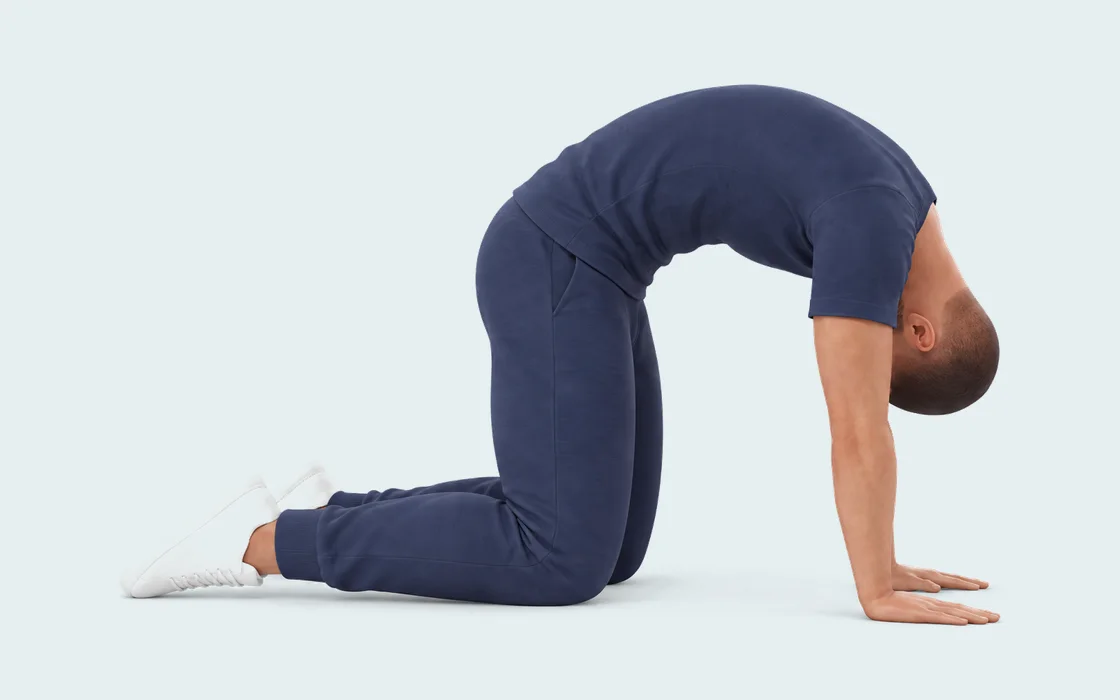

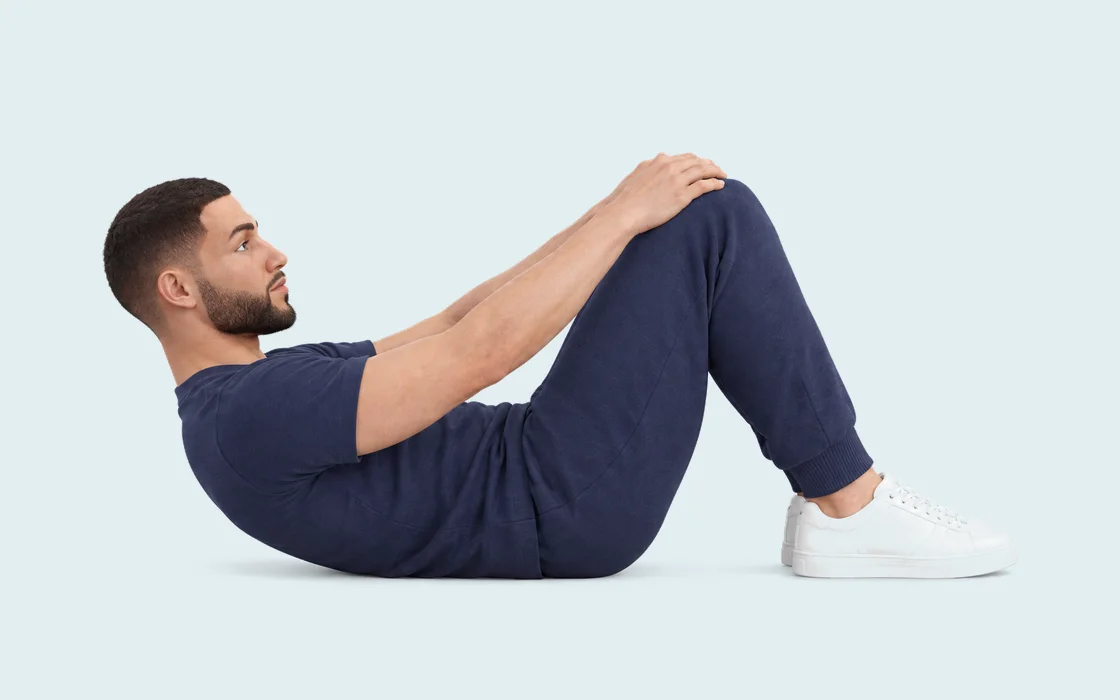
This 30 day ab challenge opens with a 1-minute crunch test, then asks for about 9 minutes a day at Intermediate, and even the longest Expert day stays near 20 minutes. Apart from the test on day 1 and day 30, you never count a rep. Three short ab workouts take turns, A, B and C, and every move runs for a set number of seconds while the page keeps time. Press Start above for a 1-minute warm-up (cat-cow and full back curls), the day's test or timed rounds, and a 1-minute stretch (cobra pose and a spinal twist).
How the 30 days work: three timed workouts in rotation
Day 1 is the crunch test. After it, each training day is one workout, and they take turns: A on day 2, B on day 3, a rest day on day 4, C on day 5, then A again on day 6. Each workout comes up seven times. At Intermediate:
- Workout A curls, bends to each side, lifts the legs, then holds: crunches, heel taps, leg raises and a forearm plank.
- Workout B curls the hips, keeps the back still while one leg lowers, turns, then holds on one side: reverse crunches, dead bugs, Russian twists and a side plank.
- Workout C twists while the legs pedal, drives the knees, flutters the legs, then holds a high plank: bicycle crunches, mountain climbers, scissor raises and a hand plank.
Day 2 runs each move for 30 seconds, with 15 seconds of rest between moves and 45 between rounds, for 2 rounds. Moves grow to 35 seconds on day 9. On day 15 a third round joins, the biggest step of the month, and the session goes from about 9 to about 13 minutes. From day 22 each move runs 40 seconds, about 14 minutes a day.
Days 4, 8, 12, 16, 20, 24 and 28 are rest days with only the warm-up and the stretch, about 2 minutes, so your streak keeps going. Day 1 and day 30 are the crunch test, about 3 minutes each. The 21 training days and 7 rest days between the tests add up to exactly four weeks, the length of the programs in the FitCraft app. Minutes per training day at each level:
- Beginner: about 7 through day 14, then about 10. Three moves per workout, 20 to 30 seconds each.
- Intermediate: about 9 to 14. Four moves, 30 to 40 seconds each.
- Advanced: about 14 to 20. Harder moves, 40 to 45 seconds each, 3 rounds and later 4.
- Expert: about 14 to 20. 45 to 50 seconds per move, only 10 seconds between moves.
The 1-minute crunch test, and why the workouts run on a clock
The test. On day 1 and day 30, after the warm-up, a 60-second clock runs while you do as many crunches as you can. Then you type in your count and press Save my number. It is plain crunches at every level, Expert included, so every level measures the same thing.
What counts as one crunch. Lie on your back with your knees bent, feet flat and heels a little more than a foot from your tailbone. Rest your hands on the fronts of your thighs with straight arms. Breathe out and curl your head, shoulders and upper back up until your hands reach your kneecaps, then lower until your shoulders touch the floor. That is one. Your lower back, hips and feet stay down, and a small gap stays between your chin and chest. Sitting all the way up makes it a sit-up, and jerking up with momentum does not count.
How to count. Count out loud each time your hands reach your kneecaps, or ask someone to count for you. A rep that stops short of the kneecaps, or starts before your shoulders touch down, stays off the tally. If you need a breath, rest on the floor for a moment, then keep going until the minute is up.
What the number tells you. On day 1 it checks the level you picked, and the page suggests a better one if your count falls outside that level's range (the ranges are in the level guide below). On day 30, take the test at the same level and about the same time of day, and the page sets the two counts side by side. Treat the number as a check-in on your own progress, not a fitness norm: counts depend on how far people curl and how strictly the reps are judged, so a figure from a chart or a gym class does not compare with yours.
Why the training days use seconds. Rep counts fit most core moves badly. Ten slow crunches with a pause at the top are harder than ten fast ones, and charts rarely say whether one bicycle crunch means one side or both. With a clock, everyone works for the same 30 seconds at their own pace: a beginner might do a handful of careful reps and a trained athlete twice as many, and both are doing it right.
Time also tells you the length of the day before you start. The seconds are the session, so the minutes on the Start button are the minutes you spend on the mat, not a guess at your pace. And a timer removes the urge to rush. Chasing a number, people speed up and let their form slide. Working to the timer, you can slow down the moment your lower back lifts, and the set still counts.

The 30 day ab challenge chart, day by day
The 30-day grid in the tool shows each day's minutes under its date. This table has every day at all four levels. Each training-day cell shows the workout, rounds x seconds per move, and the whole session in minutes with the warm-up and stretch, and day 1 and day 30 say Test. At Intermediate, day 2 is workout A, 2 rounds of crunches, heel taps, leg raises and forearm plank, 30 seconds each, about 9 minutes. Day 29 is workout C, 3 rounds of bicycle crunches, mountain climbers, scissor raises and hand plank, 40 seconds each, about 14 minutes.
| Day | Beginner | Intermediate | Advanced | Expert |
|---|---|---|---|---|
| Day 1 | Test (3 min) | Test (3 min) | Test (3 min) | Test (3 min) |
| Day 2 | A: 2 x 20 s (7 min) | A: 2 x 30 s (9 min) | A: 3 x 40 s (14 min) | A: 3 x 45 s (14 min) |
| Day 3 | B: 2 x 20 s (7 min) | B: 2 x 30 s (9 min) | B: 3 x 40 s (14 min) | B: 3 x 45 s (14 min) |
| Day 4 | Rest (2 min) | |||
| Day 5 | C: 2 x 20 s (7 min) | C: 2 x 30 s (9 min) | C: 3 x 40 s (14 min) | C: 3 x 45 s (14 min) |
| Day 6 | A: 2 x 20 s (7 min) | A: 2 x 30 s (9 min) | A: 3 x 40 s (14 min) | A: 3 x 45 s (14 min) |
| Day 7 | B: 2 x 20 s (7 min) | B: 2 x 30 s (9 min) | B: 3 x 40 s (14 min) | B: 3 x 45 s (14 min) |
| Day 8 | Rest (2 min) | |||
| Day 9 | C: 2 x 25 s (7 min) | C: 2 x 35 s (9 min) | C: 3 x 40 s (14 min) | C: 3 x 45 s (14 min) |
| Day 10 | A: 2 x 25 s (7 min) | A: 2 x 35 s (9 min) | A: 3 x 40 s (14 min) | A: 3 x 45 s (14 min) |
| Day 11 | B: 2 x 25 s (7 min) | B: 2 x 35 s (9 min) | B: 3 x 40 s (14 min) | B: 3 x 45 s (14 min) |
| Day 12 | Rest (2 min) | |||
| Day 13 | C: 2 x 25 s (7 min) | C: 2 x 35 s (9 min) | C: 3 x 40 s (14 min) | C: 3 x 45 s (14 min) |
| Day 14 | A: 2 x 25 s (7 min) | A: 2 x 35 s (9 min) | A: 3 x 40 s (14 min) | A: 3 x 45 s (14 min) |
| Day 15 | B: 3 x 25 s (10 min) | B: 3 x 35 s (13 min) | B: 4 x 45 s (20 min) | B: 4 x 50 s (20 min) |
| Day 16 | Rest (2 min) | |||
| Day 17 | C: 3 x 25 s (10 min) | C: 3 x 35 s (13 min) | C: 4 x 45 s (20 min) | C: 4 x 50 s (20 min) |
| Day 18 | A: 3 x 25 s (10 min) | A: 3 x 35 s (13 min) | A: 4 x 45 s (20 min) | A: 4 x 50 s (20 min) |
| Day 19 | B: 3 x 25 s (10 min) | B: 3 x 35 s (13 min) | B: 4 x 45 s (20 min) | B: 4 x 50 s (20 min) |
| Day 20 | Rest (2 min) | |||
| Day 21 | C: 3 x 25 s (10 min) | C: 3 x 35 s (13 min) | C: 4 x 45 s (20 min) | C: 4 x 50 s (20 min) |
| Day 22 | A: 3 x 30 s (10 min) | A: 3 x 40 s (14 min) | A: 4 x 45 s (20 min) | A: 4 x 50 s (20 min) |
| Day 23 | B: 3 x 30 s (10 min) | B: 3 x 40 s (14 min) | B: 4 x 45 s (20 min) | B: 4 x 50 s (20 min) |
| Day 24 | Rest (2 min) | |||
| Day 25 | C: 3 x 30 s (10 min) | C: 3 x 40 s (14 min) | C: 4 x 45 s (20 min) | C: 4 x 50 s (20 min) |
| Day 26 | A: 3 x 30 s (10 min) | A: 3 x 40 s (14 min) | A: 4 x 45 s (20 min) | A: 4 x 50 s (20 min) |
| Day 27 | B: 3 x 30 s (10 min) | B: 3 x 40 s (14 min) | B: 4 x 45 s (20 min) | B: 4 x 50 s (20 min) |
| Day 28 | Rest (2 min) | |||
| Day 29 | C: 3 x 30 s (10 min) | C: 3 x 40 s (14 min) | C: 4 x 45 s (20 min) | C: 4 x 50 s (20 min) |
| Day 30 | Test (3 min) | Test (3 min) | Test (3 min) | Test (3 min) |
New to ab work? Start at Beginner even if Intermediate looks short. Its 20-second breaks between moves give you time to get into each position, and changing level later keeps the days you have finished.
Levels and moves: which one to pick
| Level | Moves across workouts A, B and C |
|---|---|
| Beginner | Crunches, Heel taps, Forearm plank, Reverse crunches, Dead bug, Side plank, Bicycle crunches and Mountain climbers |
| Intermediate | Crunches, Heel taps, Leg raises, Forearm plank, Reverse crunches, Dead bug, Russian twists, Side plank, Bicycle crunches, Mountain climbers, Scissor raises and Hand plank |
| Advanced | Bicycle crunches, Leg raises, Heel taps, Forearm plank, Reverse crunches, Russian twists, Dead bug, Side plank, Mountain climbers, Scissor raises, Hollow hold and Spider plank |
| Expert | Leg raises, Bicycle crunches, Hollow hold, Plank jacks, Russian twists, Scissor raises, Reverse crunches, Side plank, Mountain climbers, Spider plank, Dead bug and Hand plank |
Pick a level with this guide before day 1, and the crunch test then checks it:
- Beginner if you have not trained your core in months, or if 30 seconds of crunches or a 30-second forearm plank with a flat back is a struggle today.
- Intermediate if 30 seconds of each Beginner move feels steady. It adds leg raises, Russian twists, scissor raises and a hand plank.
- Advanced if you already train your core two or three times a week. Rounds start at 3, and a hollow hold and spider planks join workout C.
- Expert if the first Advanced workout feels comfortable. Moves run 45 to 50 seconds with 10 seconds between them, and plank jacks join workout A.
A day 1 count of up to 30 fits Beginner, 15 to 45 fits Intermediate, 30 to 55 fits Advanced and 45 and up fits Expert. Land outside the range for the level you tested on and the finish screen points you to the level next to it, with a Switch button. Where two ranges overlap, either level works, so take the lower one if the last few seconds of your test were ragged.
If you cannot finish the last round of your first workout with good form, drop a level, whatever your count said. If it feels easy, give it a week: the seconds grow on day 9, and an extra round arrives on day 15.
Get ab workouts built around you, with every move shown in 3D
The FitCraft app builds workouts around your goals, shows every move with a 3D AI coach and adjusts as you progress. Earn XP, keep your streak and level up. Free version available.
Take the Free Assessment Free • 2 minutes • No credit cardForm cues for each move, and the mistakes to watch
Most ab mistakes come from two habits: letting the lower back peel off the floor, and using speed or your neck to finish the move.
- Crunches: curl your upper back off the floor and slide your hands up toward your knees while your lower back stays down. Do not sit all the way up (our crunches vs sit-ups guide explains why), and leave space between chin and chest.
- Reverse crunches: knees bent, curl your hips off the floor with your abs. Do not swing your legs to throw the hips up, stop before your weight rolls onto your neck, and lower slowly.
- Bicycle crunches: turn your ribcage so the elbow travels toward the opposite knee, rather than swinging the elbow alone. Raise the straight leg if your back lifts, and never pull on your head.
- Dead bugs: arms flat at your sides, lower back flat, one leg lowering until it hovers above the floor. Stop lowering where your back starts to arch.
- Heel taps: lift your shoulder blades, then bend sideways to reach each heel. It is a side bend, not a twist, and your hips and feet stay down.
- Leg raises, scissor raises and the hollow hold: long legs make the lower back the first thing to give. Press it into the floor, and bend your knees or shorten the range the moment it lifts.
- Russian twists: feet up, back long, chest lifted, then turn your shoulders, not just your arms. Put your heels down if your back rounds.
- Planks and mountain climbers: the forearm plank, hand plank, side plank, spider planks and plank jacks all want a straight line from head to heels, elbows or hands under the shoulders. End the hold when your hips sag. The side plank switches sides halfway.

What the research says about ab training
Ab work builds the muscle, not a smaller waist. Vispute and colleagues (2011) split 24 sedentary men and women aged 18 to 40 into two groups on steady diets. One did seven ab exercises, two sets of ten, five days a week for six weeks; the other did nothing extra. The ab group finished with far more curl-ups, 47 on average against 32, but body weight, body fat, fat around the middle, waist size and skinfolds showed no significant change from the training.
No single move covers every part of the abs. Axler and McGill (1997) measured muscle activity and lower spine load while nine volunteers did 12 ab exercises. Partial curl-ups, close to the crunches here, gave the best ratio of muscle work to spine load, yet no one exercise trained all the ab muscles at a low spine load. They concluded that a mix of exercises is needed, which is why this plan rotates three workouts instead of repeating one move.
Harder versions also work the hip. Escamilla and colleagues (2006) recorded muscle activity in 21 healthy adults aged 23 to 43. A reverse crunch on a 30-degree incline drew some of the highest ab muscle activity they measured, alongside ab-wheel moves and hanging knee raises in arm straps. Several of them, the inclined reverse crunch included, also worked the muscle at the front of the hip hard, which the authors flagged as a possible problem for some people with low back trouble. Those readings were for the incline version; this plan uses the reverse crunch flat on the floor.
Side planks earn their place. Calatayud and colleagues (2017) compared eight plank variations in 20 university students. Front planks and roll-out planks done on suspension straps worked the abs hardest, while side planks, on the floor or on straps, worked the muscles along the lower back the most. So the plan pairs front planks with a side plank.
What 30 days can and cannot change. Expect better endurance, as in the six-week trial above: your day 30 crunch count is likely to beat day 1, and the longer intervals late in the month should feel steadier than the first ones did. A month will not uncover abs unless you started lean. Our guide to how to get abs in 30 days runs the numbers by starting body fat and shows how to take fair before and after photos, and the best exercises to lose belly fat covers what does move fat.
Does ab training help your lower back?
Exercise in general helps prevent back pain, though the trials did not test ab circuits on their own. Steffens and colleagues (2016) pooled 21 randomized trials with 30,850 people. Exercise with education cut the risk of a new episode of low back pain by about 45 percent (moderate-quality evidence), and exercise alone may cut it by about 35 percent (low to very low-quality evidence). Our review of exercise for lower back pain has more.
How you do the moves matters too. Monfort-Pañego and colleagues (2009) reviewed 87 muscle-activity studies of ab exercises and listed the safety points that kept coming up: do not pull on your head, do not hook your feet under something, and keep your knees and hips bent when you curl the upper body. The crunches here keep the knees bent and the feet free. Leg raises, scissor raises and the hollow hold lean hard on the front of the hip, and none of them is in the Beginner workouts. If a move bothers your back, swap in a dead bug or a forearm plank, or see the best exercises for lower back pain.
Starting the ab challenge on January 1, week by week
Week 1 (days 1 to 7). Day 1 is the 3-minute crunch test. From day 2 you do 2 rounds a day at Intermediate, 30 seconds per move, about 9 minutes. If your abs have not trained in a while, expect soreness on day 2 or 3; the rest day on day 4 comes at a good moment. Pick a time that repeats, like straight after work, and leave the mat where you will see it.
Week 2 (days 8 to 14). Moves grow to 35 seconds on day 9, and the session stays at about 9 minutes. Form slips in the last few seconds, so slow down rather than stop.
Week 3 (days 15 to 21). The third round arrives on day 15 and the day grows to about 13 minutes, the biggest jump of the month. The timer keeps running, but nothing says you have to move fast inside it.
Week 4 and the finish (days 22 to 30). From day 22 each move runs 40 seconds, about 14 minutes a day. Day 29 is the last workout, C. Day 30 is the crunch test again: take it at the same level and about the same time of day as day 1, and finishing it completes your grid.
Missed a day? Do it the next day. The page opens on your next unfinished day rather than the calendar date, so the plan waits. Your streak starts again, but finished days stay marked. January 1 is a fine start, and so is January 9.
After day 30. Set your two counts side by side, then run it again one level up, keep two or three of these workouts a week next to full-body training, or move to a full program. The 30 day workout challenge has a full-body plan, and the fitness test shows where you stand.
When to check with a doctor before the ab challenge
- Pregnant, or within a year of giving birth. Crunches and long planks are often swapped out, and a gap between the two sides of the abs needs its own plan. See our postpartum fitness guide.
- A hernia, or surgery on your abdomen or spine. Ask your surgeon when floor core work is safe again.
- Back pain that travels into a leg, or numbness or tingling there.
- High blood pressure or heart disease. Planks are isometric holds, and blood pressure rises while you hold them (see isometric exercise and blood pressure). Breathe steadily and never hold your breath.
- Osteoporosis. Ask whether repeated curling and twisting, as in crunches and Russian twists, suits you.
Stop the session for sharp pain in your back or neck, chest pain or dizziness.
Related reading
References
- Vispute SS, Smith JD, LeCheminant JD, Hurley KS. "The effect of abdominal exercise on abdominal fat." Journal of Strength and Conditioning Research. 2011;25(9):2559-2564. doi:10.1519/JSC.0b013e3181fb4a46
- Axler CT, McGill SM. "Low back loads over a variety of abdominal exercises: searching for the safest abdominal challenge." Medicine and Science in Sports and Exercise. 1997;29(6):804-811. doi:10.1097/00005768-199706000-00011
- Escamilla RF, Babb E, DeWitt R, et al. "Electromyographic analysis of traditional and nontraditional abdominal exercises: implications for rehabilitation and training." Physical Therapy. 2006;86(5):656-671. doi:10.1093/ptj/86.5.656
- Calatayud J, Casaña J, Martín F, Jakobsen MD, Colado JC, Andersen LL. "Progression of core stability exercises based on the extent of muscle activity." American Journal of Physical Medicine and Rehabilitation. 2017;96(10):694-699. doi:10.1097/PHM.0000000000000713
- Steffens D, Maher CG, Pereira LS, et al. "Prevention of low back pain: a systematic review and meta-analysis." JAMA Internal Medicine. 2016;176(2):199-208. doi:10.1001/jamainternmed.2015.7431
- Monfort-Pañego M, Vera-García FJ, Sánchez-Zuriaga D, Sarti-Martínez MA. "Electromyographic studies in abdominal exercises: a literature synthesis." Journal of Manipulative and Physiological Therapeutics. 2009;32(3):232-244. doi:10.1016/j.jmpt.2009.02.007
How this differs from a typical 30 day ab challenge chart
Most charts give you a list of rep counts that climbs every day, often into the hundreds of crunches, with no rest day and no idea how long day 25 will take. This plan gives you three different workouts that take turns, so your core does not repeat the same move every day, and each move runs on a clock instead of a count. You see the minutes before you start, from about 7 at Beginner to about 20 at Expert, and every fourth day is a short rest day.
It also measures you. Day 1 and day 30 are the same 1-minute crunch test, so the month ends on a count you can set beside your first one rather than on its biggest workout. In between, the page runs each session for you, from the warm-up and every timed move to the rests and the stretch. Each level has its own moves, from crunches and heel taps at Beginner to hollow holds, spider planks and plank jacks higher up, and the page says plainly that ab training builds endurance but does not burn the fat over your abs.
Frequently Asked Questions
Does a 30 day ab challenge actually work?
Yes, for core strength and endurance, and no, for belly fat. In a six-week trial, adults who did ab exercises five days a week could do far more curl-ups at the end, yet their waist size and belly fat did not change. Use this plan to make your core stronger and steadier, and pair it with eating changes and daily walking if a flatter stomach is the goal.
How many minutes a day does the 30 day ab challenge take?
About 7 to 10 minutes at Beginner, 9 to 14 at Intermediate and 14 to 20 at Advanced and Expert, warm-up and stretch included. Because every move runs on the clock, those minutes are the real length of the session, not a guess. The crunch tests on day 1 and day 30 take about 3 minutes, and rest days about 2.
Is this 30 day ab challenge good for beginners?
Yes. The Beginner level has three moves per workout instead of four, 20 seconds per move in the first workouts, 20 seconds of rest between moves and no straight-leg raises. A workout takes about 7 minutes through day 14, and from day 15 a third round makes it about 10. On day 1, a crunch count over 30 suggests Intermediate instead. Slow down whenever your lower back starts to lift.
How many crunches in 1 minute is good?
There is no single good number for this test, so treat it as a check-in on your own progress, not a fitness norm. Counts swing with how far you curl, how fast you go and how strictly the reps are judged. Here the count has two jobs: on day 1 it checks your level (15 to 45 fits Intermediate), and on day 30 it shows how far you have come since day 1.
Is the ab challenge different for men and women?
No. The plan is the same for men and women, because what decides your starting point is how trained your core is, not your sex. Pick the level whose first workout you can finish with good form, and let the day 1 crunch test check it. Where fat sits on the body differs between people, but no ab workout chooses where you lose fat.
Why does this ab challenge use seconds instead of reps?
Because core moves vary so much in pace. A slow crunch with a pause is harder than a fast one, and a count rewards rushing. With a clock, everyone works for the same seconds at their own speed, and the length of the session is known before you start. The one count in the month is the crunch test on day 1 and day 30, where the same minute on both days keeps the two numbers fair to compare.
Should I feel ab exercises in my lower back?
No. You may feel the muscles along your spine working in planks, but you should not feel pinching or sharp pain. A common cause of lower back strain in ab work is the back arching off the floor in leg raises, scissor raises and dead bugs. Bend your knees or shorten the range when it lifts, and stop the move if pain stays.
Can I print the 30 day ab challenge or save it as a PDF?
Yes. Press Print or save as PDF under the Start button and the page prints all 30 days at the level you picked, each with its workout or test, its minutes and a box to tick. The table in the article also lists every day at all four levels.
What should I do after day 30?
Compare your two crunch counts, then pick one of three paths. Run the challenge again one level up, keep two or three of these workouts a week next to full-body training, or move to a full program that trains the legs, chest and back as well. The core work you built carries into all three.